Sgt John R Creek
UNFORTUNATE BAIL OUT
by
Sgt. John R Creek
6th Bomb Group Radio Operator
Tinian 1945
Editor’s note: This article is an excerpt from Sgt. Creek’s military memoirs Short Stories of World War II.
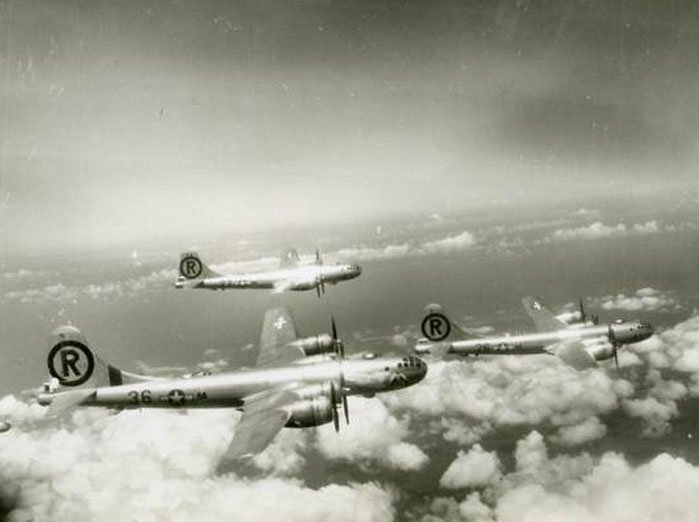
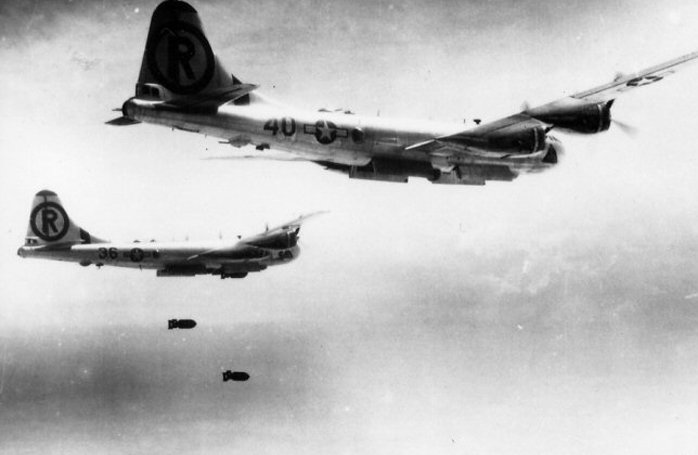
To demonstrate the effectiveness of our ability to make war, one of the most intense attacks on any one city was launched against Tokyo on May 23, 1945. Thirty-five [6th Bomb Group] planes departed and thirty-one reached the target; one of which was ours. This was not accomplished without difficulty, however.
We were to arrive at the target about 4:00 AM. Everything went well until we were in sight of the target area. I was busy at my station dropping RADAR jamming material to make it more difficult for the Japs to select a specific B-29 by RADAR for anti-aircraft fire. Suddenly we were in search lights making the outside as bright as day. We were now on the final bomb run and could not start evasive maneuvers. We were rapidly becoming the prime target of visual sighting anti-aircraft guns.

Mission to Tokyo © John Potenza
“I LOOKED OUT THE NAVIGATOR’S WINDOW AND SAW NOTHING BUT FLAMES. WE WERE ON FIRE AND AT 10,000 FEET ALTITUDE! THE PLANE BEGAN TO VIBRATE VIOLENTLY AND A VOICE ON THE INTERCOM SAID “LETS GET THE HELL OUT OF HERE”.
Just after the bombs were dropped and the bomb bay doors closed, a large bump occurred. I looked out the navigator’s window and saw nothing but flames. We were on FIRE and at 10,000 feet altitude! The plane began to vibrate violently and a voice on the intercom said “Let’s get the ‘hell’ out of here”. I stayed at my radio since I had not yet heard an order to “bail out”. After a few minutes F/O Mitchell came over to my station and told me we were to bail out. My operating position required that I wear a chest pack parachute system. I always wore the harness but I could not operate the radio while wearing the parachute pack. Neither did I have the leg straps fastened on my harness. These are the straps that support the entire weight of the body when the parachute opens. I was not ready to jump! I was standing in front of the escape door we were both to use and Lt. Mitchell was ready to go. So while desperately trying to get my equipment in order, I acted the perfect gentlemen and offered F/O Mitchell the opportunity to go first. The bomb bay doors were open so he jumped. By the time I got everything assembled, and assumed a position to jump, the bomb bay doors closed! I was trapped! I came back inside to assume a crash landing position and the bomb bay doors reopened. I attempted to exit again and the doors closed before I could get out. A few seconds before, I had thought I was the only one left on the plane, since it had taken me so long to get my parachute on, but now I was beginning to think someone must be opening and closing these doors. About this time, Lt. Hays, the bombardier, came around the turret and told me that those in the front could not get out. The nose wheel could not be lowered to provide them with a route of escape. They were forced to stay with the plane as long as it would fly and were trying to get us out over the open sea and away from Japan. A most desirable situation right now! I went to the front of the plane to talk with the remaining crew and determine our course of action. The Flight Engineer, Sergeant H. R. Brenholtz, looked ill. He had regurgitated in his flak helmet. The Co-pilot looked like he was in a state of shock and had possibly fainted.
HE HAD NOT BEEN ABLE TO CONTACT ANYONE IN THE BACK OF THE PLANE BY INTERCOM AND ASKED IF I WOULD GO THROUGH THE TUNNEL TO FIND OUT WHAT HAPPENED BACK THERE. I DID AND FOUND IT WAS EMPTY. THE ESCAPE DOOR WAS STILL OPEN.
Lt. Anderson told me that, as long as the fire did not spread to a gasoline tank, we were safe and the plane was flying. He had not been able to contact anyone in the back of the plane by intercom and asked if I would go through the tunnel to find out what had happened back there. I did and I found it was empty. The escape door was still open. I forced it closed to reduce wind resistance on the plane and then called Lt. Anderson to report what I had found. I returned to the front to do whatever I could to help get us out of this mess.
I now had time to survey the damage and ask a few questions. We had received a direct hit in the left outboard engine, terminating all control and use of that engine. It was still burning but the flames had subsided somewhat.
I began to piece together what had happened from conversations with the others. When the direct hit occurred, Lt Anderson requested the Co-pilot to feather the propeller on the disabled engine. (This was to prevent it from rotating like a windmill, possible breaking loose from the engine, and doing damage to the body or wings of the plane.) In the excitement, the left inboard engine was accidently feathered, leaving only the two engines on the right side operating. This immediately caused the plane to go into a tight spiral flight path, called a spin, thus dropping from 10,000 feet to 2,000 feet before the error could be corrected. While the Co-pilot and the Flight Engineer were trying to correct this near deadly error, Lt. Anderson was straining with all his available energy to apply right rudder and terminate the spin. Immediately upon correction of this the mistake, the plane resumed a normal flight path and we were now out of range of anti-aircraft fire. I’m sure the Japanese thought we had crashed by now.
I resumed my post at the radio to see if I could contact someone who could help us. Much to my disappointment, I found that the long distance radio transmitter was not working, nor was the radio compass. An inspection from the astrodome, after daylight, revealed that both antennas had been damaged by flak. This was bad news! I was hoping to contact a Navy ship close by so that we could ditch the plane or bail out near it and go home with the Navy. Without a transmitter, this was impossible. Suddenly I wondered where we were and how Lt. Anderson had set his course from Japan since we did not have a navigator. I went to the front to report the failure of our long range radio equipment and the radio compass. While I was there I asked Lt Anderson if he knew where we were and where we were going, since we had no navigator. His answer was a shock to me. He stated that he did not know either of these, that his intent was to get us away from Tokyo, out over the ocean, and then decide what to do. We were now one and one-half hours from Japan and our position was unknown. Our air speed was only about 150 miles per hour, since we were operating with some flaps to maintain lift. This meant we would be less than 300 miles from Tokyo. We would still be, at best, 600 miles from Iwo Jima, the nearest known point to land. I asked if we had enough fuel to reach there if I could find it. After a few minutes of calculations, the answer was yes, maybe.
I set up the LORAN system, which I had only just learned to operate on the last mission, and immediately obtained a position. Bad news!!! We were heading for the Philippines which were 2500 miles away. I plotted our position on the map, took a drift meter reading to compensate for wind, made a magnetic deviation correction, and I had a compass heading for Iwo Jima which was only about 700 miles away. I wondered now if the officers would accept my work, because I was an enlisted man and not officially trained in navigation. I presented my recommendation to Lt. Anderson and explained how I arrived at it. His response, “It’s better than we have now”. He changed our course for Iwo Jima immediately.
FOR THE FIRST TIME SINCE WE HAD BEEN HIT, I FELT THAT MAYBE WE MIGHT HAVE A CHANCE TO GET OUT OF THIS ALIVE.
For the first time since we had been hit, I felt that MAYBE we might have a chance to get out of this alive, if only there was enough fuel to get us there. I continued to watch wind drift in case of any change and an hour later tried to get another position from LORAN. It had quit working!!! We now had to depend on our calculations of estimated ground speed and the remaining distance to Iwo Jima for our future fuel estimates.
Lt. Anderson continued to try to reach help on the radio equipment available from his operating position and finally found that one small voice transmitter, the SCR 522, which the pilot used only for take-off and landing instructions, was still working. It had a range of about 50 to 75 miles so we didn’t expect to get much help from it but at last a Navy ship picked up our call for help and relayed it to Iwo Jima. An amphibious plane, called a DUCK, soon came out to meet us. What a welcome sight!
By now we were within 50 miles of land and the Flight Engineer was issuing remaining fuel estimates of plus or minus two minutes. That meant we might run out of fuel two minutes before we landed or we might have two minutes left after we landed.
We came in on final approach with no preliminaries. The ground crew was prepared for a crash landing. I was asked to go to the rear of the plane and observe the engines for smoke or fire and assume a crash landing position just before touchdown. When we touched the runway there was a sudden twisting motion of the plane and a great smoking of tires. I had been told to jump to the ground and run like “hell” as soon as we stopped I did that too, and stood there helplessly watching the other four laboriously climb down from the nose wheel well, their normal exit route.
The tires on the left side were flat when we landed, punctured by flak. The right brakes had to be applied very hard to prevent the plane from spinning to the left after we were on the ground. Lt. Anderson had done an exemplary job of handling the plane under very adverse conditions.
THE LOSS OF HALF OUR CREW HAD NOT YET MADE ITS FULL IMPACT ON US.
Needless to say we were all very shaken-up. The loss of half of our crew had not yet made its full impact on us. We had been so deeply involved in trying to get back to Iwo Jima. Now there was nothing to do but think. We immediately boarded another plane for Tinian. I felt sick.
News of our experience had reached there by radio before we did. We were taken promptly to de-briefing, which is interrogation with generous quantities of medical alcohol to drink. We told them what we could remember and went to our bunks to get some sleep.
During the next few weeks we became painfully aware of the long term influence this incident would have on all of us. None of us would ever fly in combat together again! Each of us would be reassigned to a different crew after returning from a ten day rest leave in Honolulu.
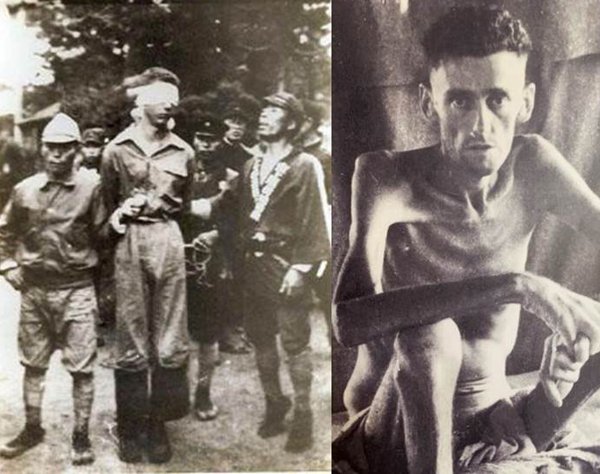
Editor’s addendum: The six crew members who bailed, Lt. Harold J Anderson (radar), Sgt. Michael Boyko (CFC), Cpl. Albert P Lounsbury (LG), F/O William A Mitchell (navigator), Cpl. Joseph E Costello (TG) and Cpl. Ralph G Sasser (RG), were captured, brutally beaten and nearly starved to death through war’s end by the Kempei Tai Military Police at its headquarters prison in Tokyo. Until sometime after their liberation on August 29, 1945, the six were listed as Missing in Action.
MORE TO READ
Read B-29 Navigator Donald W Kearney’s Firebombing of Tokyo articles below for a first-person, in-cockpit narrative of these harrowing missions. Also read an excerpt from Sgt. Creek’s military memoirs Short Stories of World War II.

Firebombing of Tokyo – March 9, 1945
Most Devastating Bombing Raid in History
Firebombing of Tokyo – May 23, 1945
First of Two Roughest B-29 Missions

Firebombing of Tokyo – May 25, 1945
Finishing Tokyo