
by
Scott B. Davis
Honorary member 509th Composite Group (1944-1946)
©2025 Scott B. Davis. All Rights Reserved
Additional content copyright © 2025 6th Bomb Group Assoc. All Rights Reserved
Editor’s Note: Pictures, map, links and highlights have been added to the original document to complement the author’s writing.
TABLE OF CONTENTS
Dawn, The World Forever Changed is the title of a limited-edition work by William S. Phillips. In this painting, the “Enola Gay” is portrayed against a backdrop of the Pacific dawn. The rising sun, of course, is the symbol of Japan, but, in this case, it is a whole new dawn – for the United States, but also for the world. The time is 5:55 a. m. and at an altitude of 9,300 feet, the aircraft that were in trail were closing formation with the “Enola Gay.” Things would never be the same again.

What follows is one of the many amazing stories from World War II, about science, technology, training, airmanship, organization, performance and secrecy.
The Manhattan Project

Manhattan Project, Oak Ridge TN
THE MANHATTAN PROJECT FOCUSED ON THE FUNCTIONALITY OF THE ATOMIC BOMB, PROJECT ALBERTA WAS A DIVISION THAT FOCUSED ON THE PLANS FOR DELIVERING THE BOMB
Beginning in 1939 and throughout World War II, the United States was deeply and secretly involved in the development of the atomic bomb, under the code name of the Manhattan Project. While scientists of the Manhattan Project focused on the functionality of the atomic bomb, Project Alberta was a division that focused on the plans for delivering the bomb.
Research and production for the Manhattan Project took place at more than 30 sites across the United States, the United Kingdom, and Canada.

Hanford Engineer Works, WA

Trinity Test Site, NM

Clinton Engineer Works, TN
BOTH GERMANY AND JAPAN WERE ALSO DEEPLY INVOLVED IN THE DEVELOPMENT OF ATOMIC WEAPONS
As told by former employees of the Clinton Engineer Works in Oak Ridge, Tennessee, both of our WWII enemies, Germany and Japan, were also deeply involved in the development of atomic weapons. Anyone who has studied the history of the barbarism of our WWII adversaries would not doubt that had either of them won the race, the United States would have suffered a fate far more devastating than our attack on Japan.

Clinton employees, Oak Ridge, TN
The 509th Composite Group and Project Silverplate
THE ROLE OF THE 509TH COMPOSITE GROUP WAS TO FACILITATE PROJECT ALBERTA, DESIGNING THE WEAPONS TO HOUSE THE BOMB, TESTING, AND TRAINING AIR CREWS TO MAN PROJECT SILVERPLATE BOMBERS, A SPECIAL VERSION OF THE BOEING B-29 SUPERFORTRESS DESIGNED AND PRODUCED SPECIFICALLY TO DELIVER THE ATOMIC BOMB.

509th Patch
In January 1940, the Army Air Corps chose Boeing’s Model 345 design and the aircraft’s prototype first flew in September of 1942. The criteria for the new bomber included a speed of 400 mph and carrying 10 tons of bombs with a 2500 mile combat radius. The engineering, design and production of the B-29 was one of the many examples of the massive and highly successful American war effort and eventually became the nation’s largest military expenditure during WWII.
GIVEN THE EXPECTED EXPLOSION, SHOCKWAVE BLASTS AND RADIATION FROM THE A BOMB, THE SILVERPLATE B-29’S REQUIRED A HIGH-PERFORMANCE ENVELOPE
Given the expected explosion, shockwave blasts, and radiation from the A Bomb, the Silverplate B-29’s required a high-performance envelope. Early Silverplate models were retrofitted with modifications made and used for testing and training.
In August 1944, The Glenn L. Martin Plant in Omaha, Nebraska began constructing the Phase 2 Silverplates. The first of these 17 planes arrived at the 509th HQ in Wendover, Utah in October. Upon arrival, maintenance crews began to remove the upper and lower turrets to lighten the aircraft. Three were used for the Los Alamos test programs building ballistic tables and helping design bomb components. The other 14 were used for aircrew training.
However, in January 1945, it was decided that instead of modifying the current fleet, the Martin Plant in Omaha would provide 20 new Silverplate aircraft that incorporated all the changes and modifications. This third batch of aircraft was significantly different from the first two. New engines, the Wright R-3350-41 had better cooling, fuel injection, and improved fuel and manifold systems. Mounted on these engines were new Curtis Electric propellers with reverse pitch capability, allowing the plane to improve power braking when landing. Additionally, the bomb bay doors used pneumatic actuators, replacing the slower hydraulic system and allowing for a shorter transition period when opening and closing the doors. The defensive turrets were also omitted as part of Phase III, with aircraft rolling off the production line retaining only the rear gunner’s twin .50 caliber M2 Browning machine guns.
Perhaps most importantly, the bomb bay was now fitted with an H-frame structure with improved sway braces that accommodated both Little Boy and Fat Man bomb casings. The bomb bays also included both a dual electric and manual release system for the payload as it sat in the forward bay.
A new crew position, “Weaponeer” was also created. Just behind the radioman’s seat, an electronics test officer station was installed. This new crewman monitored the electronic equipment and cables associated with the bomb.
AFTER RELEASE OF THE WEAPON, THE AIR CREW WAS TO EXECUTE A 155-DEGREE DIVING RIGHT TURN AT A 60-DEGREE ANGLE OF BANK, LOSING 1,700 FEET OF ALTITUDE AT FULL POWER TO GIVE THE CREW A 10-MILE SEPARATION FROM THE POINT OF IMPACT
These modifications were required not only to deliver the bomb over Japan but also, perhaps more importantly, to make good the egress of the plane and crew from the target area once the weapon was delivered. The B-29 is a large aircraft, with a 141-foot wingspan and a 99-foot fuselage, and weighing 105,000 pounds. Despite this large size, after the release of the weapon, the air crew was to execute a 155-degree diving right turn at a 60-degree angle of bank. While losing 1,700 feet of attitude, the plane’s engines also had to be flown at full power to give the crew a 10-mile separation from the point of impact. The lightening of the load, the more powerful engines, and the quick cycling of the weapons bomb bay door were all important factors in putting as much distance as possible between the bomber and bomb explosion.
Formation of the 509th Composite Group

Col. Paul Tibbets
The 509th Composite Group, the group to master these planes and execute their missions, was created in 1944. Lieutenant Colonel Paul W. Tibbets, a pilot with an exceptional record in bombing missions in Germany and North Africa and extensive experience flying B-29’s, was chosen for the role.
No one called him Paul. He was always Colonel. Some men worshipped him; others loathed him. He was charged with training crews to fly modified B-29s that would eventually carry a 9,000-pound bomb. The bomb would need to be accurately dropped from an altitude of 30,000 feet, and the pilots needed to perfect dramatic turns and dives to avoid the bomb’s blast.
THE MEN WOULD NOT BE ALLOWED TO KNOW THE PURPOSE OF THEIR UNIT
In addition, throughout training, the men would not be allowed to know the purpose of their unit. For a final layer of secrecy, this unit was to be a “Composite Group,” meaning all necessary support units would be part of the group itself. Tibbets would be promoted to full bird Colonel in January 1945.
Leading up to the formation of the 509th in mid-summer, 1944, newly graduated as well as combat experienced air crew members of all ranks and MOS’s (Military Occupational Skill) arrived at Fairmont Army Airfield, Nebraska. They were brought together to form the 504th Bombardment Group (H), consisting of the 393rd, 398th and 421st Bomb Squadrons.

Fairmont AAF, NE

393rd Bomb Squadron Insignia
Under the command of Pacific Theatre veteran Lt. Col. Thomas J. Classen, twenty individual air crews were formed in the 393rd. These crews flew familiarization and orientation missions in Boeing B-17’s, gaining experience working as a unit while individual airmen were familiarized with other crew members jobs in order to substitute competently should the need arise.
After being adjudged combat ready, on the day the 504th Group was under orders to ship out, the orders pertaining to the 393rd Bomb Squadron were rescinded and new orders issued. Fifteen of the crews were directed to proceed without delay to Wendover Army Air Base, Utah to become the only bomb squadron of the 509th Composite Group (VH), equipped with B-29 aircraft.
Other forces which joined the 509th Composite Group included an Air Service Group, an Air Engineering Squadron, an Air Materiel Squadron, a Military Police Company, an Ordnance Squadron and the 320th Troop Carrier Squadron. Members of the five displaced air crews were reassigned to crew the C-54’s of the 320th. In total, the 509th came to include 225 officers and 1542 enlisted men.
TIBBETS’ MEN WERE SOME OF THE BEST CREWS IN THE ENTIRE U.S. MILITARY
Tibbets’ men were some of the best pilots, navigators, bombardiers, flight engineers and ground crews in the entire U. S. military, as Tibbets was able to commandeer men from missions all over the globe.
Top Secret

509th secrecy sign
Colonel Tibbets told his men that they weren’t to discuss with anyone where you are, who you are, what you’re doing, with your wife, your mother, your sister, your girlfriend, or anyone. Lt. Jack Widowsky recalled “Every once in a while, one of our fellows ended up in Alaska because they opened their mouth too much. They shipped them out immediately.” Jack was a B-29 navigator that was on support aircraft for both atomic missions. He was one of the last survivors of the group and passed away in 2018 at the age of 95.
In Cpl. Bob Garn’s words, “I remember very well the day when Col. Tibbets called us out behind the orderly room and told us, “You will be doing some experimental and very secret work, and you will not know if the man working next to you might be Military Intelligence or not.”
WE EXPECT A FEW MEN TO END UP IN LEAVENWORTH BEFORE THIS IS OVER WITH
His final words were, “We expect a few men to end up in Leavenworth before this is over with.” Bob said that put the fear of God in them and they became very tight-lipped from that time on.
Atomic Bomb Training, Wendover AAF, UT
On December 17, 1944, the 509th Composite Group was officially activated at Wendover, Utah. The men practiced flying the modified B-29 Superfortress. They honed their skills of bomb release and target aiming by dropping “pumpkin bombs,” or specially designed bombs that mimicked the atomic bombs in their unique shape and heavy weight. High altitude bombing and long-range flights carrying heavy loads were common. Each bombardier completed at least 50 practice drops of inert pumpkin bombs before Tibbets declared his group combat ready.
Wendover was a 3.5-million-acre military preserve. It appeared perfect for the secretive unit. Buffered by miles of emptiness in every direction, it wasn’t only off the grid; there was no grid.

Wendover Air Base

Stateline Hotel
Life at Wendover was spartan at best. Many of the airmen had wives and families there and housing was sparse. Refurbished farm buildings and gas stations were among the fine accommodations. Choice entertainment was a trip to the Stateline Hotel, where the bar, the dance floor and the casino were enjoyed.
SPECIAL PITS WERE DESIGNED TO LOAD THE LARGE, HEAVY BOMBS INTO THE PLANES
The practice bombings helped engineers make final modifications to the planes in terms of weight distribution. At this time, special pits were also designed to load the large, heavy bombs into the planes.
In January 1945, part of the 393rd Group was sent to Batista Field in Cuba for three months where they practiced high-altitude coastal and ocean flying, as well as long-range navigation.
CREWS PRACTICED STEEP DIVING MANEUVERS; THIS WAS THE ONLY WAY, TIBBETS BELIEVED, A B-29 WOULD BE ABLE TO ESCAPE AN ATOMIC BOMB’S BLAST
High-altitude bombing was a new tactic in 1944, and Tibbets relentlessly drove his flight crews to increase the accuracy of their bomb drops. The crews also practiced steep diving maneuvers; this was the only way Tibbets believed a B-29 would be able to escape an atomic bomb’s blast.
Sloppy Joe’s Bar in Havana was the go-to place for the crews training and testing in Cuba. 80 years later it was still a fixture in Havana.

509th Laggin’ Dragon officer crew, Sloppy Joe’s Bar, Havana 1945
Taming the B-29 with Women Pilots
The B-29 initially didn’t have a reputation that gave some pilots a nice warm fuzzy feeling to fly them. The chief test pilot had been killed in a crash. The aircraft could be difficult to fly, and engines had a habit of catching fire. USAAF Major General Curtis LeMay said, “The B-29 had as many bugs as the entomological department of the Smithsonian.”
When one seasoned B-29 and C-54 pilot was asked by friends after the war why he didn’t get his private pilot’s license and join their flying club, he replied that he had too many times taken off with four engines and landed with less, and he’d be damned if he was starting out with just one.

Johnson, Tibbets, Dougherty and Hudson (FAA)
In a previous command in 1944, Tibbets had engaged Women’s Air Service Pilots Dorothea Johnson and Dora Dougherty to learn to fly the Boeing B-29 Superfortress heavy bomber. The plane was considered dangerous and cumbersome, and Tibbets believed the two women could learn to fly the four-engine plane to showcase its reliability.
[THE FEMALE PILOTS] TOOK MALE CREWS ON FLIGHTS AND FURTHER TRAINED THEM, DEMONSTRATING THE FEASIBILITY OF FLYING THE B-29
After four days of flight training, Dougherty and Johnson flew the B-29 from Alabama to New Mexico. There they took male crews on flights and further trained them, demonstrating the feasibility of flying the B-29. Tibbets’ method of creating a message to the airmen he commanded likely wouldn’t fly today!
The Destination – Tinian
Tinian, in the Marianas Islands, was known to the 509th as The Destination. Located 1500 miles from the Japanese mainland, it put the B-29’s within range.
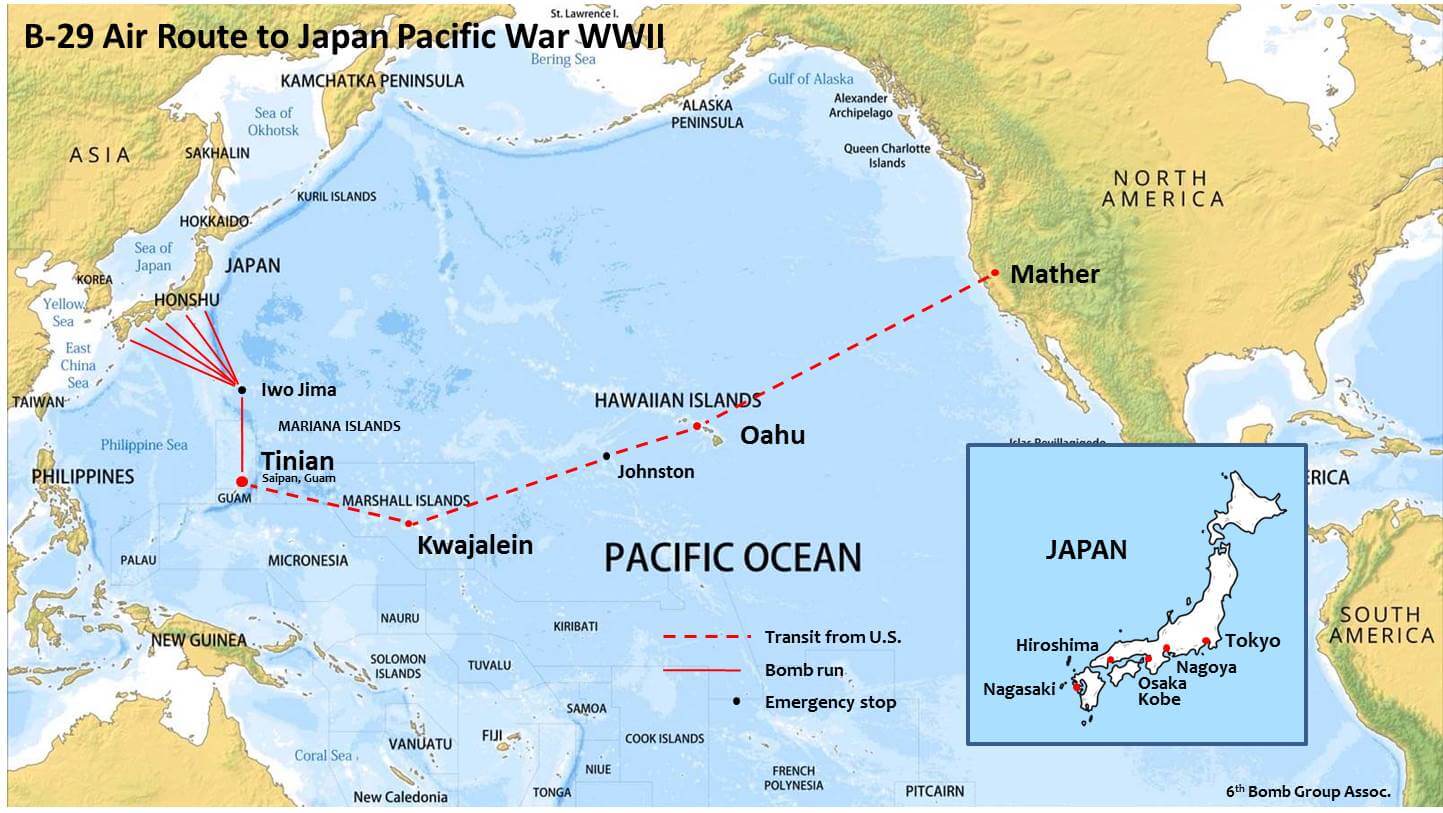
B-29 air route to Japan Pacific War WWII © 2025 6th Bomb Group Assoc.

Tinian Island cliffs 1944
The invasion of Tinian, that began July 24 and ended August 1, was difficult with 300 Americans and 6,000 Japanese losing their lives. Many Japanese residents chose to jump off the cliffs onto the rocks below while holding their children. Some holed up in the caves and jungle and spied on the American base until the end of the war.
TINIAN SOON BECAME THE BIGGEST AIR BASE IN THE WORLD
Navy construction battalions known as the Seabees began bulldozing mere days after the island was secured. Six runways were completed within two months and Tinian soon became the biggest air base in the world. North Field consisted of four runways and West Field had two.
The Seabees mined a large coral ridge and ground up the coral for aggregate to be used to build the runways and roadways on Tinian.

North Field on Tinian Island in the Marianas – launching point for the atomic bomb drops on Hiroshima and Nagasaki, Japan. ©Bill Webster. All Rights Reserved.
The runways were as wide as a ten-lane highway and each almost two miles long. Rows of B-29 bombers numbering in the hundreds lined the taxiways.
From the air, Tinian looked like a little Manhattan Island. The construction battalions named the roads they built after NYC streets. There was Broadway, Forty-Second Street, Wall Street, and even a livestock reserve named Central Park. Little did they know that from this remote island, the super-secret Manhattan Project was going to bring to a close World War II, half the world away from New York.

504th B-29s hardstand area

B-29s crashed on takeoff Tinian 1945
ALL BOMBERS WERE MAX LOADED WITH FUEL [MAKING] TAKEOFF CRASHES COMMON
Because the round trip to Japan was close to 3000 miles, all bombers that took off from the island were max loaded with fuel. This requirement made takeoff crashes common – a problem that planners of the atomic bomb had not anticipated. After taking off over the island’s cliffs, sometimes the Superfortresses’ dipped out of sight and never reappeared above the horizon.
Following the capture of Tinian, thousands of Okinawans, Japanese and Korean refugees emerged from the caves and were interred in Camp Churo on the island.

Camp Churo, Tinian 1945
THE SILVERPLATE AIRCRAFT WERE EQUIPPED WITH FUEL-INJECTED ENGINES, CURTISS ELECTRIC REVERSIBLE-PITCH PROPELLERS, PNEUMATIC BOMB BAY DOORS, ARMOR PLATING OMITTED AND ALL GUN POSITIONS, EXCEPT FOR THE TAIL GUN, ELIMINATED
In April 1945, the 509th began taking delivery of the third modification Silverplates coming off the assembly line at the Martin plant in Omaha. These “fly-away” aircraft were equipped with fuel-injected engines, Curtiss Electric reversible-pitch propellers, pneumatic actuators for rapid opening and closing of bomb bay doors, armor plating omitted and all gun positions, except for the tail gun, eliminated.
The ground support echelon of the 509th Composite Group traveled by rail to the west coast and then by ship to the Marianas. An advance party of the air echelon flew by C-54 to North Field, Tinian, in May. It was joined by the ground echelon on May 29, 1945, marking the group’s official change of station. Project Alberta’s “Destination Team” also sent most of its members to Tinian to supervise the assembly, loading, and dropping of the bombs. They were compartmented in their own secretive part of the 509th area.

509th Composite Group camp
After establishing the unit on Tinian, they operated combat missions starting June 30th dropping bombs on Japanese-controlled islands and the mainland throughout July and practicing missions with inert Little Boy and Fat Man prototypes.
SECURITY MEASURES WERE PARAMOUNT INCLUDING KEEPING THE MODIFIED B-29S IN AN ISOLATED CORNER OF THE BASE. ACCESS WAS HEAVILY RESTRICTED. GUARDS THEMSELVES WERE OFTEN UNAWARE OF THE IMPORTANCE OF WHAT THEY WERE PROTECTING.
Secrecy and Sarcasm
The island buzzed with rumors as a result of the secrecy. It also led to ridicule as rumors swirled that the 509th was “going to win the war.” One example is the poem “Nobody Knows,” author unknown.
Preparation for the Atomic Missions
THE 509TH FLEW 51 COMBAT MISSIONS OVER JAPAN, DROPPING HIGH EXPLOSIVE “PUMPKIN BOMBS” SIMILAR IN SIZE, WEIGHT, AND DROP CHARACTERISTICS TO THE “FAT MAN” ATOMIC BOMB, AS IF THEY WERE ACTUAL NUCLEAR STRIKES WITH PROPER EVASIVE MANEUVERS FOLLOWING THE WEAPON RELEASE
While the other bomber groups on Tinian were involved in the devastating incendiary bombing raids launched against Tokyo, the 509th Composite Group flew 51 combat missions over Japan, dropping high explosive “pumpkin bombs” similar in size, weight, and drop characteristics to the “Fat Man” atomic bomb. The intent of these missions was to carry them out as if they were actual nuclear strikes with proper evasive maneuvers following the weapon release.
AS PART OF THE PREPARATIONS, SINGLE B-29’S ROUTINELY FLEW OVER MAINLAND JAPAN AT 30,000 FEET AND BEFORE LONG WERE PRETTY MUCH IGNORED, LIKELY WRITTEN OFF AS RECONNAISSANCE AIRCRAFT
Also, as part of the preparations, single ship B-29’s routinely flew over mainland Japan at 30,000 feet, far out of range of anti-aircraft fire. They also flew without fighter escorts and before long were pretty much ignored, likely written off as reconnaissance aircraft that might not even generate an air raid alert on the ground.
ANOTHER DECEPTIVE PRACTICE WAS CHANGING THE TAIL MARKINGS OF THE SILVERPLATE BOMBERS TO MARKINGS FROM OTHER MARIANAS BASED BOMB GROUPS, SUCH AS CIRCLE-R OF THE 6TH BOMB GROUP THAT DISGUISED THE ENOLA GAY
Another deceptive practice was changing the tail markings of the Silverplate bombers from the forward pointing arrow in a circle of the 509th to markings from other Marianas based bomb groups, such as circle-R of the 6th Bomb Group that disguised the Enola Gay. With the exception of the Enola Gay, to which Tibbets had painted the day before its historic mission, the nose art for each aircraft was not painted on until after the atomic missions.

Enola Gay Silverplate B-29 on Tinian with 6BG tail marking. ©Photo by Bill Webster
Crew A-2 and the Tale of the Laggin’ Dragon
Crew A-2 was one of the fifteen crews assigned to the 509th and trained to deliver the atomic bomb. Capt. Edward M. Costello was the Aircraft Commander, 1Lt. Harry B. Davis, Pilot, 1Lt. Robert J. Petrolli, Navigator, 1Lt. Tomas H. Brumagin, Flight Engineer, and Bombardier 1Lt. John L. Downey manned the Norden bomb sight in the nose.
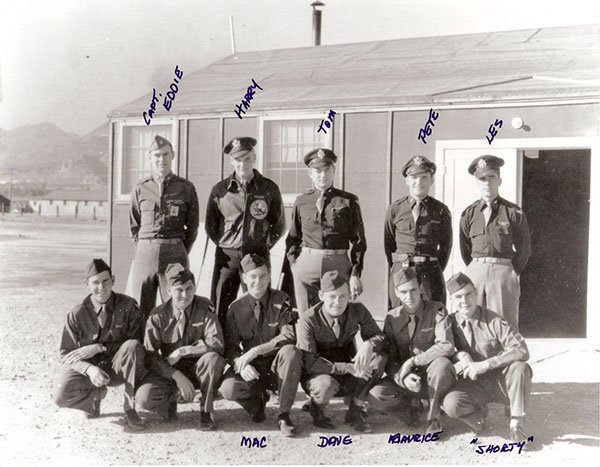
Crew A-2 at Wendover, UT>

Crew A-2 at North Field, Tinian
Bombardier Downey recalled, “As time went by, the 509th started receiving factory new, specially modified “Silverplate” B-29’s, each crew in turn picking up their airplane at the factory and returning to Wendover. At last, we were to put our long and difficult training to use.”

Boeing B-29 Plant in Renton
“The crews who received their new airplanes soon flew from Wendover in small groups to the Pacific Theatre, and those left behind, waiting impatiently, continued to refine weapon delivery techniques and procedures.” Before taking delivery of V-95, S/N 44-86347, Crew A-2, commanded by Capt. Ed Costello, West Point Class of 1943, performed several testing and development missions that directly supported the successful deployment of the atomic bombs to Japan.
The crew flew a test section B-29 in excess of 125 hours while detached to Eglin Field, Florida. Their mission was to develop fuel charts and power settings for the Silverplate configured B-29’s while working with engineers from Boeing and Wright Cyclone.
A second detached mission was to “Destination I”, Navel Ordinance Test Station, Inyokern, California, where the crew dropped dummy bombs in conjunction with camera equipped Navy aircraft to record the ballistic characteristics for the bombs to be dropped by the 509th. A precise flight and bomb release plan had to be executed. In addition, drops were made to test special fusing.
ED, HARRY AND LES FLEW TO WHITE SANDS, NEW MEXICO IN MID-JULY TO OBSERVE THE TRINITY TEST ON BEHALF OF COLONEL PAUL TIBBETS
In addition, Ed, Harry and Les flew to White Sands, New Mexico in mid-July to observe the Trinity Test on behalf of Colonel Paul Tibbets, 509th Composite Group commander, who was already on Tinian. A missed refueling connection at an airfield necessitated the crew staying overnight and arriving at Trinity after the test had been completed. However, the data was collected and delivered to Col. Tibbets on July 31st.
By this time, only two crews, A-2, and Capt. Herman S. Zahn’s, C-12, remained at Wendover, neither having received their Silverplate airplanes. Both crews were greatly disappointed and somewhat bitter about being the last despite having high proficiency ratings.
CREW A-2 WAS SENT TO THE FACTORY TO TAKE DELIVERY OF WHAT WAS TO BE THE LAST OF THE SILVERPLATE BOMBERS COMPLETED
Finally, crew A-2 was sent to the factory to take delivery of what was to be the last of the Silverplate bombers completed at the Glenn L. Martin Aircraft Company in Omaha, Nebraska, designated for the 509th Composite Group. With only 2 hours of flight time on the airframe, the gleaming new B-29 was flown from adjoining Offutt Army Airfield in July 1945 enroute to Wendover Army Airfield.
Crew member Maurice Clark, who hailed from Nebraska, was summoned to the flight deck by the pilot, who asked him if he might recognize his parent’s farm from the air. He was able to point out the family farm as they flew over and the pilot dropped altitude and again and flew over the house, at which time Maurice’s parents appeared in the barnyard. The pilot then changed altitude again and did a low pass over the farmstead, then climbed away. In a letter received later by Maurice from his parents, his father told him if the aircraft had made one more pass, the chickens wouldn’t have laid eggs for a week!
The only remnant of the aircraft is, for lack of a better name, the warranty plate, which was mounted above the aircraft commander’s seat and was removed, in his words, “for safekeeping,” by Bombardier Les Downey.
It reads: “To the men who fly this ship: We, the men and women who helped build this airplane, were ever mindful that your lives and possibly our futures might depend on how well we did our jobs. We, therefore pledge, that every detail of construction of this airplane was completed as carefully and thoroughly as though we were to fly it ourselves.”

B-29 Silverplate warranty plate
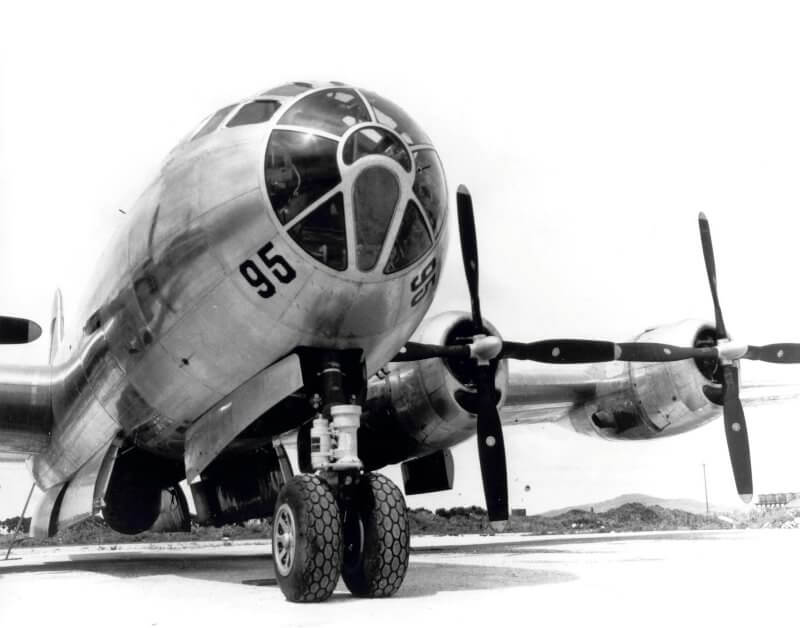
Laggin’ Dragon B-29 Silverplate without nose art
There was only time for several short shake down flights, calibrating the air speed, altimeter, swinging the compass and checking out all the systems before the ship left Wendover, final destination Tinian. At this time, the airframe had only 11 hours on its flight log.
The Laggin’ Dragon name and nose art were the work of the bombardier, who sketched the weary looking dragon shortly before departing Wendover. In light of being the last crew to leave for Tinian, it seemed that a parody of the 393rd Bomb Squadron insignia of a vicious, raging, fire breathing, bomb carrying dragon would be appropriate. The aircraft commander and crew gave their approval, and the Laggin’ Dragon was born.
The actual nose art, a somewhat censored version of the original drawing, was painted on the aircraft on Tinian following the atomic bomb missions.
THE MORNING WE WERE TO LEAVE WENDOVER WE WERE ORDERED BY MILITARY INTELLIGENCE TO REMOVE ANY PAPERS OR FORMS OF IDENTIFICATION THAT WOULD INDICATE WE WERE AT WENDOVER AIR BASE
Ground crew member Bob Garn recalled, “The morning we were to leave Wendover we were assembled in an area and ordered by Military Intelligence to remove any papers or forms of identification that would indicate we were at Wendover Air Base. They were either destroyed or placed in a lock box from which we could retrieve them after arrival at Tinian. We were told we could not telephone, write or make contact with anyone until after we arrived on Tinian.”.
UPON REACHING ALTITUDE, THE ORDERS WERE OPENED DIRECTING THE CREW TO KIRTLAND FIELD IN ALBUQUERQUE, NEW MEXICO, NOT TO TINIAN AS EXPECTED
The Laggin’ Dragon departed Wendover on July 24th under sealed classified orders, fully loaded and ready for overseas duty. Packed with the cargo in the rear bomb bay, but probably not on the weight and balance form, were a 12’ tall concrete statue of the Blessed Virgin Mary as requested by the 509th Chaplin, two slot machines salvaged by Pete following the Wendover Officer’s Club fire and several cases of Southern Comfort, which proved to be more valuable than currency on Tinian. Upon reaching altitude, the orders were opened directing the crew to Kirtland Field in Albuquerque, New Mexico, not to Tinian as expected.
Although security and secrecy were paramount, the aviators and their families weren’t clueless. They saw things and heard things, speculated, worried and had a normal curiosity about their lot in life, but it ended there.
The wives and families of the men of the 509th, billeted at remote bases lacking the usual comforts, became a very tight knit group of friends that continued throughout their lives.
When their husbands donned their flight suits and walked out the door, the wives never had an idea of where they were going or when they would return. Sometimes it was local training missions, and they came home at the end of the day. Other times they were deployed to distant places for training and testing and might be gone for days or weeks. The ladies relied upon one another until their return.
When the orders for deployment overseas came, it was probably obvious that the guys were packing for an extended assignment and the savvy women put two and two together……
The wives had gone together to watch the planes take off before and knew where they normally rotated from the runway into flight. As a group of them assembled to watch their husbands depart for overseas, they stood at their spot and watched the grossly overloaded Laggin’ Dragon roll past the rotation point, at which time, one of the ladies began shouting, “Throw out the Virgin, throw out the Virgin!” Eventually the bomber lifted off the ground and lumbered into flight.
UPON ARRIVAL AT KIRTLAND, SPECIAL PERSONNEL TOOK THE AIRCRAFT TO A REMOTE SITE TO LOAD FAT MAN SPECIAL STORE #F-31 (MINUS THE PLUTONIUM CORE) INTO THE FRONT BOMB BAY. THIS WAS THE BOMB THAT ULTIMATELY WAS DROPPED ON NAGASAKI ON AUGUST 9, 1945
Upon arrival at Kirtland, special personnel took the aircraft to a remote site to load Fat Man Special Store #F-31 (minus the Plutonium core) into the front bomb bay. (Special Store was a military euphemism for an atomic bomb. The term was used in an effort to reference a nuclear weapon in a less formidable manner.) This was the bomb that ultimately was dropped on Nagasaki on August 9, 1945, hastening the surrender of Japan on August 15th. The Laggin’ Dragon participated in that mission as a weather recon plane, but it was flown on that mission by Crew B-8. The delayed arrival on Tinian and lack of time to complete the required orientation precluded Crew A-2 from flying any missions in support of either the Hiroshima or Nagasaki missions.
FROM KIRTLAND, THE CREW FLEW THEIR CARGO TO MATHER FIELD IN SACRAMENTO, CALIFORNIA
From Kirtland, the crew flew their cargo to Mather Field in Sacramento, California, the home of the Air Transport Command, which had jurisdiction over all military aircraft departing for or arriving from the Pacific Theatre.
Tom and Les recall that, “Upon arrival of V-95 at Mather Field, the aircraft was subjected to an inspection of all emergency gear per Air Transport Command requirements for all aircraft departing for overseas bases.” This seemed redundant since the aircraft was fresh out of the factory. After some debate between base personnel and on board intelligence officers, however, the procedure was followed.
ABOUT NOON ON JULY 29TH, THE LAGGIN’ DRAGON DEPARTED MATHER FIELD ENROUTE TO JOHN ROGERS FIELD ON HAWAII
About noon on July 29th, the Laggin’ Dragon departed Mather Field enroute to John Rogers Field on Hawaii, Kwajalein, and ultimately, Tinian. On board were 19 souls including the flight crew, ground crew and two security agents.
All crew members except for the pilots and flight engineer were in the rear crew area of the aircraft to help offset the nose heavy condition of the airplane. On that day, Crew A-2 would face an unanticipated emergency that would test their mettle to the max.
THE PLANE BEGAN TO SHAKE VIOLENTLY AND STARTED TO NOSE DOWN
With a gross weight of 136,000 pounds, spuriously recorded on the flight log to conceal the secret and clandestine cargo, clearance from the tower was obtained and the taxi-out and takeoff were normal. At about 50 feet off the ground, the gear was just being retracted when a loud “Whap!” noise was heard in the aircraft and felt by the pilot through the controls. Immediately the plane began to shake violently and started to nose down.
HE LOOKED TO THE REAR OF THE PLANE AND SAW THE LARGE SEVEN-MAN LIFE RAFT FLOPPING ON THE HORIZONTAL STABILIZER
Cpl. Shorty Bryant, the right scanner, was observing the gear and flaps to report “full up” position to the pilot, when suddenly he saw a bright orange flash pass by his portal. As the plane began to shake violently, he looked to the rear of the plane and saw the large seven-man life raft flopping on the horizontal stabilizer.
As pulling on the yoke and rolling trim didn’t help, the aircraft commander called to his co-pilot, who was described in the official report as “6’3”, weighing 220 lbs., in good physical shape, and strong,” saying, “Help me, Harry!”
HE SUMMONED LES FORWARD TO HIS BOMBARDIER’S POSITION TO PREPARE TO SALVO THE BOMB. HE CUT THE SAFETY WIRE ON THE SALVO SWITCH AND AWAITED FURTHER ORDERS
He also summoned Les forward to his Bombardier’s position to prepare to salvo the bomb, an emergency contingency the pilots would reserve as a last resort. The continuing secrecy of the 509th left the flight crew, as aware as they were that they had some special cargo on board, really just guessing what was in the front bomb bay. Les was more than happy to make the quick trip forward through the tunnel in as much as he had left his parachute in the bombardier’s position. Upon assuming his station, he cut the safety wire on the salvo switch and awaited further orders.
Both pilots, with feet braced on the rudder pedals and pulling with all their strength on the control yokes, were physically being bounced up and down in their seats by the intensity of the shaking.
THEY SAW A CLEARER CRASH SITE TO THE RIGHT AND MADE A 10º TURN. AS THE WING LOWERED ON THAT SIDE, THE RAFT AND OTHER PIECES OF DITCHING GEAR WERE DISLODGED
They saw a clearer crash site to the right and made a 10º turn. As the wing lowered on that side, the raft and other pieces of ditching gear were dislodged from the horizontal stabilizer and the vibration of the airplane diminished to a more controllable level. The pilots were able to bring up the nose of the crippled aircraft and climb to a higher altitude and proper air speed.
Les recalls the Captain calling Mather tower declaring an emergency and requesting immediate landing clearance, at which time the tower asked the weight of the overloaded aircraft.
The tower then advised the aircraft commander to fly around until the ship reached 125,000 pounds so as not to damage the Mather runway. He responded, “Fly around Hell, I don’t know if we are going to get around this time!” Les said that this was the only time he’d ever heard Ed swear.
There has been discussion as to possible radio interference at this time affecting communications between the tower and the damaged airplane as the Aircraft Commander told the crew and passengers to prepare for a crash landing.
Upon approach to Mather, Shorty watched a convoy of fire trucks and ambulances heading onto the field. He recalls, “The touchdown was very fast, but smooth as silk. The Curtis Electric reversible pitch props helped bring the aircraft to a stop with the nose gear just off the end of the runway but the main gear still on the hard surface.”
Although crashing, or a crash landing, were both strong possibilities, at no time did the pilots ever lose control of the aircraft. What could have been a disaster ended with a safe, smooth, albeit hot landing, with no injuries or further damage to the aircraft. Upon entering the cockpit after rolling to a stop, however, Pete noted that the two pilots remained in their seats, physically and emotionally drained, their flight suits soaked in perspiration.
APPROXIMATELY TWELVE HOURS LATER, THE LAGGIN’ DRAGON DEPARTED FOR AN UNEVENTFUL THREE LEG FLIGHT TO TINIAN, DELIVERING THE F-31 BOMB CASING, THE NAGASAKI BOMB, TO NORTH FIELD ON AUGUST 1ST
Maintenance personnel at Mather appropriated the necessary parts from another B-29 on the ramp to repair the tail structure and approximately twelve hours later, the Laggin’ Dragon departed for an uneventful three leg flight to Tinian, delivering the F-31 bomb casing, the Nagasaki bomb, to North Field on August 1st.
Through subsequent examination of records and crew interviews, it appears that the oversight which could have spelled disaster was the result of security measures dictated by a Military Intelligence officer attached to the aircraft for the mission. Additionally, the opening of the hatches and repacking were done while the crew chief and ground crew were absent, thus they had no knowledge of the potentially catastrophic lack of communication.
So, on a good note, ends the Tale of the Laggin’ Dragon and Crew A-2, whose most important mission could have been their last.
Operation Downfall – Planned Invasion of Japan
PREDICTIONS OF CASUALTIES FROM BOTH THE ALLIES AND JAPAN NUMBERED IN THE MILLIONS
Another plan was in the works to hopefully bring the war in the Pacific to an end. Most Americans were probably never aware of it, but for the approximately 2,000,000 troops that were staged stateside, in Europe, on Pacific Islands, or aboard ships, they quietly remembered it as an experience they were blessed to have missed. Even before the surrender of Nazi Germany on May 8, 1945, plans were underway for the largest operation of the Pacific War, Operation Downfall, the Allied invasion of Japan. Predictions of casualties from both the Allies and Japan numbered in the millions. As a result, completion and successful testing of the atomic bomb moved that particular option to the front burner.

Operation Downfall map
Potsdam Declaration
THE ALLIES DEMANDED THE UNCONDITIONAL SURRENDER OF THE IMPERIAL JAPANESE ARMED FORCES IN THE POTSDAM DECLARATION ON JULY 26TH, THE ALTERNATIVE BEING “PROMPT AND UTTER DESTRUCTION.” JAPAN IGNORED THE ULTIMATUM, AND THE WAR CONTINUED.
The final items of preparation for the operation came July 25th and 29th. The orders designated four targets: Hiroshima, Kokura, Niigata, and Nagasaki, and ordered the attack to begin as early as the next week, weather permitting.
Hiroshima
For the bomb code-named “Little Boy”, the Hiroshima bomb, the uranium-235 projectile and partially assembled bombs without the fissile components were delivered to Tinian on the cruiser USS Indianapolis. Three C-54s of the 320th Troop Carrier Squadron, each with three of the uranium-235 target rings landed at North Field on July 28th.
FINALLY, TIBBETS TOLD THE MEN ABOUT THEIR MISSION TO BOMB JAPAN AND THE IMMENSELY DESTRUCTIVE NATURE OF THE BOMB
Later that day, men of the 509th Composite Group assembled for a briefing. Finally, Tibbets told the men about their mission to bomb Japan and the immensely destructive nature of the bomb. Tibbets did not, however, reveal it was a nuclear weapon. At this briefing were the six crews of the 509th that would participate in dropping Little Boy and top officials from Washington.
THIS BOMB THAT YOU ARE GOING TO USE IS NOT AN ORDINARY BOMB. IT IS NOT A THOUSAND POUNDER, IT IS NOT A TEN-TON BLOCKBUSTER, THIS BOMB HAS THE STRENGTH OF TWENTY THOUSAND TONS OF TNT
“During your training period you were called upon to do many strange things,” Tibbets said. “There was a reason for all of that, because this bomb that you are going to use is not an ordinary bomb. It is not a thousand pounder, it is not a ten-ton blockbuster, this bomb has the strength of twenty thousand tons of TNT.”
The 509th were further informed that the mission would occur as soon as the weather cleared, what their targets were, and that the Japanese would not be expecting them. Three crews were to fly ahead to assess the weather and to relay the information to the bomb carrier. The other two crews were to accompany the bomb carrier as observation units. Finally, the men were told that until the mission occurred, they could not discuss the mission, even among themselves.
Enola Gay Silverplate B-29 on Tinian with 6BG tail marking. ©Photo by Bill Webster
On August 5th, the weather cleared and the Enola Gay, piloted by Colonel Tibbets, was maneuvered over a bomb loading pit and then taxied to Runway Able at North Field. At 2:45 AM on August 6, the B-29 named after Tibbets’ mother took off. The gun type fission weapon was armed by the weaponeers after takeoff.
Enola Gay backing over pit
Lifting Little Boy Atomic Bomb from Atomic Bomb Pit into Enola Gay
Little Boy atomic bomb in loading pit
Hydraulic lift used to raise atomic bomb into Enola Gay
ON AUGUST 6TH AT 8:15 AM HIROSHIMA TIME, THE LITTLE BOY BOMB WAS DROPPED ON HIROSHIMA.
On August 6th at 8:15 AM Hiroshima time, the Little Boy bomb was dropped on Hiroshima. The Enola Gay and her trailing escorts, The Great Artiste and Necessary Evil immediately began their evasive maneuvers. About 45 seconds later the bomb exploded at an altitude of 1968’ and the first shock wave overtook the aircraft a minute after the blast. It exploded with the energy of 15 kilotons of TNT. The crews arrived back on Tinian at 2:58 PM without incident, after about 12 hours in the air.
Hiroshima atomic bomb blast August 6, 1945
Rare Footage of 509th Composite Group and Atomic Missions. Narrated by Anderson Giles, 6th Bomb Group Associate.
Description: 509th film recordings of top secret Wendover bombing trials, Tinian inner sanctum atomic bomb assembly buildings, atomic bomb loading and drops on Hiroshima and Nagasaki, crew interviews after atomic bombings (34:49 min).
The aircraft assigned to the Hiroshima mission consisted of three weather recon planes, two observations planes, a strike spare aircraft located on Iwo Jima and the Enola Gay, the weapon delivery plane.
Aircraft Assignments
| Aircraft | Crew | Pilot | Mission |
|---|---|---|---|
| Enola Gay | B-9 | Col. Tibbets | Weapon Delivery |
| Straight Flush | C-11 | Capt. Eatherly | Weather recon (Hiroshima) |
| Jabit III | B-6 | Capt. Wilson | Weather recon (Kokura) |
| Full House | A-1 | Capt. Taylor | Weather recon (Nagasaki) |
| The Great Artiste | C-15 | Major Sweeney | Blast instrumentation |
| Necessary Evil | B-10 | Capt. Marquardt | Observation & Photography |
| Big Stink | B-8 | 1Lt. McKnight | Strike spare Iwo Jima |
The Enola Gay carried a blended crew, with Col. Tibbets replacing the regular Aircraft Commander, Capt. Robert Lewis, who was bumped to the right seat.
Enola Gay Crew
Special Mission 13 Hiroshima 06AUG45
| Col. Paul Tibbets Jr. | Pilot and Aircraft Commander |
| Capt. Robert Lewis | Co-pilot; Enola Gay’s regular Aircraft Commander |
| Major Thomas Ferebee | Bombardier |
| Capt. Theodore “Dutch” Van Kirk | Navigator |
| Capt. William Parsons, USN | Weaponeer and Mission Commander |
| 1Lt. Jacob Beser | Radar Countermeasures |
| 2Lt. Morris Jeppson | Assistant Weaponeer |
| SSgt. George “Bob” Caron | Tail Gunner |
| SSgt. Wyatt Duzenbury | Flight Engineer |
| Sgt. Joe Stiborik | Radar Operator |
| Sgt. Robert Shumard | Assistant Flight Engineer |
| PFC Richard Nelson | VHF Radio Operator |
Nagasaki
Bockscar was to be the strike aircraft for the second atomic bomb, the F31 store.
B-29 Bockscar
The components for the bomb code-named the Fat Man arrived by air. The bomb’s plutonium core initiator was flown from Kirtland to Tinian by C-54 in the custody of Project Alberta couriers. Three Fat Man high explosive pre-assemblies designated F31, F32, and F33 were picked up at Kirtland on July 28th by three B-29’s and transported to North Field, arriving August 2nd. Again, the loading pit was used to hoist the weapon into the front bomb bay.
Fat Man atomic bomb in assembly
Fat Man atomic bomb assembled (Tinian)
On August 9th, the second atomic mission was put into play. Four planes and four crews from the Hiroshima mission flew again, but in different roles, taking off at 3:49 AM Tinian time. The safety plugs were removed in flight.
The initial target, Kokura, was reported to be obscured by clouds by the Enola Gay in its role this mission as a weather recon aircraft, Bockscar proceeded to Nagasaki. Although under strict orders to drop the bomb visually, after fifty minutes of waiting for clear conditions and running tight on fuel, the call was made to drop the bomb by radar.
At the last minute, a break in the clouds emerged and enabled the bombardier to release visually. The “Fat Man” atomic bomb exploded over the city of Nagasaki at 11:02 AM Nagasaki time at an altitude of 1650’ releasing the energy of 21 kilotons of TNT. Both the Little Boy and Fat Man bombs used proximity fuses to detonate above the ground, intensifying the effect of the blasts. Again, the three aircraft performed evasive maneuvers and headed home.
Due to its fuel shortage, Bockscar made an emergency landing on Okinawa at 2:00pm Tinian time. They landed with seven gallons of fuel left, which was less than a minute of flight time. It arrived back at Tinian at 11:06 PM.
The total mission time was 19 hours, the mission unfolding very differently from the Hiroshima mission due to several glitches, including the delayed arrival of photo plane Big Stink, a faulty fuel transfer pump, adverse weather conditions both approaching and over target resulting in three bomb runs that could not be completed before the target finally opened up.
Nagasaki atomic bomb blast
Aircraft Assignments
Nagasaki Mission – 09AUG34un
| Aircraft | Crew | Pilot | Mission |
|---|---|---|---|
| Bockscar | C-15 | Major Sweeney | Weapon Delivery |
| Enola Gay | B-10 | Capt. Marquardt | Weather recon (Kokura) |
| Laggin’ Dragon | B-8 | 1Lt. McKnight | Weather recon (Nagasaki) |
| The Great Artiste | C-13 | Capt. Bock | Blast Instrumentation |
| Big Stink | C-14 | Major Hopkins | Observation & Photography |
| Full House | A-1 | Capt. Taylor | Strike spare Iwo Jima |
For the Nagasaki mission there were two weather recon planes, two observation planes, the strike spare on Iwo Jima and the weapon delivery aircraft.
Bockscar Crew
Special Mission 16 Nagasaki 09AUG45
| Major Charles Sweeney | Aircraft Commander |
| 1Lt. Charles Albury | Pilot |
| 2Lt. Fred Olivi | Third Pilot |
| Capt. Kermit Beahan | Bombardier |
| Capt. James Van Pelt | Navigator |
| Frederick Ashworth | Weaponeer and Mission Commander |
| 1Lt. Jacob Beser | Electronic Countermeasures |
| SSgt. Albert Dehart | Tail Gunner |
| M/Sgt. John Kuharek | Flight Engineer |
| Sgt. Raymond Gallagher | Asst. Flight Engineer |
| SSgt. Edward Buckley | Radar Operator |
| Sgt. Abe Spitzer | Radar Operator |
| Cpl. Ape Spitzer | VHF Radar Operator |
Official Japanese surrender Sept. 2, 1945 aboard USS Missouri
The Japanese Emperor Hirohito announced the country’s surrender on August 15, 1945.
The 509th Composite Group had officially completed its mission for which it had been specifically created and trained, to deliver the atomic bombs. In October 1945, the 509th departed Tinian and proceeded to Roswell, New Mexico, where it was assigned a new commander and later became part of the Strategic Air Command.
Legacy
The legacy of this historic group carried on after the war as the 509th Bomb Wing, an active unit of the United States Air Force. Following their success with the B-29 Superfortress, the squadron subsequently flew the B-50 and the B-47 in the 1950’s, and then transitioned to the B-52 in 1966, followed by the FB-111 in 1970. The unit received the first of its B-2 Spirit Stealth Bombers on December 17, 1993, the 49th anniversary of the activation of the 509th Composite Group and the 90th anniversary of the Wright brother’s flight.
By 1970, none of the B-29s built during the war years were flyable. The B-29 named FIFI, however, was rescued from the China Lake U.S Naval Weapons Center in California by the Confederate Air Force (subsequently renamed Commemorative Air Force) in 1971, after being retired in 1958. Victor Agather, a successful businessman and member of the B-29 development program in WWII, provided much of the guidance and financing for the project. The aircraft was made airworthy and flown from the desert to CAF Headquarters in Harlingen, Texas. After three years of restoration was completed, FIFI began flying with the CAF, one of the 181 aircraft they’d restored as of 2025.
A second B-29 named Doc also came from China Lake after being found by Tony Mazzolini sitting in the Mojave Desert where she served as a target. It took 12 years for Mazzolini and his team to be able to take possession of the airplane from the U.S. Government. The plane was taken back in pieces to its birthplace at the Boeing-Wichita plant in Kansas in 1998. The extensive restoration work was completed and Doc flew in 2016 for the first time in 60 years, when, like FIFI, it began touring the air show circuit, providing cockpit tours and rides through the help of many dedicated volunteers.
B-29s Doc and Fifi in flight post restoration
In 2003, the Enola Gay was restored and made a permanent part of the National Air and Space Museum’s Steven F. Udvar-Hazy Center in Chantilly, VA, near Washington DC.
Enola Gay displayed at the Udvar-Hazy Center near Washington DC
Author Scott Davis with Enola Gay at Smithsonian (1980’s) during prep for display
Before restoration, in 1995 the cockpit and nose section of the aircraft were exhibited at the National Air and Space Museum (NASM) in downtown Washington, D.C. for the bombing’s 50th anniversary amid controversy about the context in which she was displayed. The initial exhibit was criticized for portraying Japan as victims and questioning the morality of the bomb’s use. Many veterans, and their organizations, with the Japanese atrocities still on their minds, responded strongly. The controversy led to the cancellation of the original exhibit and the implementation of a scaled-down version. Not a single crew member of the Atomic Missions ever expressed any remorse about the job they were assigned and completed, and many an infantryman, staged in the Pacific on ships or islands, or on orders to depart the European theatre to join in Operation Downfall, shared their appreciation of the job the 509th Composite Group did to avoid perhaps a million casualties and bring World War II to an end.
Earlier, in 1961, Bockscar was restored and put on permanent display at the National Museum of the United States Air Force at Wright-Patterson AFB in Dayton, OH.
Bockscar at Wright-Patterson AFB, Dayton, OH
As of 2025, there were eighteen other Superfortresses either in storage or on static display throughout the country.
B-29 SUPERFORTRESSES ON DISPLAY OR IN STORAGE
| Enola Gay | Steven F. Udvar-Hazy Center | Chantilly, VA |
| Bockscar | National Museum U.S. Air Force | Dayton, OH |
| Sentimental Journey | Pima Air and Space Museum | Tucson, AZ |
| T-Square 54 | Museum of Flight’s Aviation Pavilion | Seattle, WA |
| Hagarty’s Hag | Hill Aerospace Museum | Ogden, UT |
| Joltin’ Josie | USAF History and Traditions Museum | San Antonio, TX |
| Legal Eagle II | South Dakota Air and Space Museum | Rapid City, SD |
| Tinker’s Heritage | Charles B. Hall Airpark | Oklahoma City, OK |
| Lucky Lady | SAC and Aerospace Museum | Ashland, NE |
| Unnamed | National Museum of Nuclear History | Albuquerque, NM |
| 3 Feathers | March Field Air Museum | Riverside, CA |
| The Great Artiste | Whiteman AFB | Knob Nostor, MO |
| Unnamed | Global Power Museum | Bossier City, LA |
| Big Red | Museum of Aviation | Warner Robins, GA |
| Sweet Eloise | Dobbins Air Reserve Base | Marietta, GA |
| City of Lansford | Georgia Veterans Memorial State Park | Cordele, GA |
| Jack’s Hack | New England Air Museum | Windsor Locks, CT |
| Peachy | Pueblo Weisbord Aircraft Museum | Pueblo, CO |
| Miss America 62 | Jimmy Dolittle Air & Space Museum | Fairfield, CA |
| Raz’n Hell | Castle Air Museum | Atwater, CA |
Signifying its place in history, the iconic B-29 has seen two resurrections:
Several B-29’s were forced to make emergency landings in Russia and the aircraft were reverse engineered to create the Tupelov Tu-4 bomber that was produced from 1948 to 1952.
Russian B-29 copy: Tupelov Tu-4
B-29 cockpit above, Millenium Falcon cockpit below
A more widely viewed replication of the B-29 was seen in the blockbuster Star Wars series. It’s quite obvious, when seeing the picture of Han Solo and Chewbacca piloting the Millenium Falcon, where the filmmaker got the idea for the cockpit.to 1952.
You may have noticed I used the first names of several aviators. They are the crew members of the Laggin’ Dragon, Crew A-2. My wife and I had the good fortune of knowing them and spending time with them and their families on several occasions as they reminisced. We had the honor and pleasure to meet not only members of Dad’s crew, but many other members of the 509th Composite Group. It was obvious that there were many lifelong bonds shared among these folks. Their stories and recollections were amazing.
On the left is Capt. Edward Costello, Aircraft Commander, and in the right seat, 1Lt. Harry Davis, Pilot, the author’s father.
Capt. Edward Costello, Aircraft Commander
1Lt Harry Davis, Pilot
On the left is 1Lt. Tom Brumagin, the Flight Engineer, and 1Lt. Robert “Pete” Petrolli, Navigator, right.
1Lt. Tom Brumagin, Flight Engineer
1Lt. Robert “Pete” Petrolli, Navigator
This is 1Lt. John “Les” Downey, the longest surviving member of Crew A-2, who passed away in 2015. When I started compiling information about the 509th and the Laggin’ Dragon, he was my sounding board and verifier. They are all gone now, and the 509th reunion group has succumbed as well. But their story will live on.
1Lt. John “Les” Downey, Bombardier
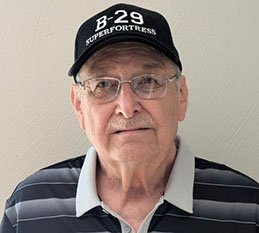
Scott B. Davis
Author Bio: Scott B. Davis is the son of 1Lt. Harry B. Davis, Silverplate B-29 “Laggin’ Dragon” pilot, WWII. He served in Vietnam and his family also includes veterans of WWI and the Middle East/Afghanistan Wars. He was a member of the legacy 509th Composite Group until it disbanded in 2015. He is active as an officer of the Veterans of Foreign Wars and volunteers as a docent for the Pennsylvania Military Museum.

PACIFIC WAR – OVERVIEW
Brief overview of the Pacific War 1941-1945 >

WERE THE ATOMIC BOMBS NECESSARY TO WIN THE WAR?
Japanese and American perspectives >
WHAT WE SHOULD HAVE LEARNED
What We Should Have Learned. >
Nose Art of the 509th Composite Group
SILVERPLATE B-29 AIRCRAFT, CREW & AIRCRAFT COMMANDER

Top Secret. 509th CG crew B-8, 1Lt. Charles F. McKnight

Strange Cargo. 509th CG crew A-4, 1Lt Joseph E. Westover

Bockscar. 509th CG crew C-13, Capt. Frederick C. Bock

Enola Gay. 509th CG crew B-9, Capt. Robert A. Lewis

Full House. 509th CG crew A-1, Capt. Ralph R. Taylor

Some Punkins. 509th CG crew B-7, Capt. James N. Price

Straight Flush. 509th CG crew C-11, Capt. Claude R. Eatherly

Next Objective. 509th CG crew A-3, Lt. Ralph N. Devore

Up an’ Atom. 509th CG crew B-10, Capt. George W. Marquardt

The Great Artiste. 509th CG crew C-15, 1Lt Charles D. Albury

Big Stink. 509th CG crew A-5, Lt. Col. Thomas J. Classen

Necessary Evil. 509th CG crew C-14, Lt. Norman W. Ray

Laggin’ Dragon. 509th CG crew A-2, Capt. Edward M. Costello

Luke the Spook. 509th CG crew C-12, Capt. Herman S. Zahn

Jabit III. 509th CG crew B-6, Capt. John A Wilson


