Lawrence Stewart
B-29 Flight Engineer
6BG, Tinian 1945
First publication July 2024
Original memoir copyright © 2024 Lawrence Steward. All Rights Reserved
Additional content copyright © 2024 6th Bomb Group Assoc. All Rights Reserved
Editor’s Note: The B-29 Bomber is an excerpt from then 1st Lt. Lawrence Stewart’s first-person memoirs: Combat in the Pacific Theater – A B-29 Flight Engineer’s Experiences During World War II. Pictures, titles, table and highlights have been added to compliment the author’s writing.

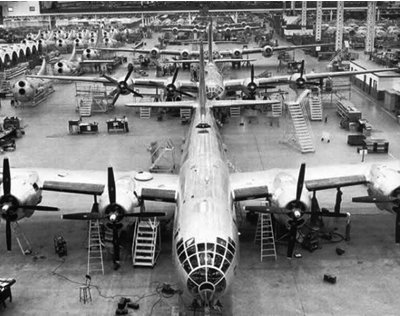
B-29 at Boeing Aircraft Factory Renton
The B-29s were the largest bombers in operational use at that time, and as a potential mechanical engineer I was interested in the statistics of the mighty bomber. It had a wingspan of 141 feet and a fuselage that was 99 feet long. The tail structure towered into the air about as high as the top of a three story house. Four main fuel tanks, located internally in the wing structure, had a capacity of 9,150 gallons. And it had a cruising speed of 220 miles per hour carrying a full load in the two bomb bays.
Technical Specs:
| Armament | Ten .50 caliber RC machine guns, one 20 mm tail cannon, 20,000 lbs of bombs |
| Engines | Four 2200 hp Wright R-3350s |
| Max. speed | 357 mph |
| Cruising speed | 220 mph |
| Range | 3700 miles |
| Ceiling | 33,600 feet |
| Span | 141 feet 3 inches |
| Length | 99 feet |
| Height | 27 feet 9 inches |
| Weight | 133,500 lbs maximum loaded |
IT WAS THE MOST POWERFUL ENGINE INSTALLED IN ANY AIRPLANE. AS A RESULT, THE B-29 HAD A CRUISING ALTITUDE, SPEED AND RANGE MUCH GREATER THAN HER PREDECESSORS.
Each of four R-3350 Wright engines was connected to two turbo superchargers. The superchargers, operated by the exhaust gasses from the engines, improved the high altitude performance of the engines. They provided sea level power up to an altitude of 33,000 feet. A large four-bladed propeller was attached to the engine. It was the most powerful engine installed in any airplane at that time! As a result, the B-29 had a cruising altitude, speed and range much greater than her predecessors. Other innovations included pressurized cabins and remotely controlled guns. The B-29 was designed as an all-weather bomber which could operate at night and in cloud cover using a new radar system and bombsight.

R-3350 Wright engine
To support the huge airplane, a dual-wheeled tricycle landing gear was utilized. There were four [remote controlled gun] turrets located on the fuselage; one on top of the forward cabin, a second situated topside behind the gunner’s compartment, a third located directly opposite the forward top turret on the underside of the fuselage, and the fourth located below the rudder on the lower fuselage surface. Another gun position was located at the tail gunner’s position. Two .50 caliber machine guns were mounted in each turret and at the tail gunner’s location except for the upper forward turret which carried four machine guns. The forward upper turret was primarily controlled by the bombardier and secondarily by the Central Fire Control or “‘CFC- gunner. The upper aft turret was controlled by the CFC gunner. The right and left (side) gunners individually controlled the lower forward and aft turrets and either gunner could control both turrets. In addition, the bombardier had secondary control of the lower forward turret. The tail turret was primarily the tail gunner’s responsibility. However, either side gunner could also operate this turret. It truly was a Superfortress, the official name bestowed on the B- 29.

B-29 cutaway illustration, PBS. Annotation added

Forward pressurized compartment
The forward entry point was located in the nose gear wheel well, which contained a built-in ladder. The forward turret protruded into the forward cabin to the left of the flight engineer’s panel which left little room for the radio operator, navigator and flight engineer to move around in.
THERE WERE THREE PRESSURIZED AREAS FOR THE CREW
There were three pressurized areas for the crew. The forward compartment contained the bombardier, pilots, flight engineer, navigator and radio operator stations. The bombardier’s station was located in the nose of the airplane. The aircraft commander’s position was on the left side and the pilot’s position was on the right side of the cockpit, above and behind the bombardier.

B-29 cockpit © Kent Vincent

B-29 Aircraft Commander controls © Kent Vincent

B-29 Flight Engineer’s station © Kent Vincent
The flight engineer’s station was located on the right side directly behind the pilot, with the flight engineer facing to the rear of the airplane.

Navigator’s celestial navigation astrodome © Kent Vincent

B-29 navigator plotting position
The navigator’s station was located on the left side of the cockpit, slightly to the rear of the flight engineer’s station.

Tunnel, forward and aft bomb bay section
The forward crew compartment, connected by a pressurized tunnel with the gunner’s compartment, was located behind the bomb bays.

Gunner sighting blister © Kent Vincent
Three gunners and the radar operator occupied this area, which also contained several bunks. Two sighting blisters were located on the left and right sides of the fuselage for the side gunners.

CFC gunner top blister
A third blister, located on the topside of the fuselage, was for the CFC gunner. This position contained a master panel from which the CFC gunner could transfer control of the turrets as explained previously.

Radar operator station
The radar operator’s station, another windowless area, was located to the rear of the gunner’s stations and a radar set was installed at his station.

Aft pressurized compartment
A small circular screen of the radar scope enabled the radar operator to determine land areas and target locations. The radar instrument, which reflected radio waves, was used by the radar operator to find the target area by observing radar reflections when the airplane approached the target area or a land mass.
CABIN PRESSURE WAS AUTOMATICALLY MAINTAINED AT AN 8,000 FOOT ALTITUDE LEVEL UP TO 30,000 FEET
The tail gunner’s position, located at the end of the fuselage, was the third pressurized compartment. It was a small compartment containing a bullet proof window.

Tail gunner compartment
The tail gunner entered this compartment prior to pressurization, since there was an unpressurized area separating the gunner’s and the tail gunner’s compartments. The forward and rear crew compartments contained cabin pressure valves, which were opened upon crew entry for a flight. When open, cabin pressure was automatically maintained at an 8,000 foot altitude level up to 30,000 feet.

Tail section
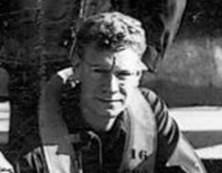
Lawrence Stewart 1922 - 2013
Lawrence Stewart 1922 – 2013
Bio: Born in Minnesota, Stewart joined the Army Air Corps at the outbreak of WWII and became a B-29 flight engineer with the 6th Bomb Group. He was stationed on Tinian Island, Pacific Theater, in 1945 where he completed 35 combat missions over Japan. He retired from the USAF Reserves in 1963.

PACIFIC WAR – OVERVIEW
Brief overview of the Pacific War 1941-1945 >

B-29 DEVELOPMENT
Designing the world’s most advanced bomber >