Pacific War Strategy – The Advance to Japan
Kent Vincent
6th Bomb Group Association
© 2026 Kent Vincent
On December 7, 1941, the Japanese Imperial Navy severely crippled the American Pacific Fleet at Pearl Harbor through a surprise carrier-based aerial attack that destroyed or damaged 19 U.S. ships, destroyed 169 U.S. Navy and Army Air Corps planes and killed 2403 service members. Days later, Japan virtually eliminated the remaining opposing military power in the Pacific through devastating attacks on U.S. and British territory bases in the Philippines, Guam, Wake, Hong Kong and Malaya. Militarily unopposed, Japan achieved military dominance in the Pacific by June 1942, occupying a vast new empire and defensive perimeter of airfields and bases extending from western Alaska in the North Pacific to the Solomon Islands in the South Pacific, including eastern China, Korea, Burma, Thailand, French Indochina, Malaya, the Philippines, Dutch East Indies and New Guinea.

Japanese Empire June 1942 – National WW2 Museum. CLICK TO ENLARGE
Island-Hopping Strategy
THE GOAL WAS TO ESTABLISH A CHAIN OF PACIFIC ISLAND BASES TO BRING THE GEOGRAPHICALLY ISOLATED ISLANDS OF JAPAN WITHIN BOMBER AND LAND ASSAULT RANGE
Following the devastating Pearl Harbor attack, Roosevelt’s declaration of war with Japan and through much of 1942, the joint military leadership of General Douglas MacArthur and Admiral Chester W. Nimitz developed a Pacific War Strategy to defeat Japan that became known as “island-hopping”. The goal was to seize and establish a chain of Pacific Island bases to bridge and provide defended supply lines for U.S. forces across the thousands of miles of open ocean to bring the geographically isolated islands of Japan within bomber and land assault range.
The progressive “island-hopping” offensive was designed to:
- save American lives and speed the march to Japan by bypassing heavily fortified Japanese island positions too costly to capture
- seize lightly defended nearby islands with flat terrain to establish the strategic forward airfields and naval bases
- neutralize the bypassed Japanese positions by cutting off their supply lines
The strategy relied heavily on newly developed mobile warfare tactics. Naval task forces centered around aircraft carriers would provide air superiority, protecting specialized landing craft during assaults on coastal beaches.

General Douglas MacArthur

Admiral Chester W. Nimitz

The Home Front Was Critical to Winning WWII
The United States, however, would not be in a position to launch its Pacific War Strategy until August 1942 at the Battle of Guadalcanal. MacArthur and Nimitz needed men, ships, amphibious landing craft and munitions that weren’t available. This was due to several critical factors:
- Japan’s destruction of the U.S. Pacific Fleet and its forward bases in the Pacific stripped the Navy of the assets, superiority and firepower needed to mount and protect an invasion fleet. The Japanese had absolute air and naval superiority in the Pacific following the Pearl Harbor attack.
- Development of the amphibious landing craft and equipment needed to seize fortified enemy beaches was in its infancy and not yet produced.
- Years of isolationism and Congressional underfunding of the military left U.S. troop strength too low and unprepared to fight the Japanese military
- A “Europe First” strategy sent the majority of available American troops, equipment and resources to fight Nazi Germany, leaving the Pacific Theater underfunded and underequipped during the early months of the war
THE U.S. SPENT THE FIRST SIX MONTHS OF THE PACIFIC WAR IN A DESPERATE DEFENSIVE STRUGGLE
The U.S. spent the first six months of the Pacific War in a desperate defensive struggle while the massive peacetime industrial might of the U.S. was rapidly transformed domestically to mass produce the ships, planes, military vehicles, weapons and ammunition that would sustain and dominate the war in both Europe and the Pacific. Some 10 million American men joined the military directly following the attack and began training.
Turning Points
Early defensive victories in the carrier Battles of the Coral Sea in May and Midway in June 1942 allowed the U.S. to shift from purely defensive posture to offensive. U.S. carriers were fortunately not at Pearl Harbor during the attack.

The five-day Battle of the Coral Sea was a strategic victory for the Allies in checking Japanese expansion. U.S. carrier aircraft prevented Japanese ships from landing troops by sea at Port Moresby at the southern tip of New Guinea, thereby keeping the vital sea lanes between Australia and the U.S. open and easing the immediate threat of Japanese invasion of Australia. Importantly, inflicted damage prevented two Japanese carriers from participating in the critical Battle of Midway the following month.

Carrier Shoho torpedoed Battle of the Coral Sea
THIS SIGNIFICANT JAPANESE DEFEAT RESTORED NAVAL PARITY ALLOWING THE U.S. TO TAKE THE OFFENSIVE
During the Battle of Midway, U.S. Navy fighter planes from its three Pacific aircraft carriers ambushed and sank four Japanese carriers near Midway Island. U.S. intelligence decoded elaborate Japanese plans to trap the U.S. carriers allowing Nimitz to position his smaller fleet for the surprise ambush. Along with the loss of four carriers, Japan lost hundreds of highly trained naval pilots. This significant Japanese defeat restored naval parity allowing the U.S. to take the offensive with its island-hopping strategy starting with Guadalcanal.

USS Yorktown Battle of Midway June 4, 1942
VICTORY AT GUADALCANAL SHIFTED THE MOMENTUM OF THE WAR AND PUT JAPAN ON THE DEFENSIVE FOR THE REMAINDER OF THE CONFLICT
The Battle of Guadalcanal in the Solomon Islands off the northeast coast of Australia was a crucial turning point in the war. It marked the first major Allied land offensive and the first major defeat of the Imperial Japanese Army in the Pacific. Fought from August 1942 through February 1943, the Allies seized the island and its strategic airfield providing a vital hub for air power and eliminating Japanese use of the base to sever vital shipping routes. It was America’s first coordinated land, air and sea offensive of the Pacific War and tested the newly developed Higgins amphibious landing craft. The brutal six-month campaign resulted in staggering losses, including roughly 24,000 to 30,000 Japanese deaths and 1,600+ American killed in action, alongside dozens of warships sunk in the surrounding waters. The Allied victory at Guadalcanal shifted the momentum of the war and put Japan on the defensive for the remainder of the conflict.
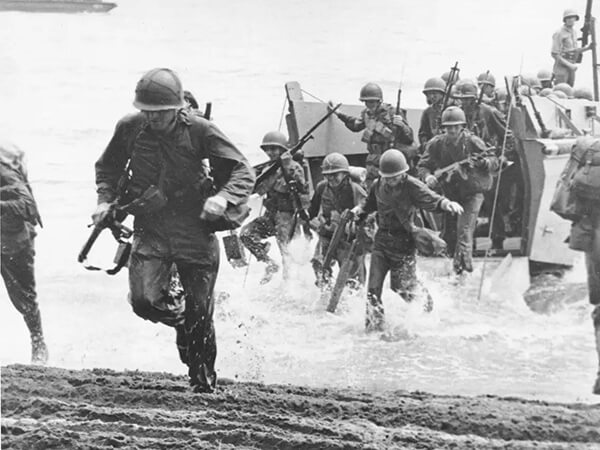
U.S. Assault on Guadalcanal
Following each island capture, Navy Construction Battalions (Seabees) immediately built or repaired airstrips (typically 2–4-day construction) for Allied fighters and bombers to establish air and naval supremacy around bypassed strongholds to isolate them and protect Allied supply sea lanes. U.S. submarines targeted Japanese oil tankers and merchant vessels breaking Japan’s logistics network.
Two-Pronged Advance Strategy
Assigned in March 1942 and beginning with the landing at Guadalcanal, the U.S. launched a two-pronged advance strategy across the Pacific to keep Japanese forces “off balance” and maximize resource efficiency.
- The Southwest Pacific Axis advance was led by General MacArthur in a predominantly land and air-based drive by the army and marines up the northern coast of New Guinea, through the Solomon Islands to The Philippines.
- The Central Pacific Axis advance was led by Admiral Nimitz in a predominantly naval and marine-led offensive involving massive amphibious assaults up the Pacific, seizing the Gilbert, Marshall and Mariana Island chains.
Critical Capture of the Mariana Islands – B-29 Bombing Campaign
THE MARIANAS PUT THE U.S. WITHIN BOMBING RANGE OF AMERICA’S NEW GAME-CHANGE LONG-RANGE BOEING B-29 BOMBER
The most strategically important capture of the “island-hopping” campaign was the Northern Mariana Islands: Saipan, Tinian and Guam, seized between June 15 and August 1, 1944. Located 1500 miles south of the home islands of Japan, the Marianas put the U.S. within bombing range of America’s new game-change long-range Boeing B-29 bomber.

Marines ashore on Tinian

Great Marianas Turkey Shoot
THE BATTLE EFFECTIVELY DESTROYED JAPAN’S NAVAL AIRPOWER AND ABILITY TO CONDUCT LARGE-SCALE AIRCRAFT CARRIER OPERATIONS
Coincident with the U.S. invasion of Saipan, the U.S. and Japanese navies clashed in the largest aircraft carrier battle in history, the Battle of the Philippine Sea (June 19 – 20, 1944 aka The Great Marianas Turkey Shoot). The battle involved 24 aircraft carriers and roughly 1350 carrier-based aircraft in the waters west of the Mariana Islands. Japan attempted to defeat the U.S. Carrier Task Force supporting the invasion in a decisive battle to halt the American advance and protect its inner defensive perimeter bases at the Marianas. Through superior technology in radar and proximity fuses, American pilots and anti-aircraft gunners shot down roughly 600 Japanese aircraft and sank three Japanese aircraft carriers in two days, effectively destroying Japan’s naval airpower and ability to conduct large-scale aircraft carrier operations.
Once secured, over 15,000 Navy Seabees built massive air bases for 21 Army Air Force B-29 bomb groups (45 B-29s each) on the three Mariana islands in record time including roads, harbors, hospitals and eleven 8500-foot runways. B-29s began arriving from the U.S. mainland in October 1944, refueling at Oahu, Hawaii and air bases (principally Kwajalein, Marshall Islands) captured and constructed months earlier as part of the island-hopping campaign.

North Field on Tinian Island in the Marianas – launching point for the atomic bomb drops on Hiroshima and Nagasaki, Japan. ©Bill Webster. All Rights Reserved.
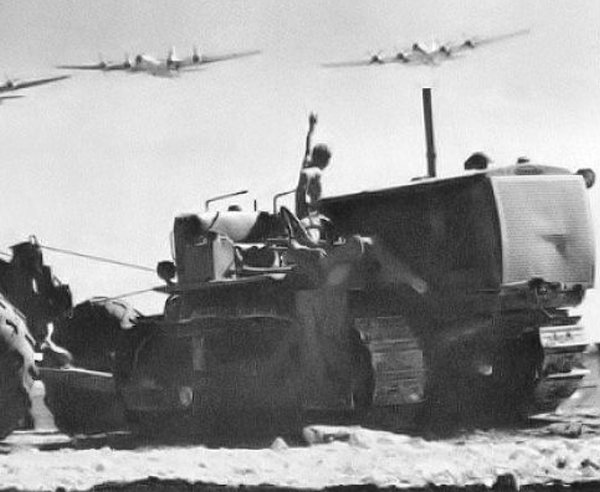
TINIAN ISLAND CAPTURE & CONSTRUCTION

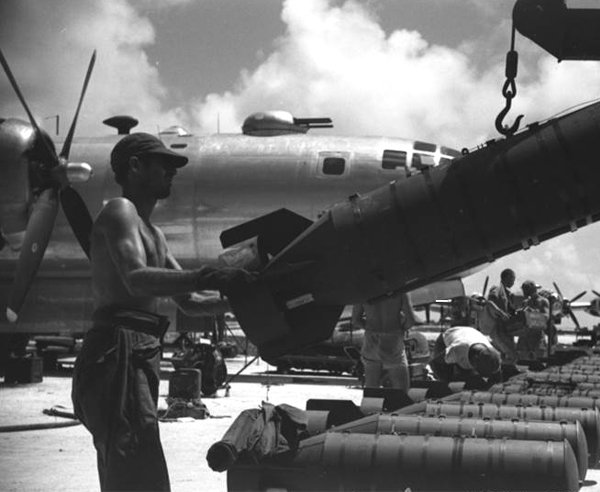
THE JAPANESE ECONOMY AND MILITARY INDUSTRY WERE DESTROYED ALONG WITH 66 JAPANESE CITIES BY B-29S
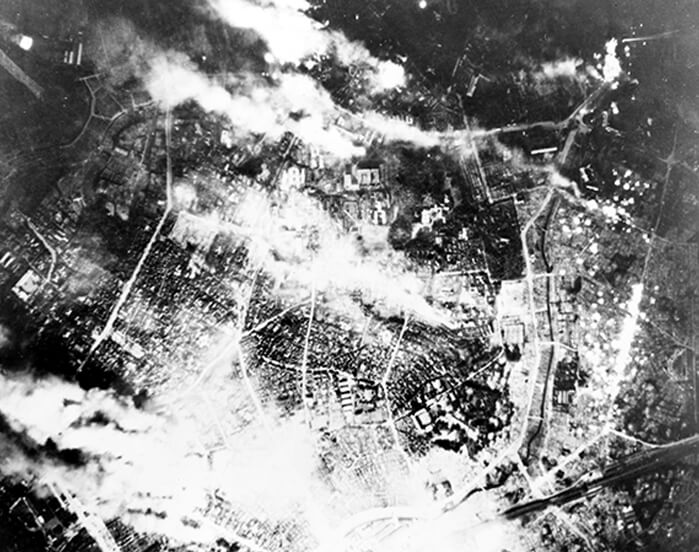
The devastating B-29 bombing campaign of Japan from the Marianas began November 24th. Individual bombing missions often included 200-300 coordinated B-29 bombers. Between November and July 1945, the Japanese economy and military industry were destroyed along with 66 Japanese cities by B-29s. The two atomic bombs dropped on Hiroshima and Nagasaki in August 1945 that brought Japan’s surrender were flown by B-29s from the base at North Field, Tinian Island in the Marianas. The 6th Bomb Group was also assigned to North Field.
The decisive impact of the B-29 bombing campaign and consequent “early” Japanese surrender, cancelled the planned final amphibious Allied land assault on Japan (Operation Downfall) saving millions of Japanese and Ally lives.
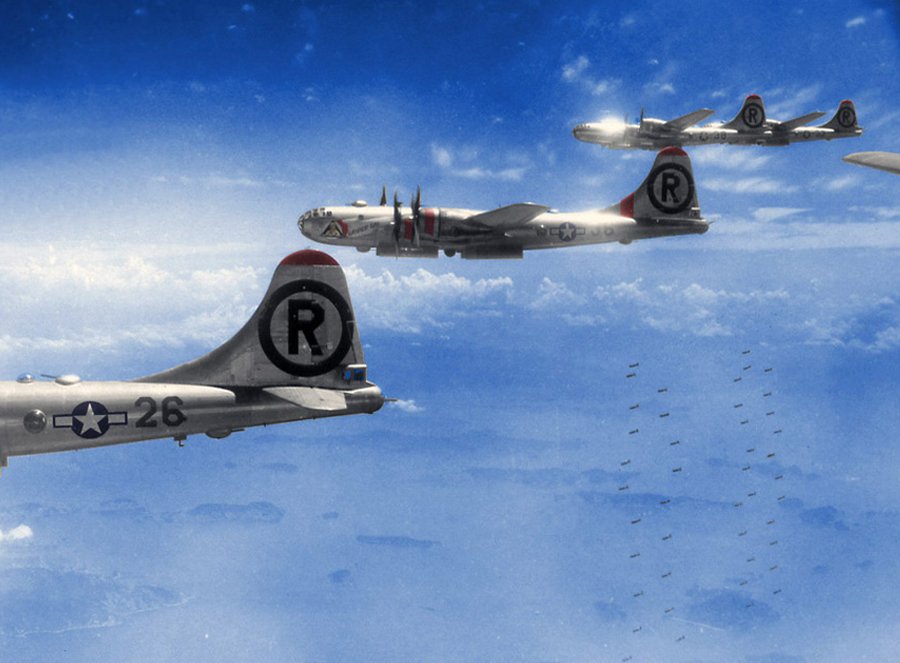
Bombing of Japan 1945 | B-29 Bombers Halfway Home - WWII - The Pacific War. Photo: John Potenza. All Rights Reserved.


Marines attack Iwo Jima
IT WAS THE ONLY PACIFIC WAR BATTLE WHERE TOTAL AMERICAN CASUALTIES EXCEEDED THAT OF THE JAPANESE OPPOSING FORCES
Early in the B-29 bombing campaign, U.S. Marines captured the island of Iwo Jima halfway between the Mariana Islands and Japan on March 26, 1945 to establish emergency landing strips for damaged B-29s returning from Japan, stop Japanese air attacks on U.S. Marianas bases and to establish a base for American P-51 fighter escorts. The 36-day Battle of Iwo Jima was the bloodiest single Marine battle of the war. Nearly 7000 mostly Marines and Navy personnel were killed, roughly 19,000 wounded. It was the only Pacific War battle where total American casualties exceeded that of the Japanese opposing forces.
Recapture of the Philippines
The recapture of the Philippines (1944-1945) was one of the most critical and bloody campaigns of the Pacific War. Sitting at the geographic crossroads between Japan and the South Pacific, re-established U.S. bases in the Philippines allowed the Allies to block Japanese shipping channels for war-critical rubber, oil and bauxite it sourced from conquered territories in Southeast Asia. The islands re-established the deep-water ports, key functional naval yards and massive airfields the Allies needed for the planned final amphibious land assault on Japan (Operation Downfall).
JAPAN SUFFERED SUCH HEAVY LOSSES IN BATTLESHIPS, CARRIERS AND CRUISERS THAT ITS NAVY CEASED TO EXIST AS AN EFFECTIVE FIGHTING FORCE

Battle of Leyte Gulf
Importantly, the Allied decision to invade the Philippines forced Japan to commit the remainder of it naval fleet to a counter attack at the Battle of Leyte Gulf (October 23-26, 1944), the largest naval battle in history at the time, which devastated its Navy. Japan suffered such heavy losses in battleships, carriers and cruisers that its Navy ceased to exist as an effective fighting force giving the Allies undisputed command of the Pacific.
The liberation of the Philippines from Japan lasted 5.5 months, with General MacArthur declaring liberation on July 5, 1945.
Capture of Okinawa – Operation Downfall
The massive amphibious land invasion of the Japanese home islands, Operation Downfall, was planned for November 1945. It was to be fought primarily by U.S. and British forces under the direction of General MacArthur and Admiral Nimitz. Located just 400 miles from the Japanese mainland, the island of Okinawa was to serve as the crucial forward staging area and air base for the operation and last island to be taken in the island-hopping strategy.
THE EXTREME LOSS OF LIFE AND FIERCE JAPANESE RESISTANCE AT OKINAWA HEAVILY INFLUENCED PRESIDENT HARRY S. TRUMAN’S DECISION TO USE ATOMIC WEAPONS LATER THAT YEAR TO AVOID A MAINLAND GROUND INVASION
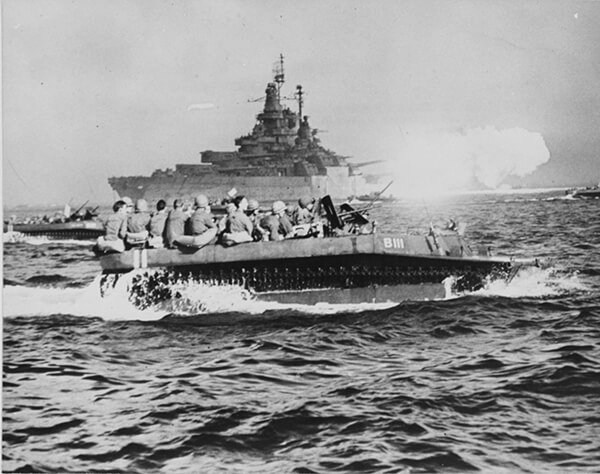
USS Tennessee Bombards Okinawa April 1945
The Battle of Okinawa (April 1 – June 22, 1945) was the largest and bloodiest amphibious assault of the Pacific War. Japanese forces entrenched themselves in a formidable network of defensive caves, ridges and tunnels in the rugged terrain of the island and launched massive suicide air raids sinking a total of 30-36 Allied ships with high naval casualties. The nearly three-month battle resulted in over 12,000 American deaths, more than 100,000 Japanese military deaths and an estimated 100,000 to 150,000 Okinawan civilian casualties. The extreme loss of life and fierce Japanese resistance at Okinawa heavily influenced President Harry S. Truman’s decision to use atomic weapons later that year to avoid a mainland ground invasion.
Economic Strangulation Strategy
THE AGGRESSIVE STRANGULATION CAMPAIGN CUT JAPAN’S TOTAL IMPORTS BY 90%, NOT ONLY STARVING FACTORIES AND THE MILITARY BUT THE POPULATION AS WELL
U.S. military planners developed a highly effective, multi-layered strategy designed to starve the resource-poor Japanese Empire of the raw materials required to sustain its military and population. The island nation was deeply dependent on maritime imports for vital resources: 90% of its oil, 88% of its iron and 20% of its food came from overseas. The strategy was principally divided into two campaigns:
- Unrestricted submarine warfare against merchant shipping lanes
- Mass aerial mining of Japanese domestic ports, straits and internal waterways by B-29 bombers (Operation Starvation March – August 1945)
By mid-1945, the aggressive strangulation campaign cut Japan’s total imports by 90%, not only starving factories and the military but the population as well.
Submarine Warfare
U.S. submarines began sinking Japanese merchant ships immediately after the outbreak of the Pacific War, receiving official orders for unrestricted submarine warfare directly after the Pearl Harbor attack. During the first two years through late 1943, however, U.S. submarines were largely ineffective due to deeply flawed Mark 14 and Mark 15 torpedoes. U.S isolationism and depression era Congressional budget cuts left American submarines with broken, untested weapons for the first 21 months of the conflict.
The turning point for submarine warfare occurred in January 1943 when the U.S. Navy broke the Japanese merchant “maru code” allowing vessels to intercept shipping lanes with great accuracy. Then, in September 1943, the major engineering defects of the Mark 14 torpedo were resolved. Thereafter submarines went on to sink over 50% of all Japanese merchant and naval shipping by the end of the war.

Periscope view of torpedoed Japanese merchant ship
Operation Starvation
In coordination with the U.S. Navy, the U.S. Army Air Force used Marianas-based B-29s to precisely lay over 12,000 advanced sea mines in the harbors and inland waterways of Japan (some Korea harbors as well) starting in March 1945. The purpose was to sever Japan’s vital maritime lifelines, supply routes and imports as well as strand Japanese navy vessels in port at the time of the Battle of Okinawa. The magnetic, acoustic and pressure-activated advanced influence mines made mine sweeping difficult.
OPERATION STARVATION PROVED TO BE THE MOST EFFICIENT ANTI-SHIPPING CAMPAIGN OF THE PACIFIC WAR
Operation Starvation proved to be the most efficient anti-shipping campaign of the Pacific War, sinking more merchant and military tonnage (670 vessels sunk or damaged) in the final five months of the war than all other American air and submarine efforts combined during that time. It brought Japan’s domestic economy and heavy industry to a near-total collapse.

Mining Missions – OPERATION STARVATION
Critical Impact of the Home Front
THE PACIFIC WAR WAS WON AS MUCH (IF NOT MORE) ON THE HOME FRONT AS IT WAS ON THE BATTLE FRONT
The Pacific War was won as much (if not more) on the home front as it was on the battle front. In 1941, the US standing military was remarkably small due to a powerful isolationist movement and Congressional underfunding —ranking behind much smaller European nations in active personnel. The U.S., however, possessed by far the world’s largest industrial base, producing vastly more steel, oil, and aluminum than Japan. Once mobilized to the war, American personnel, innovation, shipbuilding, aircraft and munitions mass production rapidly built the U.S. military into the world’s super power with the ability to replace losses at a scale Japan could never match.
Strength Following Pearl Harbor Attack
Directly following the attack on Pearl Harbor, the U.S. Pacific Fleet was left with approximately
- 50 operational warships (3 aircraft carriers, 1 battleship, 21 cruisers, 50 destroyers and 33 submarines)
- fewer than 450 operational combat aircraft
- a total force of roughly 150,000 personnel in the Pacific theater.
The Imperial Navy by comparison had
- 240-290 combat ships (10 aircraft carriers, 10 battleships, 38 cruisers, 120 destroyers, 68 fleet and roughly 50 midget submarines)
- 2000-3500 combat aircraft (430 carrier aircraft)
- 450,000 battle-hardened soldiers out of a 2 million active-duty military devoted to the Pacific theater.
Massive U.S. Industrial Contribution to the Pacific War
Through overwhelming industrial output during the war, American manufacturers built
- 100+ aircraft carriers, including 17 large Essex-class fleet carriers, plus 54,000 landing craft and assault ships for the Pacific theater
- nearly 275,000 military aircraft (split between European and Pacific theaters), including tens of thousands of naval and carrier-capable aircraft
THIS MASSIVE INDUSTRIAL SURGE COMPLETELY RESHAPED NAVAL WARFARE
This massive industrial surge completely reshaped naval warfare. By early 1944, American industrial output allowed the U.S. Navy to deploy the Fast Carrier Task Force (TF 38/58), a mobile strike force of unprecedented scale, used extensively in the island-hopping campaign, that secured absolute air and naval supremacy across the Pacific.

Task Force 58 Fast Carrier Task Force

Task Force 58 – WWII’s largest naval formation
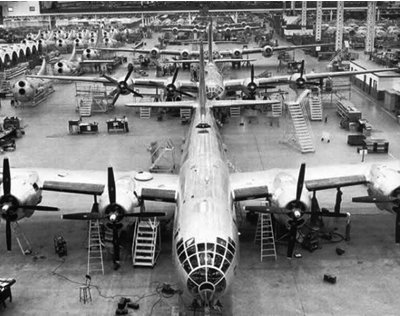
3970 B-29S WERE BUILT BETWEEN 1944 AND 1946
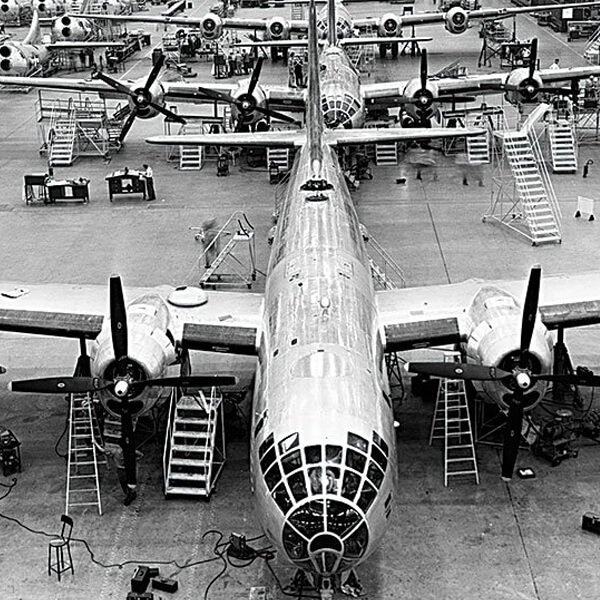
The state-of-the-art B-29 bomber was produced through an unprecedented, highly coordinated mass-production program that mobilized hundreds of peacetime companies, massive government-built factories and a vast network of subcontractors. 3970 B-29s were built between 1944 and 1946. By the end of the war, peak production reached 375 aircraft per month. The mass deployment of B-29s and trained crews was coordinated with Nimitz’s capture and base construction of the Mariana Islands.
War of Attrition
The Pacific War was a colossal naval and air conflict that resulted in the sinking of thousands of combat and merchant vessels, and loss of tens of thousands of aircraft. According to official estimates,
Japanese losses:
- 3032 ships
- 51,118 aircraft
Allied losses:
- 350 major combat and auxiliary ships
- 38,000 aircraft
WHILE THE U.S. READILY REPLACED LOSSES, IT SIMULTANEOUSLY EXPANDED ITS FLEET INTO HISTORY’S LARGEST NAVY
While the U.S. readily replaced losses, it simultaneously expanded its fleet into history’s largest navy. The once dominant Japanese Navy and merchant marine, on the other hand, were almost wiped out. Japan built the majority of its wartime naval and merchant shipping tonnage prior to 1944, before its industrial capacity collapsed under Allied submarine supply line blockades of critical steel, oil and other military raw material imports and the devastating loss of its military industry from B-29 bombing in 1945.
WHAT BEGAN AS A COUNTRY CAUGHT UNPREPARED AND MILITARILY VULNERABLE ENDED IN THE U.S. EMERGING AS THE WORLD’S ECONOMIC AND MILITARY SUPER POWER
The overall strategy developed by the U.S. to defeat Imperial Japan worked extremely well combining industrial superiority, military innovation, naval breakthroughs and the “island-hopping” approach. What began as a country caught unprepared and militarily vulnerable ended in the U.S. emerging as the world’s economic and military super power.
The Pacific War (1941-1945) cost an estimated 93,000 American lives (additional 208,000 wounded) and more than 2 million Japanese lives.