Kent Vincent
6th Bomb Group Association
© Kent Vincent 2025
During the low level nighttime firebombing raid over Osaka on March 13, 1945, a Japanese military arsenal violently exploded hurling a directly overhead B-29 upward 5000 feet, flipping it upside down and into a slow roll, high speed death dive to the ground. The enormous forces stressed the fuselage, warped the ailerons, blacked out all cockpit and instrument lighting and ripped the pilots’ hands from the controls. Against all odds, the crew survived due to an unexpected miracle.

Blast inverted B-29. Artist: Floyd B. Stubbs. B-29 image courtesy of Floyd B. Stubbs Estate
The plane, named the Bataan Avenger, was assigned to the 6th Bomb Group, 24th Squadron crew of Capt. Paul E. Jones (crew 2403) stationed on Tinian Island. The Osaka raid was its first mission, having just been assembled and freshly delivered from the Boeing Wichita Plant a week earlier. As was not uncommon, the plane was pre-named before arrival. The citizens of Junction City, KS and nearby Fort Riley earned the right to sponsor and name it by selling $500K in a special War Bond dedicated to “Avenge Bataan”. This was a popular American rallying cry for War Bonds following the horrific Bataan Death March in April 1942.

An early picture of the “Bataan Avenger”. Photo courtesy of Frank Barrella

Capt. Paul E. Jones and crew
The Osaka mission (6BG Mission 12) , codenamed Peachblow #1, was a maximum effort incendiary raid, one of the Blitz missions, involving 298 B-29s collectively based on Saipan, Tinian and Guam. Thirty aircrews participated from the 6th Bomb Group. They were among the last to depart, which was least favored by the aircrews since the fires set by the forward planes meant strong thermal turbulence for those that followed. And their assigned bombing altitude was set low at 5000 feet. The Osaka Army Arsenal was a major target of the bombing. The huge (150 acres) munitions complex included its own steel mill and chemical plant and produced guns, shells, bombs and explosives.
“THEIR AIRPLANE HAPPENED TO BE DIRECTLY ABOVE THE ARSENAL WHEN IT BLEW UP WITH A TREMENDOUS BLAST. THE B-29 WAS HURLED UPWARD ABOUT 5,000 FEET, FLIPPED UPSIDE DOWN, WENT INTO A SLOW ROLL AND PLUMMETED TOWARDS THE GROUND”
The planes of the 6th reached target just after 3:30 am releasing their incendiary bombs by radar at a ground speed of 300 mph and elevation of 5000 feet (see Kearney memoir). There was light cloud cover and the turbulence from the already set fires was “bad”. Capt. Jones had just banked Bataan Avenger away from target when it was violently blasted skyward and flipped over. According to 24th Squadron Flight Engineer Lawrence Stewart (see memoir). “their airplane happened to be directly above the arsenal when it blew up with a tremendous blast. The B-29 was hurled upward about 5,000 feet, flipped upside down, went into a slow roll and plummeted towards the ground.” Word of the explosion was reported during 24th Squadron debriefing from crews in the B-29 bombing stream.
“OUR PILOTS’ HANDS HAD BEEN TORN FROM THE CONTROLS AND PINNED IN THEIR LAPS BY THIS TERRIFIC FORCE”
Jones’ Flight Engineer, Stanley J. Thomson recalled the horrifying incident:
“As we got over our aiming point and turned on track we opened the bomb bay doors and dropped our bombs in train. As the doors snapped shut, we were tossed up like a missile, then rolled over into a dive. Our pilots’ hands had been torn from the controls and pinned in their laps by this terrific force. Both Jones and Hurd [co-pilot] were yelling, encouraging the other to get a hand on the control column as we dived toward the ground.”
“I checked my instrument panel and noted that the airspeed indicator was moving past 360 mph (past redline indicator) at a fast rate. As flight engineer I sat just behind the co-pilot’s seat facing aft to monitor my instrument panel. I turned to glance at the pilots, realizing that the tremendous centrifugal force had demobilized both pilots. Finally I noticed that Hurd was able to overcome the force and had grasped his control column. Moments later Jones got his hands on his wheel and they were finally able to pull together to try and bring the aircraft under control. At this point all lights in the cabin were out.” This included the instrument panel lights.
THE PILOTS WERE FLYING BLIND, UPSIDE DOWN AND IN A HIGH SPEED DEATH DIVE
“But I noticed that the pilots’ instrument panels were now visible because of a flashlight that had mysteriously come on during the struggle to gain control of the plane, helping the pilots to read instruments enough to finally get the aircraft under control before crashing into the ground.”
THROUGH THE VIOLENT ORDEAL, THE FLASHLIGHT HAD MIRACULOUSLY BROKEN LOSE, BANGED “ON” AGAINST THE COCKPIT WALL AND SUFFICIENTLY ILLUMINATED THE COCKPIT FOR THE PILOTS TO READ THEIR INSTRUMENTS.
According to Jones, “the air speed indicator needle was pointing to 60 and, assuming it was 160 miles per hour, I was afraid we might stall out. As we righted the plane and started to gain altitude, I saw the needle start to unwind. I picked up the flashlight and saw we had been indicating 360 miles per hour.”
‘‘I ESTIMATED THAT WE WERE NO HIGHER THAN SIX OR SEVEN HUNDRED FEET ABOVE THE GROUND BEFORE THE PILOTS STOPPED OUR ALMOST CERTAIN DEATH DIVE INTO THE GROUND’’
“I looked forward one more time” said Thomas, “and I could see men and women running through their fenced yards trying to escape the fire. I estimated that we were no higher than six or seven hundred feet above the ground before the pilots stopped our almost certain death dive into the ground. I had said my final prayers moments before.”
“As soon as Jones and Hurd could compose themselves we started a climb as we headed toward the coast and a bit more safety. We leveled off at about 15,000 as we crossed the coast and set our course to Tinian. We checked the aircraft as best we could and had a roll call with the crew in the rear to see if everyone and everything came through the frightening ordeal OK. I remember getting the shakes at this time – a delayed reaction to the experience.”
“As Skip Ellis [Navigator] gave the return heading to Tinian and I attempted to set normal cruise power on the engines, it became apparent that the Bataan Avenger had suffered some severe damage. It now required power settings which used twice normal fuel consumption for our altitude, weight and cruise airspeed. The only airstrip between Japan and Tinian was Iwo Jima and the battle was still being fought for the island. As we flew on, it became obvious that we would be lucky to reach Iwo. Jones informed the crew that we had only two choices if we got there: parachute onto the island or into the ocean, or try landing the wounded plane on a very short runway.”
“We finally reached Iwo and the crew elected to stay with the plane for an attempted landing, even though there were shell holes in one end of the runway. After our successful landing we were told that one B-29 which had landed there a day or two before had ended up in one of the holes. We spent the night on Iwo Jima and after checking over the plane and refueling we took off for Tinian. Despite a most horrifying death defying experience the Bataan Avenger brought the entire crew safely back to our home base.”

Iwo Jima Island 1945

Lt. General Jonathan Wainwright with Bataan Avenger at Boeing Seattle plant
The Bataan Avenger went on to fly an additional 12 missions before being grounded. Fuselage stress and warped ailerons caused by excessive forces associated with the inversion incident dogged each mission with fuel inefficiency and flight leveling issues. After the war, the Avenger was flown to the Boeing Seattle plant where she received a major overhaul. While there, it was visited by Lt. General Jonathan Wainwright, the senior commander of U.S. forces in the Philippines when it fell to Japan in April 1942. He was forced to endure the Bataan Death March, for which the plane was named, and survive three years of Japanese atrocities as the highest ranking American prisoner of war.
Boeing issued a news release soon after the plane’s arrival telling the story of the inversion using the pilots’ assumption that the plane was caught in a strong thermal updraft from the firebombing. Robert Ripley subsequently published a cartoon of the incident entitled The Flashlight Miracle through his widely syndicated Ripley’s Believe It or Not newspaper panel on October 26, 1945. The exact source of the explosion was not identified. Post-raid reconnaissance photos suggested most of the arsenal escaped major damage.
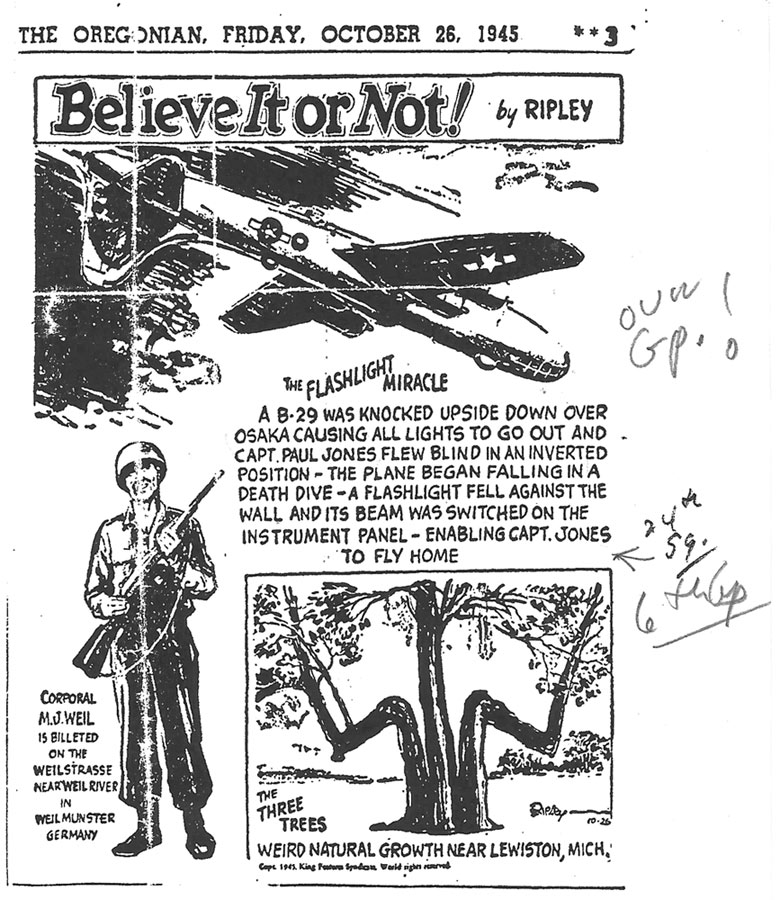
Ripleys Believe It or Not, "The Flashlight Miracle."
The Bataan Avenger did its part to avenge the atrocities of the Bataan Death March, but according to Chester Marshall’s research (see Acknowledgement below), it was never returned home to its sponsors in Junction City as hoped. It served briefly as a training plane and eventually an air tanker before being decommissioned. Capt Jones and his crew, however, did return home after the war, owing their lives to a well-designed and built B-29, excellent pilots and a miraculous flashlight.

Kent Vincent
Bio: Kent Vincent is the son of 6BG B-29 Aircraft Commander Edgar L Vincent, Tinian 1945. He is the 6th Bomb Group Association Director of Web Education and Editor of 6thbombgroup.com.
Acknowledgement:
This article is indebted to the heirs of B-29 pilot Chester Marshall, 73rd Bomb Wing, 499th Bomb Group, Saipan, 1944-45 who graciously allowed use of his research and writing on the Bataan Avenger for this article. The quotes from pilots Paul Jones and Stanley Thomson were obtained by Chester Marshall and included in his book:
Marshall, Chester. The Global Twentieth: An Anthology of the 20th AF in WWII, Vol 4, “Search for the Bataan Avenger”. Memphis, Marshall Publishers 1985

PACIFIC WAR – OVERVIEW
Brief overview of the Pacific War 1941-1945 >

THE B-29 BOMBER
Tour and specs of the most advanced bomber of WW2 >