
Lawrence Stewart
B-29 Flight Engineer
6BG, Tinian 1945
First publication July 2024
Original memoir copyright © 2024 Lawrence Steward. All Rights Reserved
Additional content copyright © 2024 6th Bomb Group Assoc. All Rights Reserved
Editor’s Note: Mining Missions is an excerpt from then 1st Lt. Lawrence Stewart’s first-person memoirs: Combat in the Pacific Theater – A B-29 Flight Engineer’s Experiences During World War II . Pictures, titles and highlights have been added to compliment the author’s writing.
We were informed that Admiral Nimitz of the United States Navy asked Air Force officials to schedule some B-29s to plant mines in Japanese waters. The intent was to keep remnants of the Japanese fleet, anchored in home waters, from interfering with the upcoming invasion of Okinawa which was scheduled to begin on 1 April [1945]. The mines were to be planted in the Shimonoseki Straits (6BG Mission 16) located between Kyushu and Honshu.
GENERAL LEMAY RESPONDED TO THE NAVY REQUEST BY ASSIGNING THE ENTIRE 313TH WING THE RESPONSIBILITY FOR THIS AND SUBSEQUENT MINING OPERATIONS
The purpose of the mining was threefold: to strangle enemy sea communications, to block any attempt by the Japanese to reinforce their troops stationed on Okinawa, and to keep the enemy fleet bottled up. General LeMay responded to the Navy request by assigning the entire 313th Wing the responsibility for this and subsequent mining operations.

Shimonoseki Straits
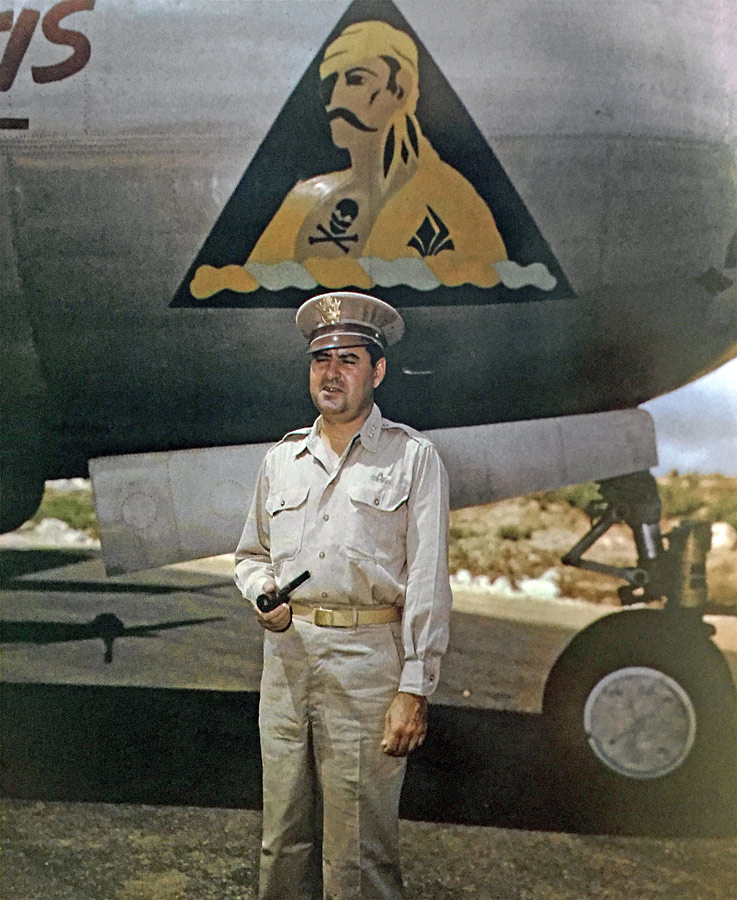
Major General Curtis LeMay in front of "Trigger Mortis." ©Martin E. Eichelman. All Rights Reserved.
THE SUPERFORTRESSES WERE IDEALLY SUITED FOR THIS TASK
The Superfortresses were ideally suited for this task. They carried radar equipment which could be used to pinpoint drop zones during nighttime. The crews could also plant mines under adverse weather conditions reaching remote areas where only B-29s could operate. Dropping the mines at night reduced the effectiveness of Japanese fighters and antiaircraft weapons. In addition, the night drop reduced the chances that the Japanese could locate the mines.
Navy personnel, experts in the handling and placement of underwater explosives, were present. They briefed us on the tactics for dropping a variety of mines. The majority of the mines were designed to be dropped below 10,000 feet. Each mine was equipped with a six-foot diameter parachute to slow the rate of descent, thereby reducing impact with the water. The parachute was automatically released upon entry into the water, allowing the mine to sink to the sea bottom.

Mine dropped by parachute

9th BG B-29 mine drop
EACH CREW WAS ASSIGNED TO A SPECIFIC LOCATION IN THE SHIMONOSEKI STRAITS DROP ZONE
To ensure that the mines were dropped into the designated area, the B-29 had to be at the exact designated location which was to be verified by radar. In addition, the airplane had to be at the correct altitude and airspeed. The drop required coordination of the pilot, bombardier, navigator and radar operator. Therefore, the bombardier was to release the mines upon command from the navigator with input from the radar operator and pilot. Navy briefers stressed the importance of accurately dropping the mines into selected areas. If any of the above conditions weren’t met during the mining run, the mines were not to be released. Each crew was assigned to a specific location in the Shimonoseki Straits drop zone to ensure proper coverage and to reduce overlapping of the mines.
THE MINES WERE MARVELS OF INGENUITY. THERE WERE ACOUSTIC, MAGNETIC AND PRESSURE MINES WHICH COULD BE PRESET TO DETER MINE SWEEPING AND TO EXPLODE WHEN THE DAMAGE WOULD BE THE GREATEST TO THE SHIPS PASSING OVERHEAD.
The mines were marvels of ingenuity. There were acoustic, magnetic and pressure mines which could be preset to deter mine sweeping and to explode when the damage would be the greatest to the ships passing overhead. Some of the mines were set to explode when the noise of the ship’s propellers activated the fuse and detonated the mine. Other mines were armed and detonated by the magnetic field of the ship’s steel structure. Another type of mine was armed by a ship counting mechanism. Each vessel passing over the mine activated a counter. After a predetermined number of ships had passed over the mine, the arming operation was completed and the mine was detonated by the next vessel passing over it.

Navy mines readied for B-29 deployment
THE MINES PLANTED BY THE 313TH BOMB WING SUPERFORTRESSES WERE APPARENTLY SINKING ENEMY VESSELS FASTER THAN THE NAVY’S SUBMARINES
We heard that Navy officials were highly pleased with our mining efforts. During April, eighteen Japanese ships had been sunk. In May, the count rose to eighty-five vessels sunk for a total of 213,000 tons sunk or out of action. During June, twenty-three more vessels, totaling 163,000 tons, were sunk. The mines planted by the 313th Bomb Wing Superfortresses were apparently sinking enemy vessels faster than the Navy’s submarines. Another effect of the mining was that Japanese ports were paralyzed for five to ten days at a time while mine sweeping efforts were undertaken.
Lawrence Stewart 1922 - 2013
Bio: Born in Minnesota, Stewart joined the Army Air Corps at the outbreak of WWII and became a B-29 flight engineer with the 6th Bomb Group. He was stationed on Tinian Island, Pacific Theater, in 1945 where he completed 35 combat missions over Japan. He retired from the USAF Reserves in 1963.

PACIFIC WAR – OVERVIEW
Brief overview of the Pacific War 1941-1945 >

THE B-29 BOMBER
Tour and specs of the most advanced bomber of WW2 >


