Walter B. Woodcock, B-29 Electrical Technician
9th Bomb Group, Tinian 1945
Original publication 9th Bomb Group Association 1995
Additional content © 6th Bomb Group Assoc. 2025

B-29 Ground crew PHOTO: ©David Wilhelm, son of Sgt Daniel L. Wilhelm (58th BW, 468th BG, 794th and 795th BS). All Rights Reserved.
Editor’s Note: Ground crews for the 6th and 9th Bomb Groups arrived by troop transport ship and established adjacent camps on Tinian December 28, 1944 three weeks ahead of the arrival of the B-29s and their air crews. Titles, pictures, links and highlights added to compliment author’s writing.
Austere Beginning
Marines with automatic rifles directed traffic as the trucks hauled us to our new home. Although the marines had secured the island five months earlier, fighting was still going on. There were seven hundred battle-seasoned and extremely annoyed Japanese soldiers in the high country. The island was only twelve miles long and never more than five miles wide. Mount Lasso was the high point, a flat topped mesa 564 feet above sea level. From Tinian Town the road narrowed between rows of Philippine mahogany and banyan trees. Beyond that on either side of the road the sugar cane, eight to ten feet high, extended to the moist jungle of rotting vegetation and fungus.
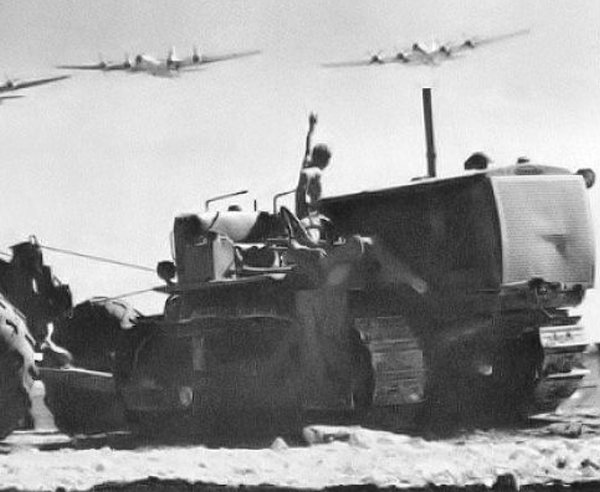
A SEABEE ON A CATERPILLAR PULLING A SHEEPSFOOT ROLLER WAS BREAKING DOWN THE SUGAR CANE TO ACCOMMODATE OUR CAMP
Our campsite was a point of land jutting into the sea on the west side of the island. A Seabee on a caterpillar pulling a sheepsfoot roller was breaking down the sugar cane to accommodate our camp. It took little time for us to pitch camp. I shared a tent with Jim McKinley; and as the sun sank into the western ocean, it tolled the end of the 28th day of December 1944.

Bomb Group Area locations. Source: Hellbird Handbook (462nd BG) p. 19
Back in June and July the marines drove a wedge through the central portion of the island. A lot of Japanese were killed, few surrendered, and many remained in the cane fields or caves. We could hear babies crying. In most cases they preferred to die rather than surrender. We rarely saw them in the daylight, but at night they were bold. Enlisted personnel were not issued firearms. Our officers considered it too risky. The 24th Infantry was assigned cleanup operations, but their commanding officer didn’t like the idea of a brush war. The Japanese could hide in places that were impossible for their infantrymen to find. He thought why risk his men’s lives foolishly digging Japanese out of caves or engaging them in hand to hand combat when the enemy would be pushed into the sea by occupation of the island by people like us.
MY CARBINE WAS MADE BY CAROLA, A JUKEBOX MANUFACTURING COMPANY
As it became obvious that it was we who were pushing the enemy into the sea, our officers agreed to issue firearms. I was issued a 30-caliber carbine and a half dozen rounds of ammunition. My carbine was made by Carola, a jukebox manufacturing company. The idea of defending myself with a weapon made by a jukebox company disturbed me. I traded it for a Thompson submachine gun, but it did not take long for me to discover that the machine gun was not for me. My supply of ammunition offered only a short burst of fire, and after that all I had was an unwieldy club. I swapped with Frenchy Veilleux for a carbine manufactured by Winchester. Since I had carried one at the ranch, I had trust in Winchesters.
One night on guard duty Don Ordahl and I sat back to back covering an indistinguishable wall of sugar cane, silhouetted black against a moonlit sky. As we watched the tops of the sugar cane part, I thought it was pigs. There were plenty of them running wild on the island, feeding on casualties of the war. I emptied a clip at ground level, expecting to hear a lot of grunting and squealing; but we heard nothing. Later we were told that our area was infiltrated. Two Japanese made off with a couple cases of rations, but as the intruders crawled into the can of an earth mover for an express ride out of the area, it turned out they boarded the wrong express. The Seabee operating the rig saw them in his rear view mirror and stopped his machine under the floodlights at the guard station.
WE WERE RATIONED TWO CANTEENS PER DAY WITH WHICH WE SATISFIED OUR THIRST, SHAVED, WASHED, AND LAUNDERED OUR SOCKS
Water was a precious commodity. We were rationed two canteens per day with which we satisfied our thirst, shaved, washed, and laundered our socks. One morning Eugene DiMiao found a jeep trailer half full of water parked in the area. He dug his soap and towel from his barracks bag and was lathering up his hairy chest when Major Jack Goodie arrived. With a big toothy Italian grin, DiMiao said, “Sure rained last night, didn’t it, sir?” “Rain hell,” said the Major, “You’re sitting in our drinking water.” Our lister bag had been punctured during the night, and the jeep trailer was the best substitute they could come up with.
OUR LATRINE WAS A SLIT TRENCH LOCATED AT THE LOWER END OF OUR AREA, AND USERS WERE ACCOMPANIED BY AN ARMED GUARD
Our latrine was a slit trench located at the lower end of our area, and users were accompanied by an armed guard. A blazing burst of gunfire sent an alarm through the camp; someone was in danger. John Schwab was the heroic defender; but the enemy proved to be a Seabee behind a coral rock, wanting only a moment of privacy. I was writing a letter when we heard an exchange of rifle fire. Jim McKinley and I went to a high point from which we could see Japanese and our infantry men exchanging fire, and then our infantry men opened up with flame throwers and burned the Japanese out of their cave below our camp. It was like sitting in the bleachers watching a rodeo, but this was no rodeo!
Japanese air raids came at night, and they usually hit Saipan. When our searchlights locked onto them, their aircraft lit up like bright stars in the sky. Our antiaircraft fire was spectacular, and sometimes they hit their target. Tokyo Rose announced the strikes on the radio and called the shots with such accuracy I bet money on her predictions; but when she predicted the recapture of Tinian, I did not bet. Major Goode ordered us to dig foxholes. I got a pick from supply, dug a foxhole, and put an open ended barrel in it to crawl into. What a wonderful day it was! We received our first mail, and I had a bundle of letters. When Major Goode checked the area, I was reading my mail beside my bonfire. He commended me on my foxhole but asked why in hell I would build a fire on top of my foxhole— “a bull’s-eye for a target.”
WE MOVED FROM PUP TENTS INTO SQUAD TENTS
Conditions on Tinian improved rapidly. We moved from pup tents into squad tents; and while I was enjoying a good sleep on a cot, dreaming about “Old Paint” and the ranch in Montana, “Wham!,” a blast blew the tent down. I woke up bound in canvas, scared stiff with the wind knocked out of my lungs. “Damn,” I thought, “that hit close!” I took inventory of my parts—arms, legs, and I wiggled my toes and fingers to be sure I was in one piece. When I came out from under the canvas, “My God!” I found the whole area in shambles, for all of our tents were down, and men were wandering around wondering what the hell had happened. Eventually we were told that a suicidal Japanese saboteur had blown up the Seabees’ explosives dump. A hundred-twenty tons of dynamite went up in the blast, debris scattered everywhere was all that was left of it and ten men of the 107th Seabee Battalion who were in the process of changing their guards when it happened.

Tent row on Tinian © Marty Eichelman

Seabee construction on Tinian. Navy.mil
OUR SQUAD TENTS GAVE WAY TO PLYWOOD BARRACKS
I admired the Marines and the Seabees. They did their job well, and in no place was that more evident than at North Field, which was a Japanese airstrip at the far end of the island near White Beach where the Marines made their landing. Japanese fortifications still contained the bodies of the dead. Grisly relics of war scattered everywhere, amphibious tanks, ammunition, grenades, helmets, and boots with feet in them. The Naval Logistics Construction Battalion or Seabees as they were known, came with bulldozers, and what had been a battlefield was soon a maintenance depot. The papaya grove became a taxiway. Four huge runways were under construction, 250 feet wide and 8,500 feet long. In a few short weeks Tinian Island changed from the devastation of war to a huge construction site. Highways encircled the island; mess halls, water and sewage facilities, outdoor theaters and recreation halls were built. Our squad tents gave way to plywood barracks, and the ox and oxcart that the fellows from Oklahoma had appropriated were condemned as being a traffic hazard.
Arrival of B-29s
ON THE 18TH OF JANUARY THE FIRST B-29 LAND[ED] ON TINIAN
On the 18th of January the Seabees joined us at North Field to welcome the arrival of the first contingent of our air echelon. Vehicles and men lined the runway as Lieutenant Raymond Johnson and his crew from the 99th Squadron of the 9th Bomb Group touched down in the first B-29 to land on Tinian. He came in low over White Beach and touched down only a short distance from where the marines had landed six months earlier. (Editor’s note: B-29s from the 6th Bomb Group began arriving the same day)

B-29s Landing on Tinian 1944

6th planes bomb Maug Island in training © 6th Bomb Group Association. All Rights Reserved
With the construction of North Field nearly completed, I was assigned to a brand new B-29, number 888, manufactured at the Renton factory near Seattle, Washington. Our Crew Chief was Glen LeGrand, and our ground crew consisted of James R. McKinley, Donald E. Tayson, Marion B. Thrasher, and myself as electrical technician. Our crew was one short, but inasmuch as I had completed the Aircraft Engine Technical School at Amarillo, I could work on engines, too.
Captain John H. Hobaugh and his flight crew were assigned to the airplane and flew their training missions on January 27th, 29th, and 31st, and February 6th over Japanese held islands of the Marianas. Hobaugh said, “I expect you members of the ground crew to fly in this airplane after you work on it.” I said, “I’ve been trying to do that from the time I enlisted as a cadet.” So Hobaugh took me with him. I wasn’t being paid for it—I was along for the ride, and Hobaugh wanted someone around who knew the airplane and was willing to get his hands greasy. That suited me fine, and I flew with them on the 31st over Rota, a small island between Tinian and Guam. I monitored functions with the crew, and the bombardier invited me to drop a bomb on a grounded freighter off the north end of the island. That was about the time General LeMay was transferred from India to replace Hansell in the Marianas. I was aboard the airplane again on the 9th of February. That was to be a training mission to bomb Moen Island in the Truk Atoll, but they chalked it up as combat after encountering heavy flak over the target area.
THE RENTON AIRPLANES WERE DESIGNED WITH A THIN WING WHICH DID NOT ACCOMMODATE FUEL TANKS OF SUFFICIENT CAPACITY TO GIVE THE AIRPLANE THE NECESSARY RANGE TO FLY TO JAPAN AND BACK
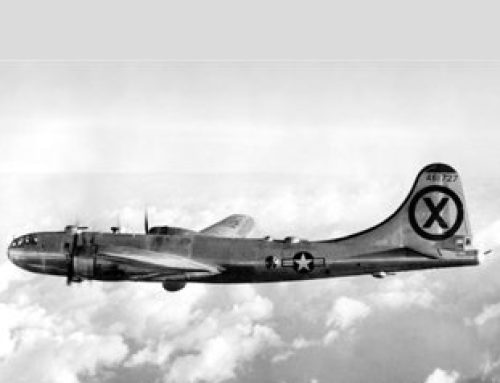
Later our Renton B-29, number 888, was replaced by B-29, number 544, manufactured by Bell Aircraft Company in Marietta, Georgia. The Renton airplanes were designed with a thin wing which did not accommodate fuel tanks of sufficient capacity to give the airplane the necessary range to fly to Japan and back. I was saddened to see 888 go, but 544 was a beautiful airplane.
After Colonel Eisenhart arrived, regulations were strictly enforced and ground crews were restricted to checkouts or slow time. No passengers or pets were permitted on combat flights. That had always been the case, but the decision had been left to the airplane commander. I was glad to have gone to Truk.
I gathered some bottles and went to the beach for target practice. While I was alone, pecking away at a bottle in the surf, I noticed warships gathering on the horizon. As they approached, I saw landing crafts group and move out toward me, and fighter planes lift from the deck of an aircraft carrier, circle and come in low at me. I was curious, wondering what the hell was going on, and then I went into shock. “Good God,” I thought, “It’s an attack! This was Tokyo Rose’s prediction. The Japanese are coming to retake Tinian Island.” I thought of all the money that I had won betting on her predictions. She called the shots, and there was nothing I could do. There was no time to give alarm and to get our planes in the air, and my only defense was five rounds of ammunition for my carbine and three beer bottles. I watched in absolute horror as the fighters bore in on me until the last moment when they pulled up, and I could see the insignia of the United States Navy on the bottom of their wings. I was observing a mock run for invasion of Iwo Jima.
Nuts and Bolts
GROUND CREWS PUT IN LONG HOURS OVER HOT ENGINES OR IN THE BAKING BOWELS OF THE AIRPLANE. IN MOST CASES A MECHANIC WAS ASSIGNED TO EACH ENGINE AND AN ELECTRICIAN TO EACH AIRPLANE
Lieutenant Archie L. Nash replaced Captain Hobaugh as commander of our airplane, and we became nursemaids to a new brood of flight crew, their welfare attached to every nut and bolt that we put our hands to. Glen LaGrand was our first crew chief, replaced later by Elmer Hampton. They were as conscientious as any persons I have ever known. The airplane was their baby, and they were mother hens to the flight crew. They were both knowledgeable of service procedures and knew much of the tech order by heart. For that which they didn’t know, they had available a dog-eared copy of the tech order that we could put our greasy hands on. Other ground crews would say the same of their crew chiefs, such as French Veilleux or Curly Klabo to name a couple as well as our maintenance officer, Major Norman E. Wienberg. They were regular Army men. In most part the ground crews were the product of months of tech schools. They put in long hours over hot engines or in the baking bowels of the airplane. In most cases a mechanic was assigned to each engine and an electrician to each airplane.

No. 2 Engine inspection

Ground crewman PHOTO: ©Chris Murphy. All Rights Reserved.
North Field thundered with activity. Our planes hit Nagoya on the 11th, Osaka on the 13th, Kobe on the 16th, Nagoya for the second time on the 18th and the Mitsubishi Aircraft Engine works on the 24th, and mined the Straits of Shimonoseki and the approaches to Hiroshima on the 27th and 30th. It was flown by Nash, but in late March Captain Burton E. Cox took his place as airplane commander, and the airplane was named “Cox’s Army.”
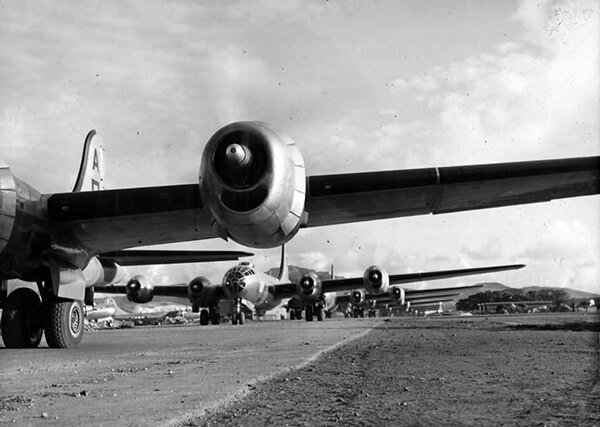
B-29s in line for take-off

Air Crew of Cox’s Army
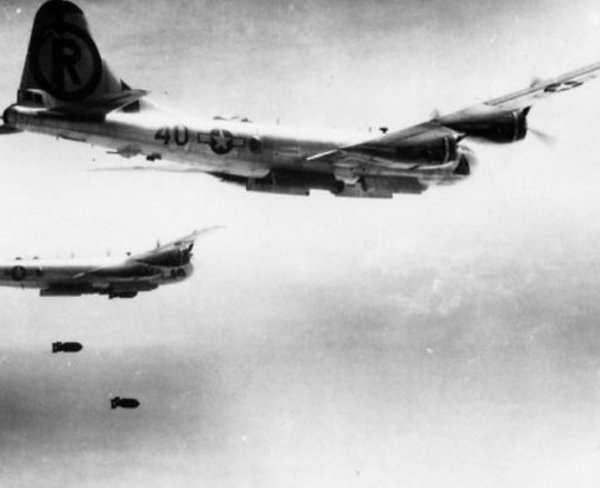
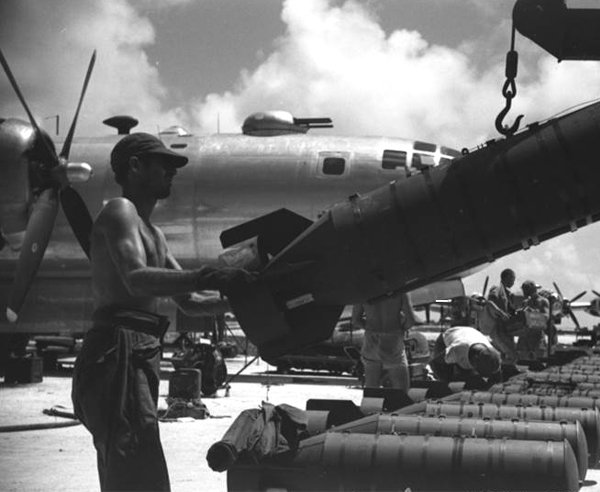
Our airplanes lumbered off the runway loaded with 7,000 gallons of gasoline and their bomb bays stuffed, either with firebombs or with general purpose bombs, high explosive bombs, or with mines (the ones with the untrustworthy salt arming washers—compliments of the Navy—that no one felt comfortable around).

B-29 take-off

Ground crew © Marty Eichelman. All Rights Reserved
OUR AIRPLANE WAS SCHEDULED TO FLY A MISSION EVERY FORTY-EIGHT HOURS
Weather permitting, which was not always the case over Japan, our airplane was scheduled to fly a mission every forty-eight hours. The group chalked up 261 missions during the month. Missions sometimes extended to fifteen hours in the air, and by the fifteenth hour every eye of the ground crew scanned the sky. Some never found what they were looking for. The ground crews were conscientiously aware that the lives of the air crew depended upon their skills. Oh! how happy I was when “Cox’s Army” would roll onto her hardstand and all of her crew came out without a scratch. Our plane was as smoky as a grilled sausage – but there was not a scar on her.

B-29 engine change © 6th Bomb Group Association
We studied the dog-eared tech orders and worked long hours maintaining and repairing battle-weary airplanes. I painted a little black bomb on the nose of “Cox’s Army” after every mission. Although she was weary and covered with soot, she picked up no serious battle scars, and none of her crew were injured. It was her engines that took the beating, but she got four new ones at Production Line Maintenance and went back into action.
It was over Uji-Yamada that “Cox’s Army” developed a strange malady. Her intervalometer ticked off the bomb shackles backwards, releasing the top bombs before the bottom bombs and filling the bomb bay with loose live, shifting bombs that couldn’t find their way out. When the bombardier got the message, he jettisoned the works, but some bombs became wedged and stuck in the bulkheads, and the crew had to pry them out and dump them overboard by hand. Because of their swift and decisive action the bombs didn’t explode in the airplane, but the crew did when they got home. They exploded at crew chief and then at me, the electrical technician. I fully expected a swift kick in the seat, but they said only, “Fix it.” I had no idea what to fix. I studied the dog-eared tech order, the wiring diagrams and ran tests. Since everything was in perfect order except it ran backwards, I began the process of isolation, disconnecting the system at the central bulkhead and checking separate systems. They worked perfectly—hmm—I had found the problem— internal stresses in the fuselage had sheared the connector pin. I went to the supply depot for a replacement, but they had nothing. I tried my luck scavenging the part from a wrecked B-29, but no luck; the connector was badly damaged. Then I found a Japanese shell casing which was about the size, had it cut down, and made a connector. It did the job, and “Cox’s Army” was the only B-29 that flew with a Japanese shell as part of its working mechanism. For that I received the nickname “Cannon Plug Pete” from the line chief. Years later I came upon a clipping in a Boeing Aircraft news publication and learned that others had encountered the same problem. Perhaps theirs were a little worse, for it took them many hours to fix them.
Members of our ground crews rarely received decorations, and justly so, for we did not risk our hides in combat; but one time it did happen and I was witness to it from across the taxi way. It was an impromptu ceremony under the nose of “Goin’ Jessie” with no parade and no formation. There was only the forty-six little black bombs painted on the nose of “Jessie” to vindicate General Carl Spaatz, Commanding General of the Twentieth Air Force, pinning the Legion of Merit on Crew Chief Einar S. Klabo, August l, 1944 “Goin’ Jessie” was the top performing B-29 in the Marianas. She took off every time she was scheduled to fly, for forty-six successive combat missions and never turned back without carrying out her assigned mission. Lieutenant John D. Fleming and his crew christened her and flew thirty-two of her first forty-six missions. Then Lieutenant William Reynolds and his crew helped to keep her record intact by flying the last five missions to the count of forty-six. “Jessie” went on to chalk up a grand total of fifty-one combat missions to become the undisputed queen of B-29s. She was flown by seven airplane commanders, but she was maintained by only one ground crew. One day we were called upon to stand formation for the presentation of the awards. I’ve forgotten the names of the recipients, but later one of them wrote, “The formation was the damndest collection of greasy ragtags I have ever seen.”

“Goin’ Jessie” ground crew
Don Ordahl came into the mess hall wide-eyed. He said he saw the bomb that the 509th is going to drop— it’s concealed under a yellow tarpaulin and looks like the gondola of a P-38, like something a man is going to ride in. Don said, “The Japanese are doing it. Do you think they would put us in a thing like that do you?” The Japanese developed what they called the Ohka or “Cherry Blossom” bomb. It carried a man with a 2,640 pound warhead which they mounted beneath the fuselage of their Betty bombers. We called it the “Baka Bomb” or stupid bomb. During the battle of Okinawa, the kamikaze suicide planes and the Baka bombs caused a great deal of damage and sent the morale of our fighting men to an all-time low. Don Ordahl’s eyes narrowed and said, “If that is what it is, who are they going to put in it?” Richard Novak said, “I would imagine they would want someone small, about your size. You could zoom right in and pluck out a War Lord.”
There had been a great deal of speculation about the 509th, for they had been on the island for a couple of months with their new B-29s on their hardstands glistening in the sun. Their ground crews hadn’t soiled their coveralls, and their flight crews sat around their poker games in their barracks. The only thing they had encountered was flak from the other flight crews that were risking their necks. Some thought the 509th was designed to drop the English “Block Buster;” but if that were the case, why were they stripped of guns and ammunition to reduce weight and yet they carry all those men with no apparent jobs to do. Novak said, “Hell that figures; they will ride the bombs.”
“A PLANE FROM THE 509TH DROPPED A BOMB THAT IS SAID TO BE 5,000 TIMES MORE POWERFUL THAN ANYTHING WE’VE DROPPED SO FAR”
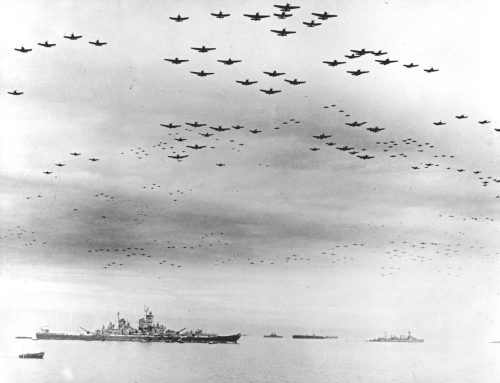
The answer came in a few days. While I was eating, Robert Pyles came into the mess hall and said, “A plane from the 509th dropped a bomb that is said to be 5,000 times more powerful than anything we’ve dropped so far.” I was sitting at the table with some other fellows, and we just looked at each other and smiled. Elmer Hampton, standing behind Pyles said, “That’s a lot of bull!” Then Gile Iliff, who just came in, said, “No, Pyles is right, it’s on the bulletin board.” The first atomic bomb had destroyed Hiroshima, and the war ended a few days later.


Bio: Author Walter B. Woodcock (1919-2012) was raised in Miles City, MT where before the war he became a partner in his family cattle ranch. In 1944, he trained at the B-29 Engineering School, Dalhart Army Air Base, TX and McCook Army Air Base, NE before deployment to Tinian Island with the 5th Squadron, 9th Bomb Group where he served as a B-29 electrical technician and flight mechanic.
TINIAN ISLAND CAPTURE & CONSTRUCTION
Seabees constructed the largest air base in the world in record time >

BOMB GROUP CAMPS
The self-contained B-29 crew camps >