Kent Vincent
6th Bomb Group Association
© Kent Vincent 2026

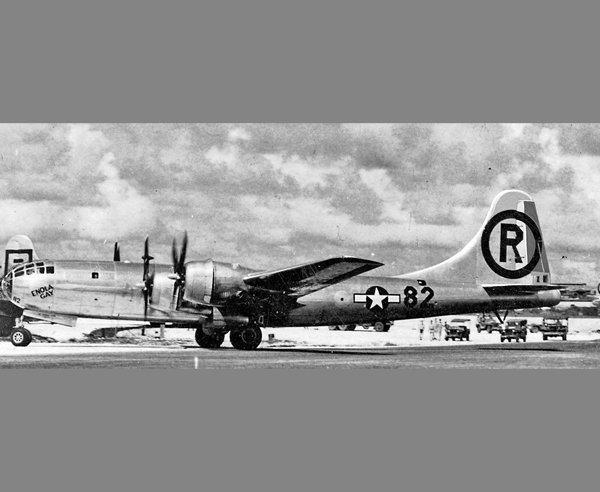
Enola Gay displayed at the Udvar-Hazy Center near Washington DC
The propellers you see on the B-29 Enola Gay at the National Air and Space Museum’s Steven F. Udvar-Hazy Center near Washington D.C. are not the originals. The only known original is mounted to the ceiling of the Gate 12 Bar & Grill at Texas A&M University, College Station, Texas. So how could the propellers of the world’s most famous, most revered, most meticulously restored and preserved B-29 have ended up anywhere but the Smithsonian? Here’s the story.
Directly following the war and its historic atomic bomb mission over Hiroshima, the Enola Gay was assigned to the 509th’s new base at Roswell Army Air Field, New Mexico. It served briefly as part the atomic bomb testing at Bikini Atoll (Operation Crossroads) in May 1946, although not chosen to make the test drop.

Enola Gay with 6th Bomb Group tail marking at time of atomic bombing Tinian Island 1945 © Bill Webster
On July 24, 1946, the U.S. Army Air Forces decided to preserve the Enola Gay as a historic artifact rather than scrap it. It was flown to Davis-Monthan Air Force Base, Arizona, to prepare for storage. Title to the aircraft was transferred to the Smithsonian Institution on August 30 a month later. While at Davis-Monthan, the Enola Gay was stripped of its specialized equipment, including its special aluminum Curtiss Electric reversible-pitch propellers. The top secret “Silverplate” B-29 with its precision-built propellers was designed specifically to manage the extreme performance requirements of carrying atomic weapons. Its propellers were transferred to the Technical Data Laboratory and the Air Force Museum collection located at Wright-Patterson AFB in Dayton, OH.
The Enola Gay was fitted with a separate set of the correct, specialized Curtiss Electric propellers prior to its physical transfer to the Smithsonian. Colonel Paul Tibbets, Aircraft Commander for the Hiroshima atomic bomb mission, flew the Enola Gay from Davis Monthan to Orchard Place Air Field (now O’Hare International Airport) on July 3, 1949 to participate in the official transfer ceremony. Between 1984 and its current display at the National Air and Space Museum starting in 2003, the aircraft underwent a massive, decades-long restoration project by the Smithsonian. What we see on display today are the same propellers fitted at Davis-Monthan AFB.

Col. Paul Tibbets

Enola Gay prop in Oran W Nicks Wind Tunnel. Circa 1950. Nicks and Cushing Memorial Library at Texas A&M University
In 1950, Texas A&M University contacted the Air Force looking for a highly durable, precision-built propeller to drive its new Oran W. Nicks Low Speed Wind Tunnel. At the time military surplus equipment was readily available for academic research. Checking its inventory at Wright -Patterson AFB, the Air Force found that the Enola Gay propellers fit the exact technical specification needed and gifted at least one to the university. The propeller used in the wind tunnel was trimmed by approximately 18” on each blade to 12.5 feet diameter to fit the tunnel. The propeller’s variable pitch was used to control wind speed, up to 200 mph, while a Navy surplus 1250 kVA, 1000 HP Allis-Chalmers electric motor turned the prop at constant 900 RPM.
The wind tunnel was completed in 1959. It was used over decades to test many aerospace systems including tests for Boeing, NASA, Howard Aero and Temco. Missiles, space vehicles and even models for offshore drilling platforms and sports equipment aerodynamics for professional cyclist Lance Armstrong were tested.
At some point, a model being tested in the tunnel broke apart damaging the spinning propeller to the point of being unsafe to use again. The decision was made to retire the prop. Years later, wind tunnel management learned that a new Texas A&M-owned restaurant was to be built on campus across the street from the wind tunnel facility. Thinking the restaurant would be an excellent place to display the historic artifact, which was then collecting dust in storage, the university arranged to have the Enola Gay propeller prominently displayed on the ceiling above the bar in what is today the Gate 12 Bar & Grill, College Station, TX, opened in December 2020. Here, instead of the Smithsonian, you will find the only known remaining propeller of the historic Enola Gay’s original four. The location of the other three is apparently unknown.

Enola Gay prop displayed in Gate 12 Bar & Grill, College Station, TX
Ref: Texas A&M University. A&M Wind Tunnel Prop from Atom Bomb Dropper. October 21, 1950.
Kent Vincent
Bio: Kent Vincent is the son of 6BG B-29 Aircraft Commander Edgar L Vincent, Tinian 1945. He is the 6th Bomb Group Association Director of Web Education and Editor of 6thbombgroup.com.

PACIFIC WAR – OVERVIEW
Brief overview of the Pacific War 1941-1945 >
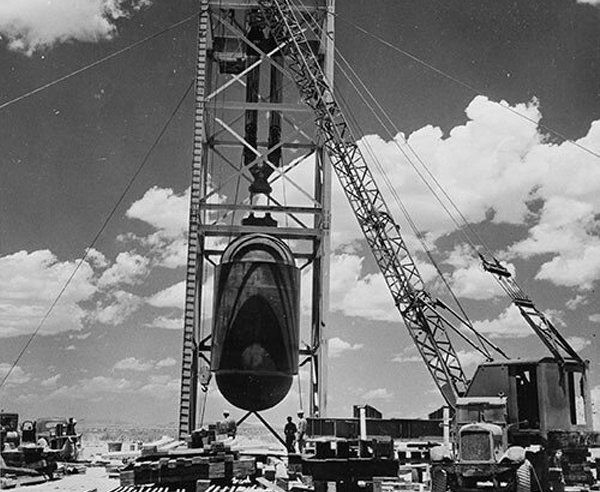
TOP SECRET 509TH – ATOMIC BOMB GROUP
Development and delivery of the atomic bombs 1939-1945 >
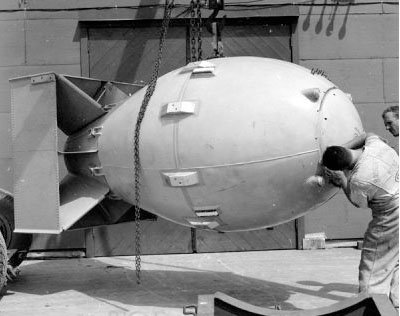
THE ATOMIC BOMBING OF HIROSHIMA AND NAGASAKI
Justification and mission details >