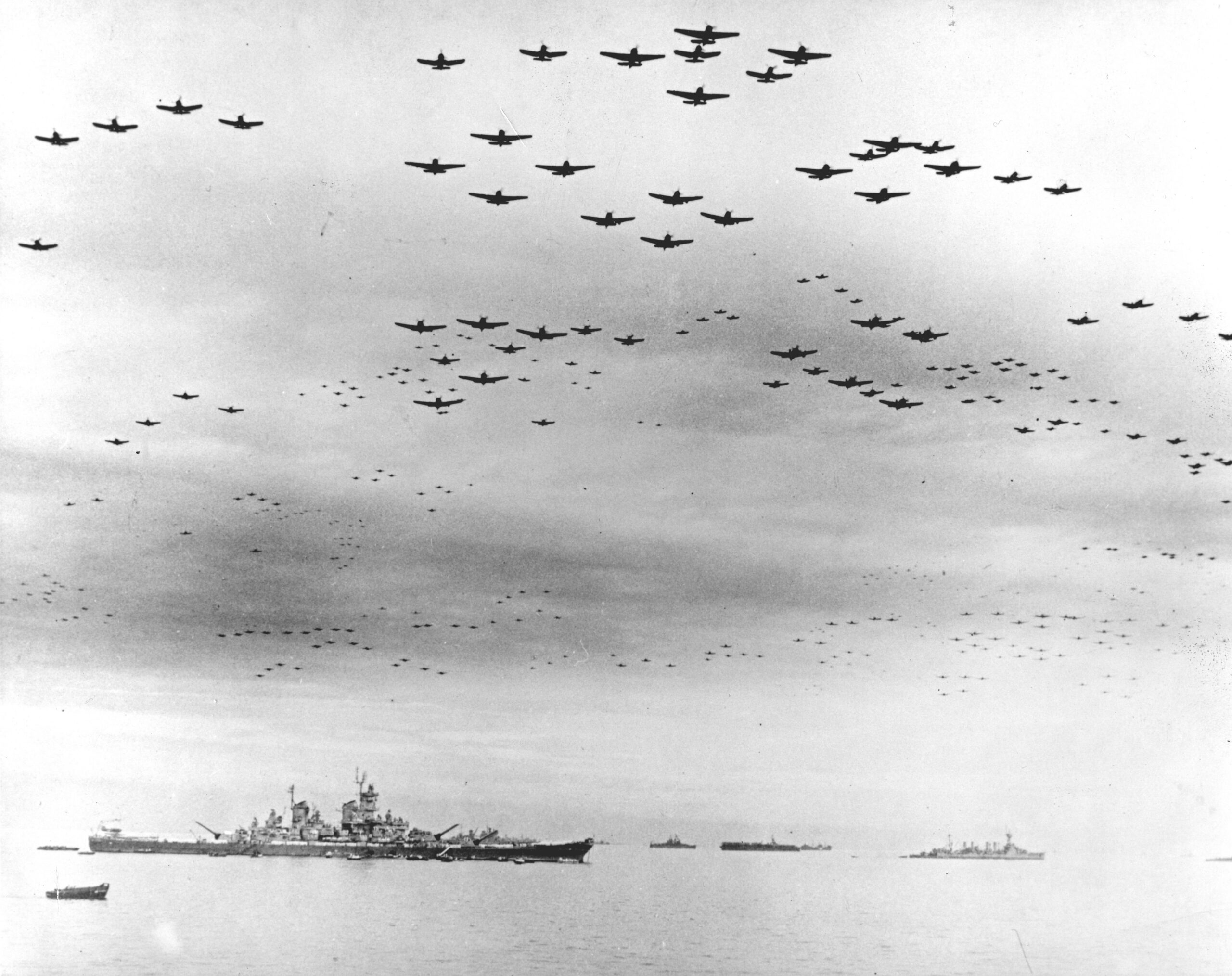
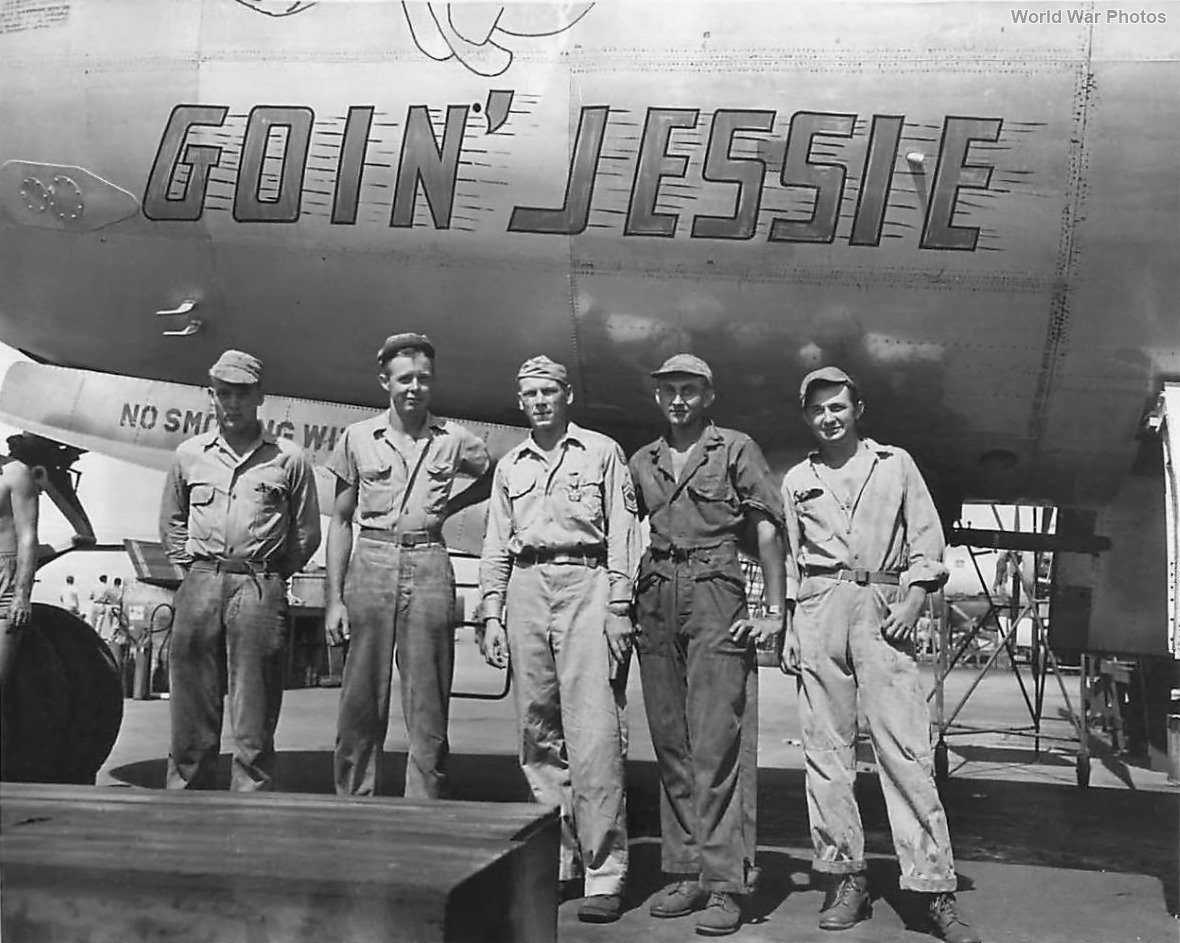
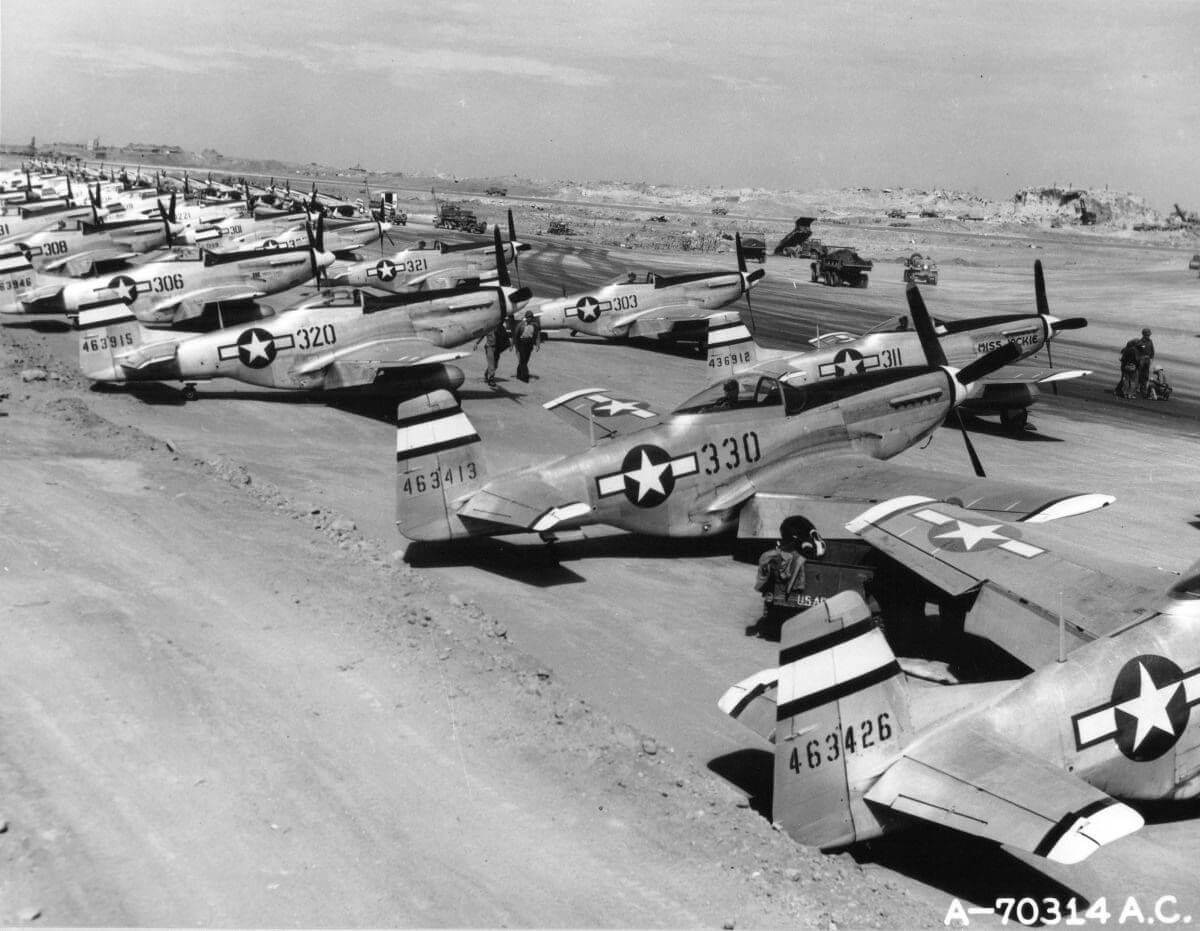
Editor’s Note: This article is an excerpt from then 1st Lt. Lawrence Stewart’s first-person memoirs: Combat in the Pacific Theater – A B-29 Flight Engineer’s Experiences During World War II. Pictures, titles and highlights have been added to compliment the author’s writing.
On 18 May [1945], we attended a briefing with thirty other combat crews for a daylight raid against the Tachikawa Army Air Arsenal, located about twenty miles from Tokyo (6BG Mission 42). Combat crews from the four bomb wings would join the attack. An enlisted man joined our crew at the briefing as he had been assigned to fly with us as our left gunner, replacing Stanley Mackiewicz.
After arriving at the flight line around midnight, I checked that a droppable fuel tank had been loaded into the front bomb bay and general purpose bombs into the aft bomb bay. Engine start up and checkout were normal and we took off about midnight. We approached the assembly area during the early morning hours and joined the circling airplanes that had preceded us. Shortly thereafter, as the formation was climbing on a heading for the initial point, we encountered an unexpected bank of clouds at 12,000 feet.
AS WE BROKE AWAY FROM THE FORMATION, OUR NUMBER THREE ENGINE LOST POWER
We climbed to 19,000 feet, our bombing altitude, and still the clouds towered above us. The flight commander ordered the pilots to continue to climb in an attempt to get above the cloud cover. At 23,000 feet, we finally cleared the top of the clouds. However, the target area was socked in. The flight commander contacted the pilots and told them to bomb their secondary targets. As we broke away from the formation, our number three engine lost power. I informed Rocky of the problem as I moved the mixture control to the cutoff position, retarded the throttle, closed the fuel shut-off valve and cowl flaps and turned off the ignition switch. He instructed Woody to feather the number three engine propeller. Woody hit the feathering button to streamline the propeller blades and stop the engine from rotating. However, the blades didn’t move and the engine continued to rotate.

B29s over cloud bank © Percy Tucker
B-29 ENGINES HAD A HISTORY OF CATCHING FIRE WHENEVER THE SUPPLY OF OIL WAS LOST. A SUSTAINED ENGINE FIRE USUALLY RESULTED IN BURNING UP THE ENGINE MOUNTS, SETTING THE WING SPAR ON FIRE……RESULTING IN A CATASTROPHIC LOSS OF THE WING
Apparently the cylinder to which the feathering motor was attached had blown off, taking the motor with it. The engine and propeller continued to rotate at low speed. Although the wind milling propeller caused a slight drag, it wasn’t a serious problem unless the engine lost its oil supply. B-29 engines contained many magnesium components and they had a history of catching fire whenever the supply of oil was lost. Tests had demonstrated that a sustained engine fire usually resulted in burning up the engine mounts and then setting the wing spar on fire. In this event, the wing spar normally burned through resulting in a catastrophic loss of the wing. If the crew didn’t escape prior to collapse of the wing, they usually became trapped in the doomed airplane.
As long as the wind milling engine had a sufficient supply of oil, there wasn’t much danger, except that the extra drag increased fuel usage. In the event excessive fuel was consumed by the remaining engines, we could land and refuel at lwo Jima enroute to our home base on Tinian.
THE CFC GUNNER REPORTED THAT A LARGE STREAM OF OIL WAS FLOWING OFF THE AFT EDGE OF THE RIGHT WING.
Rocky increased power on the three operating engines as we continued on the heading for our secondary target. Since this target was also covered by clouds the bombs were dropped using radar. Rocky immediately banked the B-29 toward the Marianas. He set up a gradual descent at the minimum airspeed that I had obtained from my three engine configuration chart. The intent was to reduce strain on the three operating engines and to conserve fuel for our return flight. James Brooks, the CFC gunner sitting in for Stanley Meickiewicz, reported that a large stream of oil was flowing off the aft edge of the right wing. I asked him to keep an eye on the leak and to keep me informed about it.

Bombardier view of cloud cover
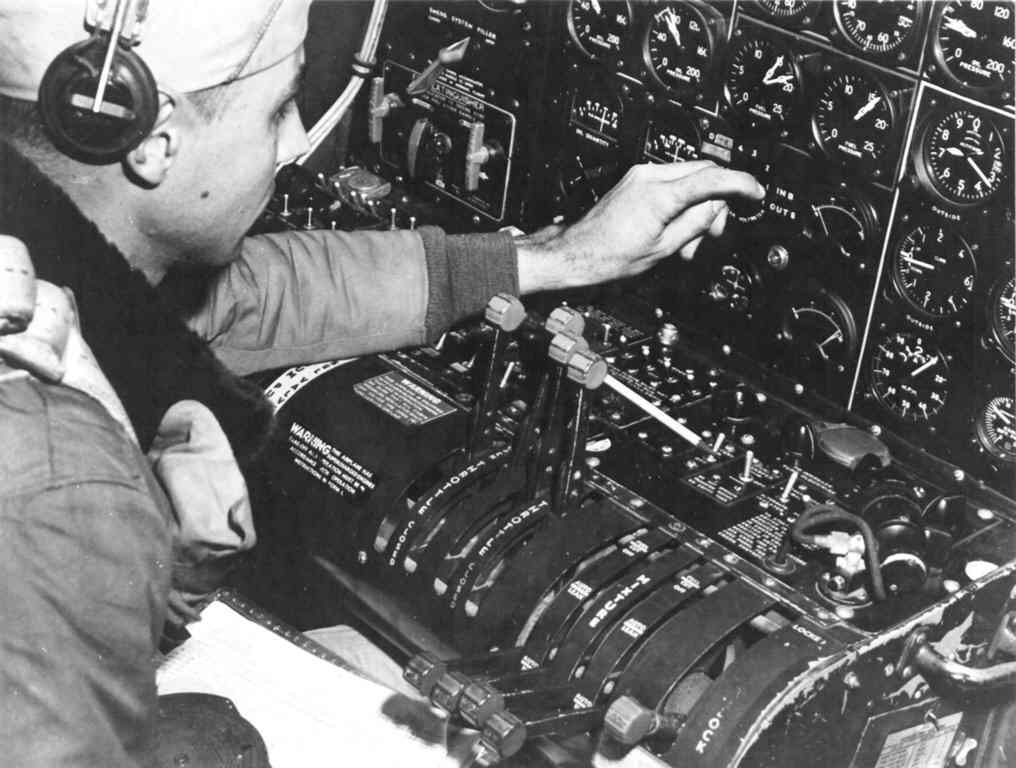
Flight engineer at controls
Rocky told David Evans to set up the radio frequency for the lwo Jima ground control communication system in case we encountered an emergency as a result of the wind milling engine. I kept a close watch on the number three engine instruments as we departed the enemy coast heading for the Marianas. As we progressed on our return flight, James Brooks periodically reported that oil continued to drip off the trailing edge of the right wing at approximately the same rate. Comparing current fuel consumption figures with preplanned estimates, I determined that we had sufficient fuel, including an adequate reserve, to reach Tinian.
THE AIRPLANE SUDDENLY BEGAN TO SHAKE VIOLENTLY AND STARTED INTO A RAPID DESCEND. AND THE NUMBER THREE ENGINE FIRE WARNING LIGHT FLASHED ON, INDICATING A FIRE IN THE ENGINE COMPARTMENT
Approximately 100 to 150 miles from Iwo Jima, the airplane suddenly began to shake violently and started into a rapid descend. And the number three engine fire warning light flashed on, indicating a fire in the engine compartment. Apparently the engine oil had leaked out and the revolving parts had seized, thereby generating friction which ignited the magnesium components. I immediately opened the cowl flaps, turned the fire extinguisher selector to the number three engine and pulled the handle, thereby activating the fire extinguisher to direct a stream of foam into the engine nacelle. I breathed a sigh of relief when the fire warning light, went out indicating that the fire had been extinguished. I informed Rocky of the engine fire and the action I had taken to put out the fire.
I REALIZED THAT IF THE FIRE STARTED AGAIN, I COULDN’T DO ANYTHING ABOUT IT SINCE I HAD USED UP THE TWO FIRE EXTINGUISHER BOTTLES
However, the fire warning light came on again several minutes later and I turned the switch of the backup fire extinguisher bottle to the malfunctioning engine and pulled the handle. In a short time the fire warning light went out. I realized that if the fire started again, I couldn’t do anything about it since I had used up the two fire extinguisher bottles. I kept a very close watch on the number three fire warning light!
ROCKY ORDERED DAVID EVANS TO CONTACT IWO JIMA GROUND PERSONNEL AND REQUEST THAT THEY RELAY THE INFORMATION TO 6TH BOMB GROUP HEADQUARTERS OF HIS PLAN TO DITCH THE AIRPLANE

Ditched B-29
As soon as the airplane started to descend, Rocky applied full power to the three operating engines which slowed the descent somewhat, but we were still descending at an alarming rate and the airplane continued its violent shaking. Rocky ordered David Evans to contact Iwo Jima ground personnel and request that they relay the information to 6th Bomb Group Headquarters of his plan to ditch the airplane.
Ditching was considered to be the preferred procedure for abandoning a damaged B-29, even though some ditchings resulted in the death of one or more crew members. It was considered the best method for survival purposes in that escaping crew members would be in the same general vicinity, aboard the two large life rafts, for rescue purposes.
In preparation for ditching, Rocky ordered Denis lnkel to drop the bomb bay fuel tank. When Denis actuated the emergency release system, the fuel tank fell from the airplane. Unfortunately, it hit a bomb bay door as it fell out of the bomb bay and as a result, the door couldn’t be closed. Now we were in a real predicament!
WITH THE DAMAGED BOMB BAY DOOR, THE ODDS OF THE B-29 BREAKING UP ON CONTACT WITH THE OCEAN WERE INCREASED
With the damaged bomb bay door, the odds of the B-29 breaking up on contact with the ocean were increased. Even if it didn’t breakup, the airplane would probably sink soon after striking the water, thereby lessening our chances of escape.

Bomb bay doors stuck open © John Potenza
WITH THE RAPIDLY DESCENDING AIRPLANE SHAKING SO VIOLENTLY THAT MOST OF THE FLIGHT INSTRUMENTS BECAME INOPERATIVE, ROCKY ORDERED THE CREW TO STANDBY FOR BAILOUT
And so with the rapidly descending airplane shaking so violently that most of the flight instruments became inoperative, Rocky ordered the crew to standby for bailout. One bailout location for the forward crew members was through the nose gear wheel well. The aft cabin crew members used the rear bomb bay for bailing out, whereas the radar operator used the rear entrance door. When in the tail compartment, the tail gunner bailed out through his escape hatch.
Rocky ordered the nose gear to be released, which could be lowered independently of the main gear. I removed my headset and put on my helmet in preparation for bailing out. I placed the headset on my clipboard which was located on my knees, put my glasses in the top pocket of my flight suit and zipped it up to keep from losing them during the descent. Meanwhile, Denis and Archie removed the nose gear cover from the open wheel well.
WHEN THE COVER WAS REMOVED, IT CREATED A SUCTION WHICH SUCKED ARCHIE’S NAVIGATION MAPS OUT THE OPEN HOLE
When the cover was removed, it created a suction which sucked Archie’s navigation maps out the open hole. When I leaned over to look out the open wheel well, located near my station, my headset slid off the clipboard and dropped into the opening. I watched the headset as it slowly dropped from the airplane and fell towards the ocean. I watched it until it disappeared from my view. At that instant, I decided I wouldn’t bail out, but instead I would attempt to land the B-29 onto the ocean after everyone else had bailed out!
I WAS RELUCTANT TO JUMP WHEN I REALIZED THAT OUR CREW WOULD BE STRUNG OUT ALONG THE FLIGHT PATH FOR MANY MILES [IN OPEN OCEAN] AND THE CHANCE OF ME LINKING UP WITH ANYONE WAS VERY REMOTE
I was reluctant to jump when I realized that our crew would be strung out along the flight path for many miles and the chance of me linking up with anyone was very remote. I would be all alone in that vast unfriendly ocean with only my Mae West to support me in the water. If I could ditch the airplane and get into a life raft, my chances of survival and rescue were much greater. Later, Rocky told me that he also intended to remain with the crippled airplane in an attempt to ditch it, after the crew had bailed out.
HE STATED THAT THE RATE OF DESCENT WAS SLOWING AND THAT IF THE DESCENT COULD BE HALTED, WE HAD A GOOD SHOT AT MAKING IWO JIMA
My thoughts were interrupted when Rocky called us over the interphone and informed us that we probably wouldn’t have to bailout after all. He stated that the rate of descent was slowing and that if the descent could be halted, we had a good shot at making Iwo Jima. I glanced at my altimeter and I noted that the rate of descent was indeed decreasing. Soon after, the B-29 mushed along at an altitude of approximately 3,000 feet. We were flying at airspeed well below the established stalling speed and the airplane should have stalled out at this low airspeed. I considered it a miracle that we were maintaining altitude and flying at this airspeed!
I prayed that we could stay airborne long enough to reach Iwo Jima and safety. Rocky told Woody to raise the nose gear and reestablish contact with Iwo Jima ground control personnel, and to ask them to get a fix on our airplane so we could obtain a heading to the island. Archie had lost his navigation maps and although we were heading in the general direction of the island, he didn’t know our exact location or heading.
AS WOODY HUMMED INTO THE MICROPHONE, IWO JIMA CONTROL PERSONNEL OBTAINED A POSITION FIX ON OUR AIRPLANE AND PROVIDED A HEADING TO THE ISLAND
When Woody contacted the ground personnel at Iwo Jima, he was surprised that they asked him to sing or hum into his microphone. He became upset and replied “We’re in an extreme emergency, barely able to maintain our altitude with our instruments out of commission, not sure of our location, and our airplane shaking so violently that it might break up at any moment and you ask me to sing?” or similar words as he later told us about the incident. As Woody hummed into the microphone, Iwo Jima control personnel obtained a position fix on our airplane and provided a heading to the island. Apparently Woody’s words were breaking up due to the violent shaking of the B-29 and they couldn’t establish a positive fix.
I continued to monitor the instruments of the operating engines for any sign of malfunctioning while I prayed that they would continue to operate satisfactorily at full power. According to the fuel quantity gauges, there was sufficient fuel to make lwo Jima. Although I wasn’t worried about the airplane shaking apart since it was well built with a sturdy airframe, the violent shaking was very distressing!
AFTER AN ETERNITY OF SWEATING OUT THE IMPOSSIBLE FLIGHT, WE SPOTTED IWO JIMA
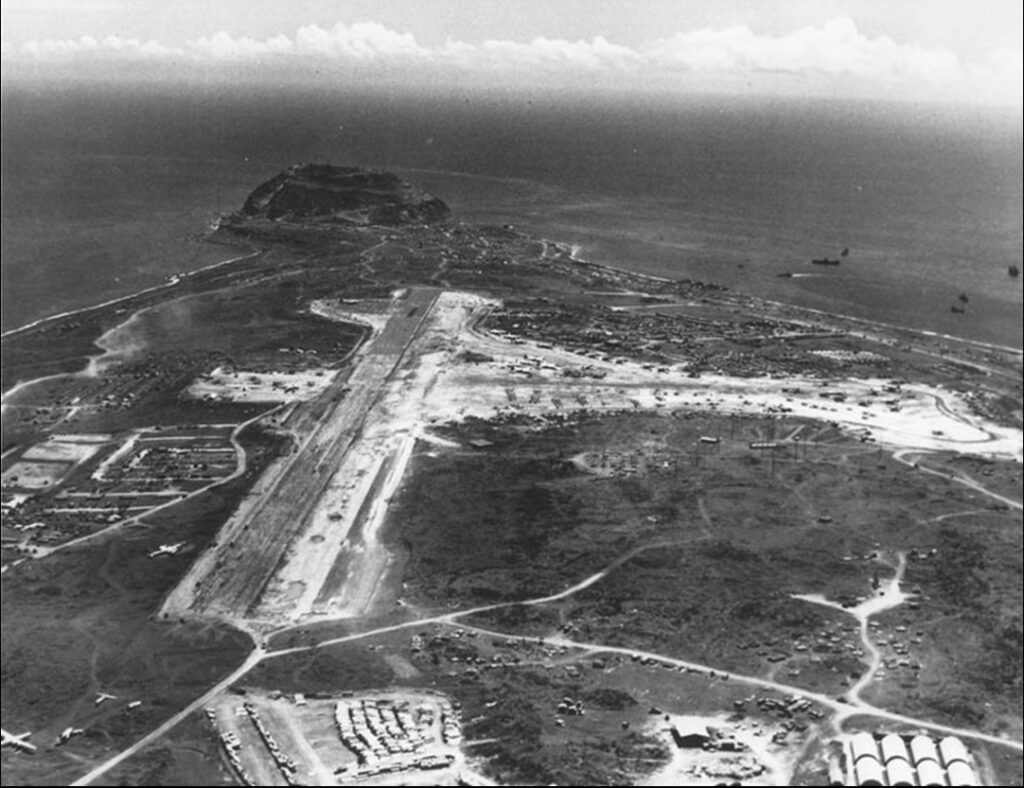
Iwo Jima Airstrip 1945
After an eternity of sweating out the impossible flight, we spotted lwo Jima. What a wonderful feeling of relief when I realized that we had made it to the island! Rocky requested a straight in approach for landing which was Okayed by ground personnel. I hurriedly completed my prelanding checks as Woody extended the landing gear and wing flaps. Rocky made a high speed landing to keep the B-29 from stalling out. After the airplane was parked among other war weary and battle damaged Superfortresses, I shut down the engines and we hurriedly deplaned. I was thankful that I had been assigned to this crew with a top notch pilot!
When we deplaned, the substitute gunner knelt down and kissed the ground. He told me that when he returned to Tinian, he would request grounding. He stated that he didn’t want to fly any more combat missions. Later, I heard that the gunner had a streak of bad luck prior to flying with us. On an earlier combat mission, his bomber had crashed into the ocean soon after taking off. He survived the crash but many of his crew mates had been killed. The potential disastrous incident involving our B-29 was the last straw, per an old saying, for the substitute gunner. He was convinced that bad luck was dogging him and that his number was always tense whenever he was flying combat missions.
After unloading our flight, survival and professional equipment, we buttoned up the airplane and departed for the flight operations area in a military truck. Since it was late in the afternoon, we were informed that we would get a patched up B-29 for our return to Tinian the next morning. We were given a ride to the mess tent for a meal and then onto to the bivouac area located some distance from the flight line.
WE WERE ASSIGNED TO BATTERED TENTS THAT HAD TEARS, RIPS AND HOLES IN THEM
We were assigned to battered tents that had tears, rips and holes in them, officers to one tent and enlisted members to a nearby one. And it appeared that none of the other tents had any occupants. When we inquired about the empty tents, the driver stated that previously a large number of Japanese soldiers had left their caves near the end of the battle for the island, and made a banzai attack against our troops. They attacked late at night and swept through several Army outfits and a Fighter unit, slashing tents, killing and wounding sleeping soldiers and airmen, and attacking everyone that got in their way. The attack continued into the hospital area where the attack was finally stopped.
WE LAID DOWN ON OUR COTS FULLY CLOTHED AND I PLACED MY LOADED PISTOL UNDER MY PILLOW
What a place to spend the night! We laid down on our cots fully clothed and I placed my loaded pistol under my pillow. I tried to sleep but instead, I dozed fitfully throughout the night and I was glad when dawn finally arrived. Later, I heard that several fellow officers also slept with their loaded pistols nearby. Fortunately, none of our crew members strayed around the tent area. A military truck transported us to the mess hall for breakfast and then onto the flight line. Here we were assigned a weary looking, patched up B-29 for our return flight to Tinian. Although we were assured that the airplane was flight worthy, the pilots and I carefully examined the exterior surfaces for any damage indicating an unsafe airplane. The airplane appeared to be okay and we accepted it for our return.
I started the engines and performed the magneto checks. They checked out okay and shortly thereafter we taxied to the active runway. During the takeoff roll, I closely watched the engine instruments for any signs of malfunctioning. They continued to operate normally at full power. We were mighty happy to leave the desolate island of lwo Jima as we headed for our home base. We landed around noon and checked in for a belated debriefing. Combat mission number nineteen, our roughest one to date, had been completed. I fervently hoped that our remaining missions would be much better.
ROCKY WAS SUMMONED TO GROUP HEADQUARTERS WHERE HE WAS GIVEN A REPRIMAND
Later that day, Rocky was summoned to group headquarters where he was given a reprimand. It seems that word of our ditching had been received by group personnel. They had contacted the search and rescue unit headquarters and informed them of Rocky’s intention to ditch the B-29. However, word of Rocky’s decision to fly to lwo Jima instead of ditching wasn’t received by group personnel. When Rocky informed them of the events that followed with our safe landing at lwo Jima, they were satisfied with his explanation.
272 B-29S HAD PARTICIPATED IN THE ATTACK AND FOUR BOMBERS HAD BEEN LOST. FORTUNATELY WE DIDN’T BECOME THE FIFTH VICTIM OF THIS ATTACK!
We heard that a B-29 taking part in the Tachikawa Army Arsenal raid had crashed into the ocean twenty minutes after taking off from North Field. Although the aircraft commander and four crew members were missing, the remaining crew members had been rescued. Altogether, 272 B-29s had participated in the attack and four bombers had been lost. Fortunately we didn’t become the fifth victim of this attack!
The next day I went to the flight surgeon’s office to see about intermittent stomach pains that I had been experiencing. The flight surgeon asked me how many combat missions I had flown. When I told him that I had just completed nineteen, he told me the problem was connected with those missions. He gave me charcoal pills to take to relieve the gas pains.
We were happy to rest and take it easy after our action packed escapade.
Lawrence Stewart 1922 - 2013
Bio: Born in Minnesota, Stewart joined the Army Air Corps at the outbreak of WWII and became a B-29 flight engineer with the 6th Bomb Group. He was stationed on Tinian Island, Pacific Theater, in 1945 where he completed 35 combat missions over Japan. He retired from the USAF Reserves in 1963.