Donald W. Kearney
B-29 Navigator
6BG, Tinian Island 1945
Original diary copyright © 1988 Donald W. Kearney. All Rights Reserved
Additional content copyright © 2022 6th Bomb Group Assoc. All Rights Reserved
Editor’s Note: This article is a sub-chapter excerpt from then 2nd Lt Donald W. Kearney’s first-person diary of the war: Crew of the Reamatroid. Pictures have been added to compliment the author’s writing.
The USAAF lost 414 B-29s during the war. Of these 267, 64%, were lost to engine fires, mechanical failures and takeoff crashes.
On May 16 [1945], it was back to Nagoya again [6BG Mission 41 ]. Our crew wasn’t scheduled because of the engine changes on the Reamatroid. Our crew members were to serve as “flagmen” for the take-offs that night [North Field, Tinian], and that turned out to provide more excitement than we cared to have.
Flagmen signaled to each plane (pilot) when to start the actual take-off. For each runway, there were two sets of flagmen. The “starter” crew stood at the beginning of the runway with what was called a “biscuit gun” – a battery-powered lantern operated by a trigger.
As each plane surged forward, the next one in line pulled in to position and waited for a green light from the starter crew. Normally, a plane would be sent on its way as soon as the previous one was about three fourths of the way down the runway – because by then it was committed: It was too late for it to stop so it was going to be out of the way one way or another – in the air or in the water.
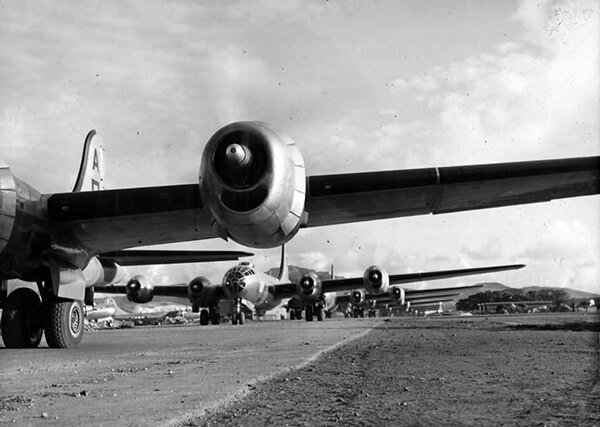
B-29s in line for take-off
But the runways were long and not perfectly level (the far end was actually out of sight of the starter). The starter could not tell when the accelerating plane was down the runway passed the point-of-no-return. So, a second flag crew stood about two-thirds of the way down to signal when the runway was clear (actually, when it was about to become clear) so that the starter at the beginning would know when to give a green light to the next plane.

North Field, Tinian 1945 © Bill Webster
Lemme’s men were to serve as the starter crew for runway C and we were to be the crew toward the end of the runway. Half of our Group was to take off on C, the other half on D. We had to stand on the south side of the runway because Seabees had dynamite strung all over the north side where they were going to do some blasting the next morning.
It was shortly after dark, some minutes before the 2110 scheduled start time, when we parked our jeep off to the side and took our position. Just about then Higgins thought he saw something fall to earth off to the west. He didn’t know what it was, but some of us guessed that it might be someone salvoing his bombs.
Although we didn’t associate the two events right away, it was only a few minutes later that we saw a plane flying low over the northeast end of the island – weaving and dipping some but headed more or less toward North Field (and us), completely out of any traffic pattern. Something was wrong – terribly wrong. We watched it come around toward us with its left wing drooping:
“He’d better get away from there: he’ll hit somebody.”
His left wing came up some, but the plane was losing altitude. Rather quickly, it seemed much more ominous. No one said so, but each of us must have realized that a crash was possible. We naturally assume that someone was struggling to gain control.
“What’s the matter with him?”
“If he doesn’t pull up, he’s going to crash”
“His No. 3 engine sure is torching.”
“He IS going to crash!”
“Pull up, for God’s sake, pull up!”
BY THEN WE ALL REALIZED THAT WE MIGHT BE WATCHING A RUNAWAY PLANE – UNMANNED AND OUT OF CONTROL.
A person’s mind races but still can’t always grasp the implications of events as fast as they happen. By then we all realized that we might be watching a runaway plane – unmanned and out of control. I’m sure it entered each of our thoughts that it might end up heading right for us – I know I thought of it. There was no use running – whatever direction one chose, the plane might lurch that way next. But then it started curving away toward the north. Lower and lower.

B-29 lost engines
“Pull up, pull up!”
“Look out.”
“There he goes.”
AS WE HELD OUR BREATH, THE PLANE SMASHED INTO THE GROUND ABOUT A MILE FROM US.
As we held our breath, the plane smashed into the ground about a mile from us. Immediately, brilliant flames shot up – not in one place, but extending for about a quarter of a mile as the wreckage skidded along the ground. All very fast. The whole quarter-mile of flame erupted almost all at once – Whoooosh! Suddenly, everything around us was as bright as day.
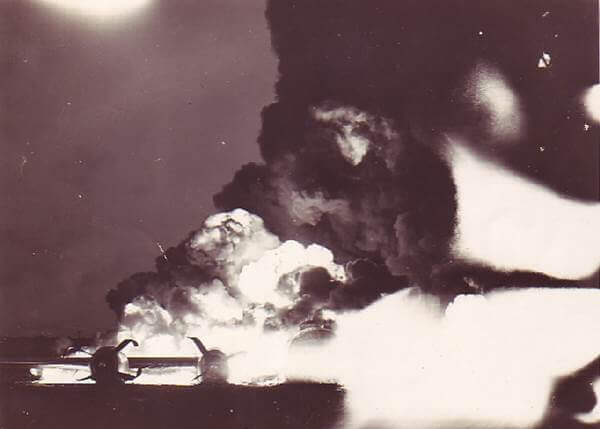
B-29 Crash on Take-off
At first it appeared to us that the wayward plane had hit in the 505th Group’s area, probably tearing up 10 or 20 parked aircraft. Then we could see that it was behind the tower, and we suspected that it had flattened the base depot. But, as we watched the flames, we finally realized that the crash was farther away – north of the field. Perhaps (shudder) in some living area.
FOR SEVERAL SECONDS ANYONE WITHIN THREE MILES COULD HAVE READ A NEWSPAPER BY THE LIGHT.
For several seconds anyone within three miles could have read a newspaper by the light. It was brilliant – not a red blaze, but a long sheet of white flame as magnesium incendiaries burned – white hot the way they’re supposed to burn. A curtain of black smoke, illuminated by the fire, rose – and kept rising. Every five seconds or so there was another white flash as something else exploded – another incendiary, presumably. The bombs made the bright white flames; the oil and gasoline made most of the smoke.
Seeing a fiery plane crash is no everyday experience. Fatalities, injuries, damage. The mind cannot comprehend it all at once. We were mesmerized; we simply stood and gaped.
But then it was time for our take-offs and we had to pay attention to business. Down they came – Jaekels, Sharp, Bunting, Andy, Sams, and others from our Squadron, then some from other squadrons. Red light. Green light. Red light. Green light. We were doing our job. One after another the planes went thundering by. Take-offs were almost finished – we were getting near the end of the line.
Then, oh-oh! The next plane was speeding along about half-way down the runway – not to us yet – when I heard a squeak I thought was brakes. In the next instant I decided I was mistaken; the pilot seemed still to have power on. The wind played with sounds so that several times it had seemed that someone had cut his power when he actually hadn’t.
But in a moment we all knew that this one really was trying to stop. Trying desperately. I still didn’t think he had his power cut off completely, but it was hard to tell. Anyway, he was applying brakes. Hard. Real hard.
ONE CANNOT READILY COMPREHEND WHAT IT TAKES TO STOP A PLANE WEIGHING MORE THAN 65 TONS AFTER IT HAS REACHED 80 OR 90 MILES AN HOUR.
One cannot readily comprehend what it takes to stop a plane weighing more than 65 tons after it has reached 80 or 90 miles an hour – and in the short distance of half a runway. Brakes alone can hardly do it.
“Take hold, brakes, take hold!” We all were saying that aloud or to ourselves, as though our verbal entreaties might help.
“Give Lemme the red light.”
We flashed the red light down the runway so no more planes would start their take-offs. The plane sped by us with brakes screeching and steaming. We could smell the brakes as they got hotter and hotter –an unwelcome odor. Soon they would literally melt.
“Oh-oh, he isn’t going to make it.”
“Yes, he is. The end is still way down there – farther than it looks.”
“He still isn’t going to, make it.”
“Yes, he is.”
“Keep that red light on!”
For the second time that night, we held our breath and our hearts pounded.
HE GOT THE PLANE TURNED ABOUT 45 DEGREES AND ALMOST DEAD STOPPED. THEN IT TEETERED ON THE EDGE – AND PLUNGED OVER!
He was slowing down rapidly; but to have any chance, he certainly had to. He reached the crossing taxi way at the end – slowed a great deal but still moving right along. Obviously, he wasn’t going to stop before the drop-off at the end. So he tried to turn off the runway to the left – maybe, maybe not, going too fast to make the turn. He got the plane turned about 45 degrees and almost dead stopped. Then it teetered on the edge – and plunged over!

B-29 over end-of-runway cliff (c) John Potenza
Oh, damn it, he had just about made it.
We could hear the fuselage strain, glass shatter, braces snap. Then it just sat there. All quiet. We hardly dared think it, but – but, yes – it might not catch fire. I crossed my fingers. We exhaled the breath we had been holding: “Whew.”
Someone dared to speak: “It might not burn”
“Hot damn! I don’t believe it’s going to.”
“How about that?”
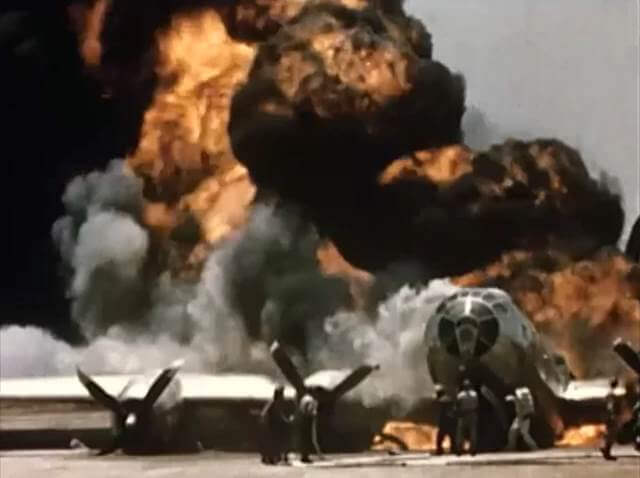
B-29 explosive fire
Only a short time had passed. Twenty or thirty seconds, perhaps. Maybe a minute. But it seemed like an eternity. We now thought that the plane actually wasn’t going to burn.
Then WHOOM!
UP IT WENT. ONE BIG DEAFENING EXPLOSION.
Up it went. One big deafening explosion. Billowing clouds of black smoke rolled out of huge reddish flames. Around the base of the fire, 50-caliber shells spit and sputtered, the tracers arching off in all different directions. Every few seconds an incendiary ignited – making a big white flash and a rumbling, roaring sound. In the flames we could see the tail still sticking up above the cliff.
We didn’t know what to do – whether to go toward it or away from it.
We kept the biscuit gun flashing red until we saw Lemme signal us that there were no more planes waiting; if there had been any, they had been diverted to another runway.
Then we hopped into our jeep, bounced out onto the runway, and drove hesitantly toward the flaming crash. We got to within about 50 yards and stopped. That turned out not to be a good idea. Flaming debris that looked like huge sparks rained down very near us. Flares went up like roman candles, and .50s were shooting out in crazy directions. A glowing object whizzed by us like a Bob Feller pitch – fast, but wide. We stayed there only a few seconds – no use adding our names to the list of casualties. We wheeled the jeep around and retreated to about 75 yards. But the shower of fire and shell seemed to get worse and again we backed away.
With so much ammunition going off, we thought the plane must have toppled onto some stored ammunition – or at least an anti-aircraft gun emplacement. Several missiles whistled overhead, and one very large flaming chunk of airplane went flying up and out about 100 yards to the south.
That again was too much for us. We drove back farther, swerved off the runway to the north, and bumped along to an uneasy stop. There we got out of the Jeep and scrambled up a low ridge where we were going to lie down in some furrows and watch. As we clambered up the incline, someone behind us started yelling. We couldn’t understand what he said and mostly ignored him. But the next time he yelled, we understood him all too well. In the confusion and noise we caught the words “dynamite up there.” It took me three seconds to cover the 60 yards back to the jeep – and I came in last! We had completely forgotten about the dynamite planted there.
Finally, we concluded that it was best to clear out altogether before we got ourselves in more trouble. We drove back to the west end of the field and around to Base Operations to return the biscuit gun. On the way, we were stopped by a guard who pointed out to us that another plane must have crashed over at the 58th Wing field. We hadn’t noticed it, but now we saw that something was sure enough burning over there. Bright white light reflected off the clouds over the hill to the south.

39th Operations Building © John Potenza. All Rights Reserved
At Base Operations we learned that the first crash was a plane from the 58th Wing. Operations thought everyone had bailed out. At least the pilot had and was safe because, about two minutes after the crash, he had walked into Operations, dragging his ‘chute behind him. Hearing what had happened, we concluded that the parachutes must have been what Hig saw floating to earth shortly before the pilotless plane cracked up.
From Operations we drove over to the first crash scene, which wasn’t far away. The plane had been ripped apart. Fairly large twisted chunks of it were scattered all along the edge of a wide hole where the Seabees had quarried rock. The plane had just missed a Seabee camp. Most of the pieces of wreckage were still burning. The engines being the heaviest parts traveled the farthest from the point of initial impact. One engine was still mostly in one piece, but mangled and fire-blackened and all covered with a paste of dirt and oil.
We saw a nurse there – not on duty, just a curious spectator, the same as we were. It was the closest we had been to an American woman in four months.
WE KNEW THERE HAD BEEN A SHORT INTERVAL BETWEEN THE TIME THE PLANE TOPPLED OFF THE EMBANKMENT AND THE EXPLOSION
Then we drove around to the east side of the field to the burning hulk below the end of runway C. We still couldn’t get close to it, but some spectators told us that everyone got out all right. That was hard to believe. We knew there had been a short interval between the time the plane toppled off the embankment and the explosion, but was it really enough time for the crew – all of them – to get out and away from the plane? Thinking of it that way, there really hadn’t been much time at all. Anyway, it was great news. We looked for wood to knock on, but not finding any at hand, we drove on.
While there we saw a plane coming in for a landing on runway A, evidently aborting the mission. As it passed through a patch of light, we thought we could see a red cowl. If so, it was one of ours. Someone said what several of us were thinking:
“Oh, if that’s. Andy. . .let’s wait and see.”
A few minutes later Andy came taxiing up. Naturally, he was disgusted no end. He seemed to be having the worst luck getting a mission completed. This time, he had had an oil leak in No. 4 and had to come back. Poor Andy.
We saw that he got some transportation, and then we drove back to our area. We stopped in the mess hall to see if they had some coffee. They did. Straws would have been useful – our hands were still trembling too much to pick up a full cup without spilling. Except for Russ: after he finished shoveling sugar in, he really had mocha syrup, for which he needed a spoon, not a straw.

39th Mess Hall © John Potenza. All Rights Reserved

Paul Reed’s crew
THE CREW GOT OUT ONLY BECAUSE SOME MARINE CAME UP BEFORE THE FIRE STARTED AND KICKED IN THE ENGINEER’S HATCH
Doc Doering came in and told us what he knew. It was Reed’s plane [Bad Penny II] that had toppled off the end of the runway. The impact jammed the escape hatches. The crew got out only because some Marine came up before the fire started and kicked in the engineer’s hatch. As it was, the crew was all okay. For Reed’s crew, one quick-thinking Marine was the difference between being alive and well and being incinerated. I hoped that someone knew the identity of that Marine and gave him the Silver Star – or, better yet, an extra beer ration.
THE 58TH WING LOST TWO PLANES – THE ONE THAT WE SAW CRASH, FROM WHICH EVERYONE HAD BAILED OUT AND WAS SAFE, AND A SECOND ONE OFF THE END OF ONE OF THEIR RUNWAYS
The 58th Wing lost two planes – the one that we saw crash, from which everyone had bailed out and was safe, and a second one off the end of one of their runways. Some of the crew of that plane were killed when it exploded, according to Doering. Also, the 73rd Wing lost a plane in the water off the end of one of Saipan’s runways. Quite a night.
Our 39th Squadron people down on the line had their own strange experience with the 58th Wing crew that bailed out. The plane had a fire in No. 3. We remembered thinking it was torching. It was doing more than that. It was a real fire. The fellows said that when the plane went across the field the flames trailing behind were longer than the plane. They were afraid it was going to explode right there – right above them. Queer we didn’t see that.
Some of the crew members who hit the silk drifted down right where our planes were just starting engines. That certainly startled our men sitting there in their planes. Sams and a few others cut the engines that were already running for fear the men would drift into the whirling props. We never did find out why that crew couldn’t get the plane headed out over the ocean.
Finally we found our way back to our Quonset and the fellows who hadn’t been scheduled for the mission. When they asked about our experiences of the evening, we summed it up in tne succinct sentence: “We saw a nurse!”
The next day we were told that the light we saw over the hill – the one the guard had pointed out to us – wasn’t a plane burning, but bombs that someone salvoed as soon as he was off the ground. However, the 58th Wing did lose two planes. One that was coming in for an emergency landing piled up just before reaching the runway; all of the officers were killed, while all of the enlisted men got out safely.
Reed – the one who had gone off the end of the runway – had had electrical trouble. Immediately after he poured on the power, he found that his turbos wouldn’t work, so he tried to stop. His bomb load consisted of incendiaries, each with an anti-personnel charge in it. It was those charges exploding that gave us the impression that his plane must have dropped down on top of an ammunition dump or something like that.

Donald Kearney
Bio: Author Donald W. Kearney (1925-1991) was raised in Ida Grove, IA. During WWII, he trained as a B-29 Navigator and served with the 6th Bomb Group, 20th Army Air Force stationed on Tinian Island in the Pacific. He flew some 20 long-range combat missions over Japan starting at age 19. Kearney retired in West Virginia and has served as Captain in the U.S. Air Force.