DELAYED CAPTURE SAVED MY LIFE
TOKYO MILITARY PRISON FIRE MAY 1945
Cpl. Nick Gazibara, B-29 Tail Gunner
9th Bomb Group, Tinian 1945
Original publication © Chester Marshall 19851
Additional content © 6th Bomb Group Assoc. 2025
Editor’s Note: Title, pictures, links and highlights added to compliment author’s writing.
I flew only one combat mission to the Japanese Empire. You will note I said TO the Empire – THAT mission was terminated shortly after our bombs were dropped on a flaming fire-bombed target in Kawasaki the night of April 15, 1945 [6BG Mission 25]. Not much of a combat record – but I can lay claim to a bit of notoriety due to the fact that after bailing out of our stricken plane I escaped capture from the Japanese authorities 14 days while wandering around in circles in a wooded area, hiding from voices, catching frogs, bugs, and even a snake to add to a meager diet trying to ward off a nagging hunger. That delay before submitting to my captors probably saved my life.
This all happened less than one week after my crew, the Lt. Edward Sullivan crew, came to Tinian and assigned to the 9th BG as a replacement after completing our combat crew training at Holloman air Base at Alamogordo, NM. You can imagine how green we were – we didn’t even have time to really get acquainted at our base on Tinian.

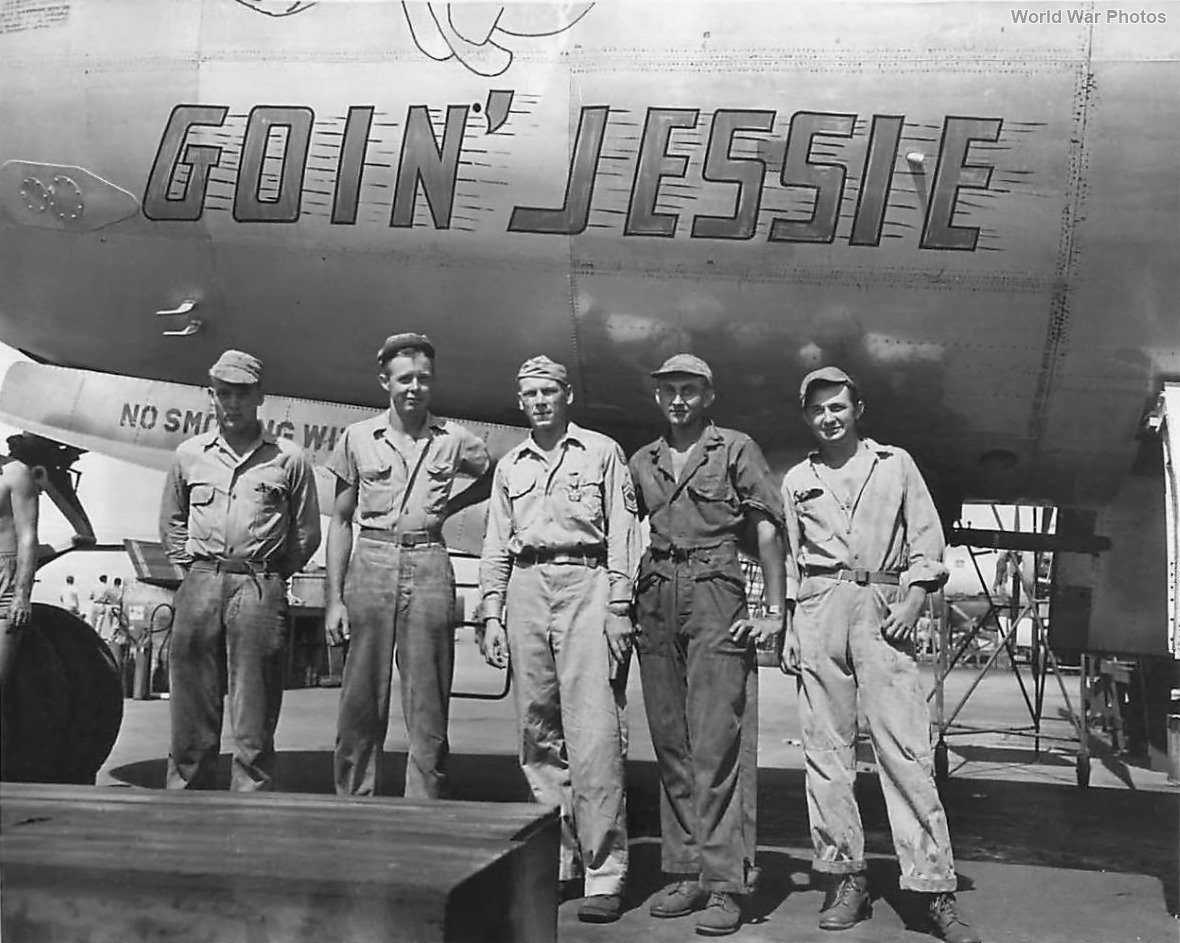
Circle X 9th Bomb Group B-29 bomber

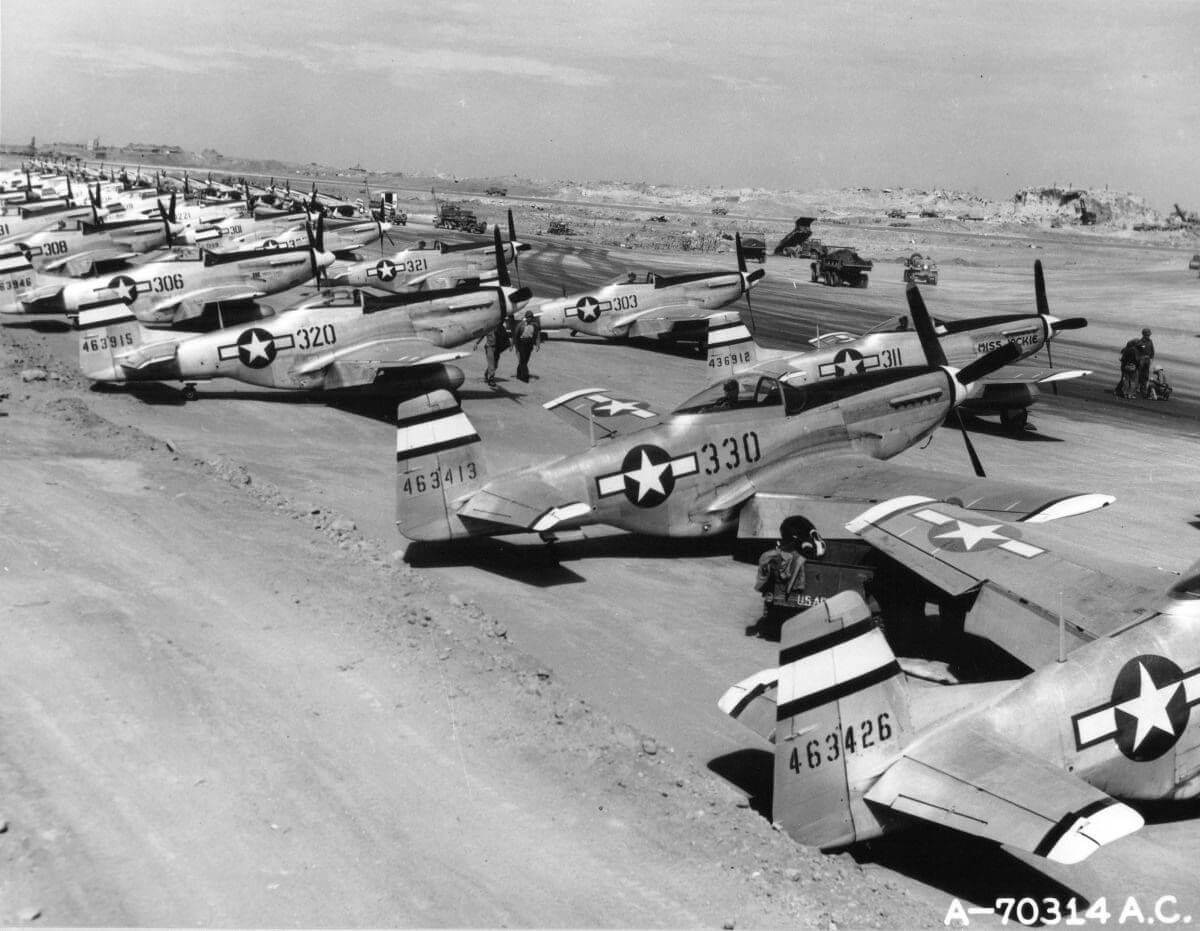
North Field on Tinian Island in the Marianas – launching point for the atomic bomb drops on Hiroshima and Nagasaki, Japan. ©Bill Webster. All Rights Reserved.
As a result of such a short association with personnel of the group, I have little recollection of the 9th BG. I didn’t even know the name of the Group Commander, and because we were catapulted into such a cruel stroke of fate so swiftly, I couldn’t recall what squadron the Sullivan crew was assigned to. I am deeply grateful to Larry Smith, historian for the 9th BG, and his effort in trying to locate me and other personnel of the group.
AFTER OUR BAIL OUT SOMEWHERE NEAR KAWASAKI I NEVER SAW A MEMBER OF MY CREW AGAIN
One of the reasons I was never able to establish many facts about our abbreviated stay at Tinian is because after our bail out somewhere near Kawasaki in the Tokyo metropolitan area, I never saw a member of my crew again. I was thrust into a totally unfamiliar environment with strangers in a strange land with little or no communication with fellow internees or anyone else.
I WAS SCARED STIFF. I HAD NEVER USED A PARACHUTE AND HAD VERY LITTLE TRAINING IN HOW TO USE IT
But memories of that memorable night over Kawasaki live on and will remain with me forever. Like all men who participated in combat bombing missions, especially that first one, I was scared stiff. As we came into the target area I could see the red glow of the fires and the flames rising from the burning city. To me it looked like the world was on fire. One of the things I remember thinking about, back there in my lonely tail gunner’s compartment, was what I would do if I had to bail out over that fire. I had never used a parachute and had very little training in how to use it.
With us that night was an extra man, Major Ralph H. Chapel, from group headquarters. His role was to provide oversight to a new crew on their first mission. As our plane lumbered on toward the lit-up inferno I settled down and busied myself with searching the sky around us for enemy fighters and other B-29s. We crossed our assigned target and dropped the bombs. I could tell when the plane was relieved of the heavy bomb load, because the plane suddenly gained several hundred feet and pinned me to my seat as if we had hit a strong updraft, called heat thermals. It was about this time that all hell broke loose.
SUDDENLY SOMEBODY UP FRONT BEGAN SHOUTING OVER THE INTERCOM, “BAIL OUT! BAIL OUT!”
I don’t know who gave the order, but suddenly somebody up front began shouting over the intercom, “Bail out! Bail out!” That message, my friends, is the most horrifying words a combat crew can receive. At first I thought maybe there was a mistake—and how could this be? I could tell something was wrong with the plane, and when the message came over the intercom again, I knew it was time to leave the “safety of our Superfort” and hit the silk.
At this juncture I was not sure if I could function well enough to get out of my cramped tail gunner’s position, and if successful would I have the presence of mind to pull the rip cord. Where was the rip cord handle anyway? The next thing I remember I was outside the plane and tumbling toward a black void below. I almost panicked when I reached for the rip cord handle and it wasn’t where I thought it should be. Luckily, after pounding my chest I found the handle and pulled the rip cord. I thought nothing about counting or anything—I just pulled—and I mean I pulled hard!
SUDDENLY I FELT TREE LIMBS BRUSHING ME. I HAD LANDED IN A WOODED AREA
By this time we were away from the fires in the city, and this was quite a relief for me. My mind was swirling as I drifted down toward an unknown venture. My feeling of panic increased when I thought I could hear water and feared I would be landing in water. Suddenly I felt tree limbs brushing me, and I found I had landed in a wooded area. Shrouds of the parachute caught in some branches, and I was left dangling just above the ground. I soon squirmed out of the harness and dropped to the ground. Recalling instructions to get rid of the parachute by burying it, I found this impossible. The alternative was to run away from the parachute. I moved out in a hurry bumping into trees and crawling through brush. I finally found a good place to bed down, but no sleep came during the night. At dawn I decided to look around the woods and finally came upon a little stream with running cool water.
I had my service pistol, a survival kit, and in my flying clothes were two sandwiches and two boiled eggs! This food ran out real quickly. I had some knowledge of handling myself in the woods and a booklet in the survival kit explained that one could eat many things. That’s when the snake, frog, and bugs came into play. I found it almost impossible to catch a frog. I can assure you a person can eat almost anything if he gets hungry enough. However, I couldn’t stomach a snake I managed to pin down with a forked stick. Even though I cut off its head and skinned it, it never stopped wiggling.
The survival kit included some bird shot for the pistol which I decided to try upon seeing some pheasants. After steadying my pistol against a tree, I fired. The bird didn’t drop, the shot echoed off the hills about nine times, and I quickly moved out of that area. During my wandering around in the woods I had a feeling of security, seemingly in a secluded spot away from people, and I just couldn’t come to grips with any idea of walking out of the woods and surrendering to the first person I saw. But I knew that sooner or later I would be found.
This was spring in Japan and I was soon confronted with some wet weather. I had discovered that there was a rice paddy running up to the edge of the woods. Rice had been shocked around a central stake much like a shock of corn. I found that I could make a nest of sorts inside the shock and it shed rain like a thatched roof. Another plus was that I had the rice grains to chew on.
It must have been the fifth or sixth day—at this juncture I had lost count of time—while sitting near my little creek I heard some voices that seemed to be coming from the rice field out near the edge of the woods. Rather than go see who it was I got the heck away from there and sought out a good hiding place.
ON WHAT I BELIEVE TO BE MY 14TH OR 15TH DAY OF AVOIDING CAPTURE, I DECIDED TO GO BACK TO THE CREEK WHERE I HAD HEARD THE VOICES. I RAISED MY HANDS IN A GESTURE OF SURRENDERING
I continued to struggle with which road to take, to go out of the woods and seek out a person or persons to surrender to with a strong possibility they might shoot me, or to stay where I was and keep wandering. Hunger would eventually decide my dilemma. On what I believe to be my 14th or 15th day of avoiding capture, I decided to go back to the creek where I had heard the voices and see if people were still in the area. I walked to the edge of the woods and found three women working in the rice paddy. I was tired, hungry, dirty, and ready to face up to what would happen. I decided to make my move. I threw my gun away and walked slowly out into the opening where the women could see me. I raised my hands in a gesture of surrendering to them. I must have scared the living daylights out of them, because they started shouting and ran away. I, also, turned and ran back into the woods.
A group of about eight people encircled the area, and I was soon captured. They tied my hands and feet to a pole, apparently planning to carry me out, before they decided that was a foolish idea, and they cut the rope to free my feet to allow me to do my own walking. I was taken to a small village where they indicated I was to remove my shoes before entering a building. Treatment was rather cordial at this point, which is possibly not an appropriate term when a captive. I was given a cup of hot tea. Boy, that tasted great after so long without anything warm to eat or drink.
I was blindfolded, handcuffed, and taken aboard a train to a point where we were supposed to change trains. A man there was attempting to act as interpreter while I was being questioned on the railroad tracks. There was not much cordiality during this session. I was wearing a small cross on a necklace which seemed to puzzle the interpreter, and I was unable to explain its purpose to his satisfaction. He asked for my watch, which I handed over. He ordered me to lie down on the railroad bed between the rails, and soon I could hear a train approaching. The train came by on an adjacent track, much to my relief. They had purposely done this to scare me, at which they certainly were highly successful.
I WAS PLACED IN THE POW HOLDING CAMP KNOWN AS KEMPEI TAI IN THE HEART OF TOKYO
Treatment deteriorated as I was moved from the rural village to the city of Tokyo. I was placed in the POW holding camp known as Kempei Tai, in the heart of Tokyo, near the Emperor’s Palace which I never saw. I was made to kneel on the floor with the hands bound together before the interrogator sitting at a table. Two guards were always present. The interrogations were pretty rough. At one session I was shown maps and asked to place pins where our bombs had dropped. While I had no idea where our bombs dropped, the interrogator coerced me with threats to place a pin on the map. Bam! I was hit on the head and told that we had bombed a hospital.
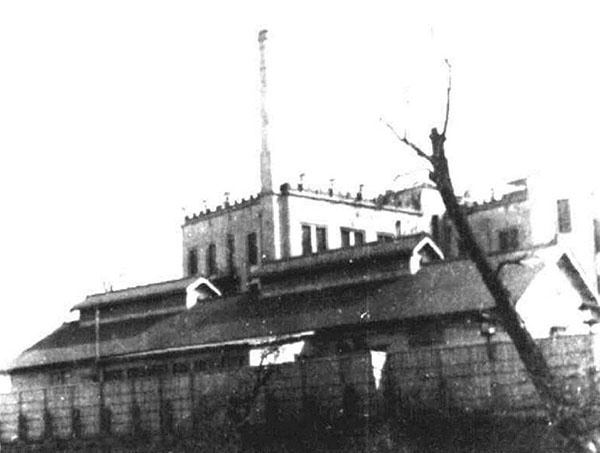
Kempei Tai HQ and stables
I SAID TO THE INTERPRETER, “PLEASE DON’T BEAT ME ANY MORE, KILL ME.”
During an interrogation session with a particular hard beating, I said to the interpreter, “Please don’t beat me any more, kill me.”
“You want me to kill you?”
“Yes, kill me!” I said.
“Stick out your neck!” he bellowed, as he pulled his sword.
HE HIT ME ACROSS THE BACK OF MY NECK FROM FLAT OF SWORD SO HARD IT KNOCKED ME TO THE FLOOR
I did as he said, and thinking, “This is it,” I didn’t dare move my eyeballs. Then, WHOP! He hit me across the back of my neck so hard it knocked me to the floor. My luck was holding, the blow came from the flat of the sword, and I lay on the floor awaiting another and final blow. But instead, my conqueror said, “Silly boy, get up!”
I WAS IN A SMALL STALL ALONG WITH ABOUT 17 OTHER NEW ARRIVALS. 62 B-29 FLIERS [TRANSFERRED] TO THE TOKYO MILITARY PRISON ALL PERISHED DURING A B-29 FIRE RAID OF TOKYO
At Kempei Tai I was placed in the horse stall section that used to house the horses of the high ranking military men. I was in a small stall along with about 17 other new arrivals. We heard that just prior to our arrival they had transferred 62 B-29 fliers from where we were staying to the Tokyo Military Prison in another section of Tokyo. The Americans were placed in a prison that held over 400 Japanese regular prisoners. They were segregated from the Japs, however, in cell blocks in a newly fenced-in compound. The above transfer sealed the fate of the 62 B-29 flyers who all perished during a B-29 fire raid on that area of Tokyo on the night of May 25/26. The story of this disaster appeared in Volume II of “The Global Twentieth” and it was written by another POW who also missed being among those who perished simply by a mix-up in names. He remained at Kempei Tai because of the Japanese name mix-up escaping the cruel fate that befell the 62 B-29 flyers. Author of that story is Fiske Hanley, who is now historian of the 504th BG. [see Firebombing of Tokyo May 25, 1945. Finishing Tokyo]
Editor’s Note2: Cpl. Gazibara assigned to Kempei Tai horse stall 6 with 6BG prisoners Walter Dickerson, Frank Massey, Maynard Hanks, David Farquhar, Franklyn Green, George McGraw and Walter Wiernick
AMONG THOSE WHO PERISHED IN THE TOKYO MILITARY PRISON FIRE WERE SIX MEMBERS OF MY CREW
Among those who perished in the Tokyo Military Prison fire were six members of my crew. Listed were: Lt. Edward Sullivan, Flight Officer John T. Hostey, Lt. Harold J. Nelson, Jr., Lt. Harvey M. Glick, Lt. James A. Reinhart, Jr., and S/Sgt. Frederick E. Hulse. Major Ralph H. Chapel who was participating in the mission with us as Group Air Inspector was also on the list.
IF I HAD BEEN CAPTURED AT THE SAME TIME AS MY CREWMATES, I WOULD HAVE BEEN NUMBERED WITH THOSE WHO WERE FORCED TO REMAIN LOCKED UP IN THEIR CELLS AT THE TOKYO MILITARY PRISON WHILE THE BUILDING BURNED TO THE GROUND
I consider myself among the luckiest people alive today, since my 14 days of wandering in the woods saved my life. If I had been captured at the same time as my crewmates, I would have been numbered with those who were forced to remain locked up in their cells at the Tokyo Military Prison while the building burned to the ground.
According to information brought out in the War Crimes Trials, guards at Tokyo Military Prison that night opened the cell doors and allowed Japanese prisoners to escape the burning buildings. Witnesses also testified that they saw guards kill at least 17 American prisoners outright who were in the fenced in compound when the buildings caught fire. In desperation these prisoners were trying to climb to safety over the wire fence when they were either gunned down or slashed to death with swords.
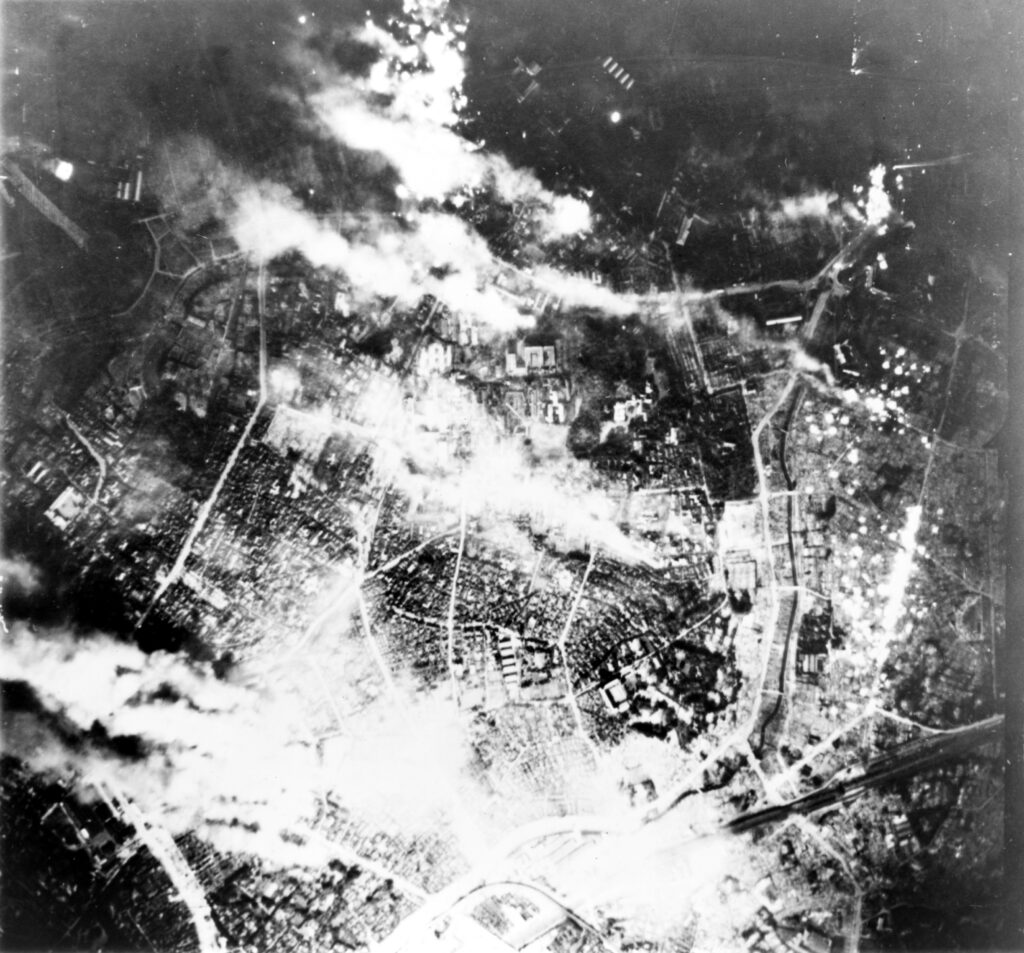
B-29 View - May 25, 1945 Tokyo firebombing
1Original publication: Marshall, Chester. The Global Twentieth: An Anthology of the 20th AF in WWII. Memphis, Marshall Publishers 1985. Permission to republish granted by the heirs of B-29 pilot Chester Marshall, 73rd Bomb Wing, 499th Bomb Group, Saipan, 1944-45.
2Fiske Hanley II. Accused War Criminal – An American Kempei Tai Survivor. Brown Books, Dallas 2020. 2nd Lt. Fiske Hanley, B-29 Flight Engineer, 504th BG, Tinian 1945.
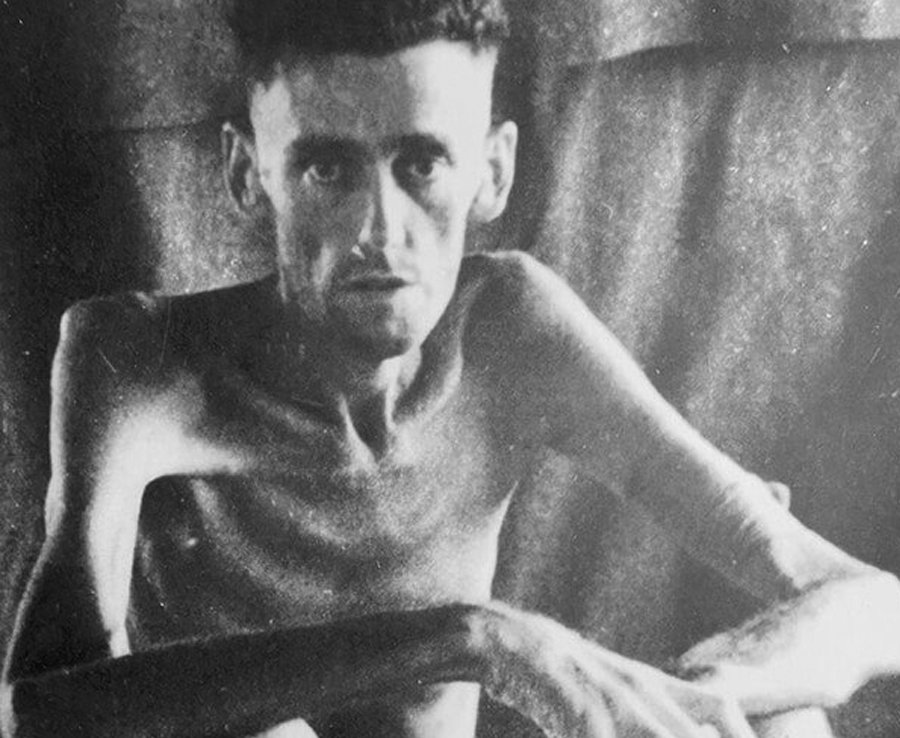
B-29 POWs – KEMPEI TAI ATROCITIES
Captured B-29 airmen suffered barbaric treatment by the Japanese >

PACIFIC WAR – OVERVIEW
Brief overview of the Pacific War 1941-1945 >