by
Lawrence S. Smith
B-29 CFC Gunner
9BG, Tinian 1945
Original publication 9th Bomb Group Association 1995
Additional content © 6th Bomb Group Assoc. 2025
Editor’s Note: Title, pictures and highlight added to compliment author’s writing.

The B-29 Superfortress
The B-29 was the culmination of strategic bomber development in the 1930s and early 1940s.
The U.S. Army Air Corps officers who developed the doctrine for strategic air warfare in the 1930s were disciples of Brigadier General Billy Mitchell who promoted the role of strategic air power in the 1920s so vigorously that he was court-martialed for stepping out of line. These strategic planners collaborated with aeronautical engineers within the Air Corps and in the major aircraft companies to devise specifications for long-range bombers exploiting the “state-of-the aeronautical-art.”
The Boeing Aircraft Company became the leader in the production of strategic bombers in the mid 1930s through their development, in response to the Air Corps’ stated needs, of the B-17 Flying Fortress. In 1937 the Air Corps contracted for the first B-17s.

B-17 Bomber
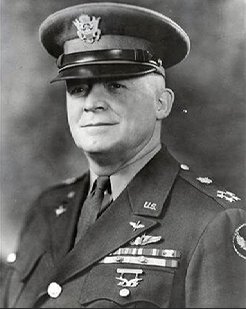
Major General Henry Hap Arnold
Three months after the outbreak of war in Europe on September 1, 1939, Major General H.H. Arnold, Chief of the Air Corps, issued contracts to the major aircraft companies for studies of a “Very Long Range” bomber capable of flying 5333 miles with a bigger bomb load and greater speed than the B-17. Thus the first step to the production of the B-29 was taken. The best proposal came from Boeing in May 1940. In November 1940 Boeing was given a contract for two prototypes.
1300 PRODUCTION CHANGES TO THE SPECIFICATIONS WERE PRESCRIBED BY THE ARMY AIR FORCES
In the two years that the development required, up to the first flight, great problems of design had to be solved. Further, as lessons from the aerial warfare in Europe and the Pacific came in, and newly developed equipment and accessories were incorporated, over 1300 production changes to the specifications were prescribed by the Army Air Forces
The Boeing Aircraft Company became the leader in the production of strategic bombers in the mid 1930s through their development, in response to the Air Corps’ stated needs, of the B-17 Flying Fortress. In 1937 the Air Corps contracted for the first B-17s.

Boeing XB-29 first flight Boeing Field Sept. 21, 1942

B-29 cutaway illustration, PBS. Annotation added
The major new characteristics incorporated in the B-29 design included:
- An innovative, high-load wing to reduce the air resistance drag, which design then required a greatly expanded flap area to increase the lift at the crucial moments of takeoff and landing. Also, the wing rivet heads were countersunk to reduce drag.
- Pressurization of the front, midsection, and tail gunner’s areas, with a tunnel 34 inches in diameter passing over the unpressurized bomb bays.
- A tricycle landing gear which had not previously been used on bombers.
- A revolutionary armament design developed by the General Electric Company: This gunnery system involved remote controlled turrets outside the pressurized portion of the cabins that were controlled by gunners in the relative comfort of warm cabins. This contrasted greatly with high altitude operations with earlier World War II bombers. There were five gun turrets: two on the top of the aircraft, two on the bottom, and one in the tail. Other than the four 50-caliber gun turrets at the top front of the aircraft, the other four turrets contained two 50-caliber machine guns. (As received from the factory, the aircraft the group took overseas were equipped with a 20mm cannon between the machine guns in the tail turret. But these 20mm cannons were soon removed. One consideration was the weight of the 120 pound cannon plus ammunition in the tail of the aircraft. The other consideration was the fact that there was a limited range within which the trajectory of the two types of guns coincided.) One big advance with the B-29 gunnery system was the presence of a computer that automatically corrected for the range, altitude, airspeed, and temperature readings which were fed into the system by the navigator. This permitted the gunners to sight directly at an enemy aircraft rather than estimate some point between the target and the front or tail of the B29. The key position was the central fire control (top) gunner who controlled the master gunnery panel. The bombardier had primary control of both the upper forward and lower forward turrets, while the CFC gunner (top) and the side gunners, (lower front) had secondary control. The tail turret was controlled primarily by the tail gunner, but either side gunner could take control of this turret. This arrangement enabled any gunner, except the tail gunner, to take control over more than one of the turrets at any one time. A gunner without a target could pass control of his turret to another gunner tracking an enemy fighter by releasing the switch on his gunsight.
- An AN/APQ-13 radar system was installed which could be used as an aid or the main tool of the bombardier releasing the bombs on the target when he could not sight completely visually; and it was used exclusively for laying mines. It was also used extensively as a navigation aid, including avoiding thunderstorms and picking the best area through which to penetrate weather fronts.
THE WRIGHT CYCLONE R-3350 RADIAL ENGINE PLAGUED THE PROGRAM
A major problem was an engine to handle the weight and required speed of the B-29. The Air Corps picked a Wright Cyclone R-3350, an air-cooled, 18 cylinder radial engine capable of producing 2200 horsepower at takeoff, with twin General Electric turbochargers, regulated by a Minneapolis-Honeywell electronic system. Although this basic engine had been developed and tested in 1937, only the test engine existed in the middle of 1940. The needed further development of this engine to be fully effective was fraught with great difficulty; it plagued the program, in diminishing degree, until 1945.

R-3350 Wright engine
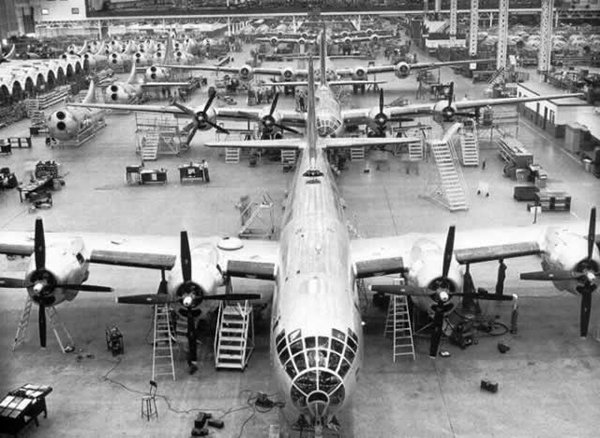
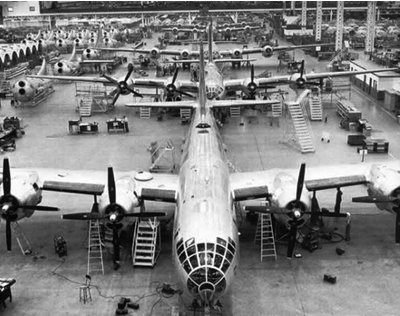
Boeing B-29 assembly line 1944
THE WHOLE B-29 PROJECT WAS THE MOST EXPENSIVE OF ANY WEAPON SYSTEM OF WORLD WAR II, INCLUDING THE “MANHATTAN” PROJECT WHICH DEVELOPED THE ATOMIC BOMB
Despite the great development work still to be done and problems to be solved, Hitler’s spectacular successes in Europe and the Japanese on-going aggression in China and Southeast Asia led the Air Corps in May 1941 to order 250 B-29s. This order was expanded to 500 right after the Japanese attack on Pearl Harbor. By the time of the first test flight in September 1942, 1664 were on order. By February 1945 1000 B-29s had been built and were coming out of the factories at a rate of hundreds a month. At that time contracts called for 6289 aircraft to be produced but, because of the end of the war, these were scaled back. By May 1946, when production stopped, a total of 3970 B-29s had been built by these four plants: Boeing, Renton, Washington, 1146; Boeing, Wichita, Kansas, 1620; Martin, Omaha, Nebraska, 536; and Bell, Marietta, Georgia, 668. Many component parts were produced by dozens of companies and shipped to the four production plants for assembly. The whole B-29 project was the most expensive of any weapon system of World War II, including the “Manhattan” project which developed the atomic bomb. From the results obtained, it was money very well spent.
CHARACTERISTICS
THE AIRPLANE WAS ORIGINALLY DESIGNED FOR A MAXIMUM GROSS TAKEOFF WEIGHT OF 128,000 POUNDS, BUT IT WAS DISCOVERED THAT IT COULD BE LOADED SAFELY TO 137,000
THE ROUGH COST OF A PRODUCTION B-29 WAS ABOUT $650,000 [1944]
The B-29s wingspan was 141 feet 3 inches. The length of the fuselage was 99 feet and its height on the ground was 27 feet 9 inches from its highest point to the ground. Its internal wing fuel capacity was 5608 gallons which could be supplemented, and sometimes was, with up to four 640 gallon fuel tanks carried in the bomb bays, for a total capacity of 8168 gallons. It was designed to carry a maximum of 20,000 pounds of bombs in its two bomb bays. The bomb bay racks could handle a number of types of bombs and mines, in various combinations, often weighing in total less than 20,000 pounds. (After Iwo Jima was captured and available for emergency landings, we sometimes did not fully fill the gas tanks so we could increase the bomb loads, but, of course we could not exceed 20,000 pounds.) The designed range with a 20,000 pound bomb load, and without bomb bay tanks, was 3250 miles. Its maximum range without bomb load and with bomb bay tanks was 4500 miles. The airplane was originally designed for a maximum gross takeoff weight of 128,000 pounds, but it was discovered that it could be loaded safely to 137,000 and sometimes it was. Its designed maximum speed (at 25,000 feet) was 310 mph, cruising speed was 220 mph, and service ceiling was 33,000 feet. Pressurization of the crew compartments to 8000 feet could be achieved, which let the crew operate without oxygen masks. But sometimes over enemy territory airplane commanders would order oxygen masks to be put on and the cabins depressurized, to avoid an explosive depressurization if the fuselage should be pierced by enemy fire. Hamilton Standard Hydromatic propellers, 16′ 7″ in diameter, were used on the engines. The 11-men of the crew were located in three areas: In the forward compartment were the airplane commander, in the left seat; the pilot, in the right seat; the bombardier, in the nose between and ahead of the pilots; the navigator in his station behind the airplane commander; the flight engineer in his station behind the pilot; and the radio operator in his station behind the flight engineer. In the center section of the fuselage were three of the gunners; the CFC gunner in his swivel type chair (termed the “barber’s chair”), below his top sighting blister with his gun sight on a ring mount and fitted with hand grips; and the right and left blister gunners in their pedestal sights on each side. The radar operator’s station was in a windowless compartment aft of the gunners. The third area, the tail gunner’s position, occupied the tail end of the aircraft; it was separately pressurized. The rough average of cost breakdowns of a production B-29 was: airframe, $400,000; engines, $100,000; propellers, $16,000; electronics, $35,000; and ordnance, $96,000; for a total of about $650,000. The B-29s constituted the peak of advanced aircraft design up to 1945. The massive effort in design and production of these aircraft constituted a great tribute to the skill and dedication of all of those who were involved. In the hands of the air and ground crews of the 20th Air Force these aircraft more than proved their worth in carrying out the assigned strategic air offensive against Japan.

6th Bomb Group: B-29 Bombers, the Pacific War. Photo: ©Percy Tucker. All Rights Reserved.
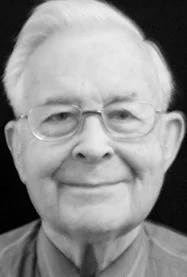
Bio: Lawrence S Smith (1925-2009) was raised on a small family dairy in Honeyville, NY. He enlisted in the Army following high school graduation in 1943. Following aircrew training in Nebraska, Larry was assigned to Tinian Island in the Pacific Theater where he flew 35 missions to Japan as a B-29 CFC gunner. After the war he received an MS degree in Wildlife Management and Fishery Biology from Cornell University in 1951 which launched a successful career with the US Fish and Wildlife Service. Larry co-founded the 9th Bomb Group Association and served as its Historian and editor of the 9th Bomb Group History book.

PACIFIC WAR – OVERVIEW
Brief overview of the Pacific War 1941-1945 >

THE B-29 BOMBER
Tour and specs of the most advanced bomber of WW2 >